

A month ago I wrote a post reflecting on whether my blog output is as relevant as it used to be:

My basic concern is that the U.S. has entered a political era in which reasoned assessment of the evidence, concern for the common good, and deliberation among intellectuals has relatively little effect on policy. When populism, tribalism, and social media shouting rule the nation’s politics, who’s even listening to someone like me?
In fact, I think it’s not that bad. Consider the 21st Century ROAD to Housing Act, which just became law after passing the House and Senate with overwhelming bipartisan majorities, despite Trump’s refusal to sign it. The main provisions of the new law read like a YIMBY’s dream:
Expedited and simplified environmental review for housing projects
More federal money for places that build more housing, less money for places that build less
Some deregulation of prefab home construction and housing finance
Given the very limited powers that the U.S. federal government has over housing in this country, this is a huge win. These are policies I’ve been advocating for years.
Notably, the bill also contains one unhelpful “slopulist” provision: restrictions on the ability of corporate landlords to buy single-family homes. This measure was based on the myth that corporate investors, especially private equity firms, are responsible for the American housing crisis. Would-be populists across the political spectrum, from Elizabeth Warren to Donald Trump, profess to believe in this myth, but it’s just not true — corporate landlords are only a tiny sliver of the housing market, and there’s some evidence that they actually reduce rents, especially for low-income tenants.
But because corporate landlords are such a small part of the market, restrictions on their activity are unlikely to have any measurable effect on housing prices nationwide. And the final bill included so many carve-outs — for example, corporations that build housing in order to rent it out are excluded from the restrictions — that its negative impact will probably be very muted.
In other words, we just saw Congress — that dysfunctional institution that everyone hates — take action on an important issue in a very reasonable and bipartisan way. It’s a validation of Matt Yglesias’ “Secret Congress” theory — the idea that our legislators mostly just want to do what’s good for the country, but are prevented from doing so by the partisan anger of their electorates. According to this theory, the way to get good laws passed is to have them remain low-profile, so they don’t arouse the nation’s compulsion to turn everything into a zero-sum politicized food fight.
In other words, there’s still some scope for reasonable individuals and intelligent discourse to make an impact on American policy. But this scope is very limited, because “Secret Congress” has to remain secret — dedicated public servants can tinker around the edges, but can’t enact the kind of bold, sweeping policy program that FDR and Reagan (and to a lesser degree, Obama) were able to carry out.
The problem is not a lack of good ideas, or a lack of tools for evaluating those ideas. The problem is America’s political economy.
Roughly speaking, we have three major political movements — the MAGA right, the socialist left, and the “woke” left. But none of these seems especially interested in the kind of smart, reasonable policies that would significantly improve the material well-being of regular Americans. Their economic programs are all pretty bad. And even if they could be persuaded to support smarter policies, the conflict between the movements will preoccupy them, keeping them focused on culture-war issues.
I’m not really a political blogger, but an understanding of my country’s political economy seems essential if I want to be a useful intellectual. So I thought I’d give a brief rundown of how I think about the U.S. political situation, and why I think the outlook for a big, constructive policy push is so bleak. I’ll start with a historical analogy.
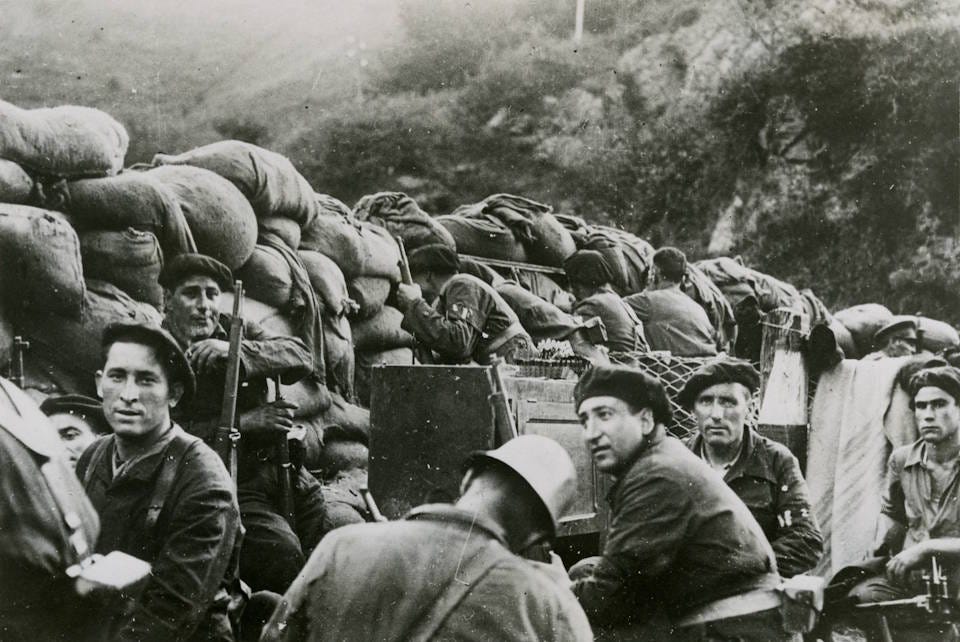
The Spanish Civil War analogy
Back in 2016, I read a bunch of books on the Spanish Civil War of 1936-1939. I immediately saw strong similarities between that conflict and America’s worsening political troubles. In the years since, as America suffered nationwide riots, a coup attempt, military purges, accusations of election theft, and increasingly authoritarian politics, I’ve continued to invoke the analogy, and I’ve been surprised at how helpful it’s been.
To be clear, I don’t think the U.S. is going to have an actual civil war. The military would have to fragment and fight itself, as it did in Spain, and I think this is unlikely. But Americans regularly use the language of civil war (or “cold civil war”) to define their current political conflicts, and fear of an actual civil war is widespread. The analogy doesn’t have to be perfect.
Here’s a very brief two-paragraph synopsis of the Spanish Civil War. Basically, Spain in the 1930s was riven by deep, long-standing, intractable class conflict (which also sometimes manifested as religious conflict between socialists and the Catholic Church). After the country became a democracy in 1931, it see-sawed between left-wing and right-wing governments, with major street clashes between rightists and leftists. In 1934, a bunch of leftist miners staged a giant strike to protest the admission of some rightists to the government, took over a province of Spain, then tried to turn the strike into a revolution.
The army crushed the revolt, but it led a bunch of right-wing types to panic that if they ever lost another election, there would be a leftist revolution. So in 1936, when a center-left coalition won an election, rightists tried to stage a coup and overthrow the republic. They failed at first, but they captured part of the country. Over the next three years, having already won more of the population and (crucially) the military to their side, they slowly ground down and conquered what remained of the republic. Although both sides were composed of various ideological factions, the rightist (“nationalist”) factions all united around the authority figure of Francisco Franco, while the leftist factions fought each other behind the lines. Both sides committed substantial atrocities, though the nationalists generally committed more.
If you want to read more about the war, I suggest:
Antony Beevor’s The Battle for Spain
Paul Preston’s The Spanish Civil War
George Orwell’s Homage to Catalonia
So how do I see the Spanish Civil War as analogous to America’s current political troubles? Basically:
A long-standing, intractable social conflict flared into a brief moment of mass revolutionary fervor
That almost-revolution panicked various factions of the right, scaring them into uniting behind a radical, authoritarian program
The most revolutionary factions of the left (the anarchists) were eventually muscled out and dominated by the most disciplined faction (the communists), who then proceeded to lose the war
The rightists had no idea how to govern the country after their victory, embracing policies that kept Spain poor for decades
The most important analogy is that although the Spanish Civil War featured a number of different factions, none of the factions had a workable program for governing the country. Spain was basically screwed no matter who it went with, but people still fought very hard for one faction or another, out of a combination of fear, ideology, and opportunism.
So let me explain how I think this analogy fits America’s current situation, and why it makes me so pessimistic about governing the country.
