


I’ve been meaning to write this post for a while, and now the AI revolution has given me an excuse.
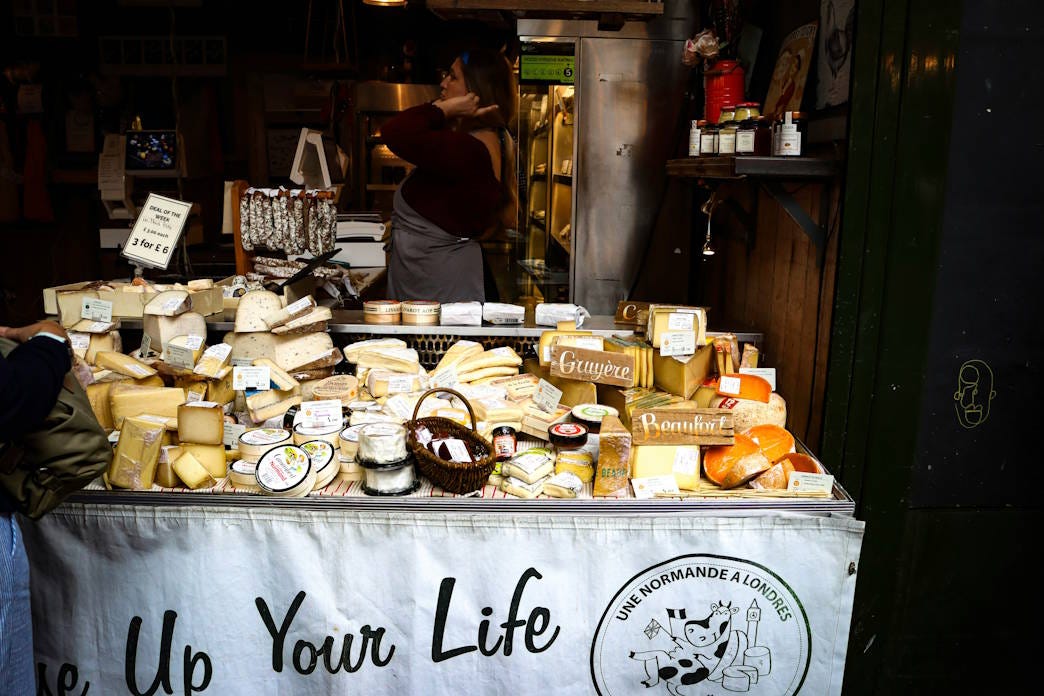
I was standing in a Whole Foods on Long Island, sometime in the early 2010s, staring at a cheese counter, when I had a sudden revelation. All my life, I realized, I had been told that it was people’s work that gave them meaning — that what you produce makes you special. Few people say this explicitly, but it’s baked into many elements of our culture.
In San Francisco, when you meet someone, the first question you typically ask is: “What do you do?” Some people will give teasing answers — “I race boats”, or “I take care of rabbits” — but everyone knows that the question is about your job. Nor is SF particularly unusual; Americans tend to identify each other by their occupation. “This is Steve, he’s a professor,” and so on. In Japan, people are more likely to identify by the company they work for, but their identity is still fundamentally about production.
Or think about movies and TV shows. Yes, there are some stories about people whose hobbies become the most important things in their lives — High Fidelity, Shall We Dance?, Schultze Gets the Blues, and so on. But in most narratives, it’s people’s career that defines their life objective, their success or failure as a person, and their identity as a character.
Consumption, on the other hand, is typically trivialized, or even denigrated. Every culture has words like “lazy”, “shiftless”, or “playboy” to make fun of people who spend their time consuming instead of producing. A “hobby” is far less noble than a “calling” or a “vocation”.
In fact, the value of work over play is one of the few ideas that traditionally united the political left and right. In the 20th century, leftists decried the “consumer society” and called for “workers” to be in control of society. Conservatives, meanwhile, value hard work and complain that the welfare state makes people lazy, while rightists view consumer societies as decadent and weak. The “degrowth” movement is all about reducing Westerners’ so-called “overconsumption”; it’s hard not to hear a moralistic message in addition to the environmental one. Production is virtuous, consumption is wicked.
Why should what you produce, rather than what you consume, be the most important thing about you? Why shouldn’t the fact that you race boats or watch anime or drink matcha lattes be what defines your identity? Why should I call myself a “writer” rather than a “science fiction fan” or a “rabbit dad”? Just imagining introducing myself as the latter makes me cringe a little. But why?
One seemingly obvious answer is that the market values production over consumption. In fact, this is almost the definition of the two terms — work is what you get paid to do, while consumption is what you have to give up something in order to enjoy. But this doesn’t explain why culture and society should give additional accolades to production over consumption. You already get paid for going to work; why should you get praised for it too?
One cynical answer is that praising people for their work ethic is a way of trying to lower labor costs, by paying workers in status instead of money. Plenty of research in both economics and psychology indicates that people will accept lower salaries in exchange for working at a job where they think they’re doing something good for society; this helps explain why wages at nonprofits are so low. This might be why tech companies traditionally tell their young employees that finding new ways to sell ads is “making the world a better place”; it might allow them to pay less than hedge funds for the same class of talent. Professors, meanwhile, often forego lucrative careers in industry in exchange for the pride and status that comes from being an academic.
A less cynical answer is that in premodern times, most work wasn’t rewarded by the market; families and villages had to persuade, bully, or cajole people into plowing the fields or cooking dinner, so they “paid” people for productive effort with compliments instead of wages; this traditional culture may have carried over into the modern day.
And there are reasons to make production the center of your identity beyond the fact that society praises you for it. Your productive power represents a key point of leverage over society; the more the world needs you to produce stuff, the less likely you are to have to depend on the largesse of others. Pride in your productive power means pride in your independence.
But at the end of the day, it’s consumption, not production, that defines you as an individual.
That might sound like an odd thing to say, especially if you’ve grown up believing — as my liberal parents taught me — that advertising is a form of mind control that greedy corporations use to force you to consume things you don’t really need. But you don’t have to trick people into buying most of what they buy; people all over the world want modern conveniences like dishwashers and cars and AI chatbots, and it doesn’t take a lot of ads to convince them to buy those things. Without ads, people would still watch movies and listen to music and wear nice-looking clothes.
The truth is that merchants advertising their wares to you are begging you to buy their brand instead of their competitors’. Everyone wants your money; you are the one who gets to choose who gets it.
That choice is yours and yours alone. Every day that you exist as a consumer in a capitalist society, you are forced to make dozens of decisions about what to spend your money on. Should you buy coffee at Starbucks or Peet’s? Should you buy a new skirt or a new pair of jeans? Should you go watch a Marvel movie or an indie film? Should you subscribe to Noahpinion or to Slow Boring?1
Each time you make one of those choices, you are forced to interrogate your own preferences. You are forced to look inside your heart/mind/soul/utility function/whatever and decide which brand of coffee you want, which type of clothing you want, which blog you want to read, and so on. It’s all about you.
There’s some research demonstrating this effect. Here’s Cheek et al. (2022):
Across six studies (total N = 3,549), we find that participants who were randomly assigned to choose from larger assortments thought their choices were more self-expressive, an effect that emerged regardless of whether larger sets actually enabled participants to better satisfy their preferences.
And here’s Nanakdewa et al. (2021):
When people think of their actions as choices, they feel larger and stronger than others, are attracted to ideas of independence, and feel empowered to voice their opinions. Choosing what to eat and which shampoo to buy may seem like trivial acts, yet the current research finds that the salience of choice alone can have a range of powerful psychological effects.
Is every choice of product or fashion going to reveal some deep truth about you to yourself? Of course not. But consumption choices force you to develop the habit of self-examination. And when you think about more complex life choices — what kind of personality to present to the world, how to behave in your romantic relationships, how to express yourself through art or music — that habit will come in handy. In fact, economists would say that social interaction, romance, and self-expression are also forms of (non-market) consumption.
Production is very different. Your decision of what to produce is not fully your own; the market gets to decide. If what you really want to do all day is carve wood, but the market doesn’t pay a woodcarver a living wage, then you’ll have to find something else to do for money. Lawyers and software engineers and brain surgeons undoubtedly take pride in their careers, but the high salaries society pays for those occupations were undoubtedly a reason they went into those fields. Those salaries are a reflection of someone else’s preferences — someone else’s demand for legal services, software, and brain surgery.
What about jobs that involve self-expression, like art and music and writing? In fact, these are simply bundles of production and consumption. I love writing, and I’m lucky enough to get paid for it. But if I really buckled down and spent a lot of effort building my brand, writing what the audience wanted to hear, covering every breaking topic before other writers did, and generally treating this blog more like work, I could make a lot more money doing it. The lower income I accept in exchange for greater self-expression is actually a form of consumption. It’s no coincidence that artists who “sell out” tend to enjoy their craft less.
To sum up: When you decide what to consume, you ask: “What do I want?”. When you decide what to produce, you ask: “What do other people want me to do?”. The former is a lot more individuating than the latter.
We can observe this effect at the level of whole societies. The World Values Survey shows that richer countries tend to value “self-expression” more:
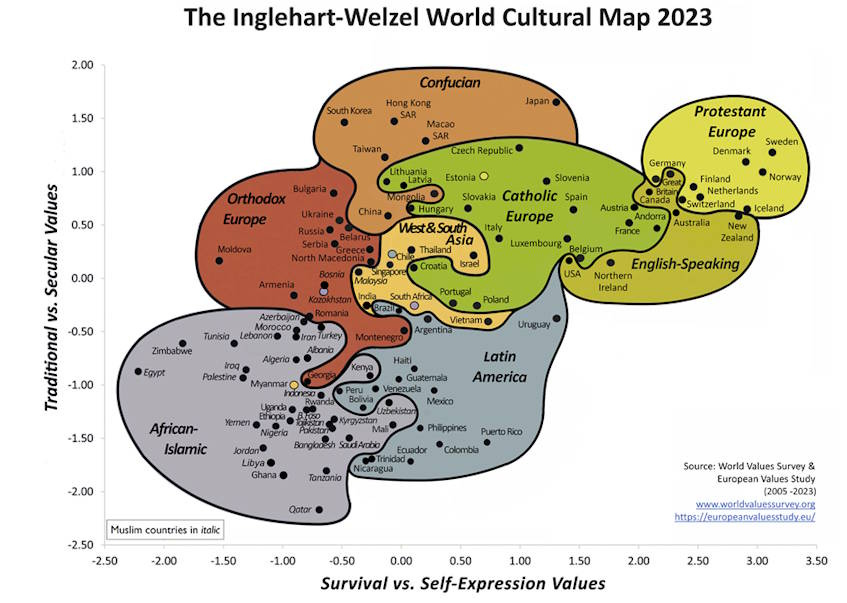
And in general, surveys consistently find that as countries grow richer, they become more individualistic. Japan often gets stereotyped as a collectivist society, but surveys show that hasn’t been true since the early 1980s — the first generation brought up in affluence became the “me generation”. America’s Boomers were undoubtedly similar.
We can argue about how much individualism versus how much collectivism is good at the societal level. But on a personal level, it seems clear to me that the standard story we grow up hearing — that your job is what makes you you, while what you consume is dictated by corporations — has it exactly backwards. In fact, consumption shapes you into a unique individual, while your job exists at the whim of the collective.
This is what I realized, staring at all that cheese.
As I said, this idea has been rattling around in my head for a while, but it’s the advent of AI that finally made me decide to write it up. A lot of people have been saying that by disrupting traditional careers and devaluing lots of human capital, AI is going to cause a crisis of meaning in our society.
I do agree that this will probably happen. If you’re an economist who prides himself on being able to do the difficult algebra required to turn a conjecture into a concrete theory, and now suddenly AI comes along and can do that at the touch of a button, you might lose some of the pride and sense of meaning that your previously rare skills had given you, even if tenure protects you from losing your income. If you were a software engineer who prided himself on being able to write good code, and now your job consists of checking the code written by Claude, you might feel less meaning in your job, even if your salary is higher.
But I don’t think this has to happen. I think it’s possible for us to reorient our identities away from what we produce, and toward what we consume, and to find meaning in the latter.
That might sound speculative, but in fact I’ve lived in a society where people’s sense of self and their social position was defined at least in part by what they consumed. It was called college. Although I worked part-time during my school years, many people didn’t — and even with my job, I still had plenty of time for leisure. I spent that time learning what music I liked, learning how to make better friends, learning about romance, and learning how to express myself better.
That was all consumption. Even my coursework contained an element of consumption — yes, studying physics built up my human capital, but it was also just fun, and my anthropology and film electives certainly weren’t about increasing my future earning power. Because I went to an elite school, I was able to have some confidence that the signaling component of my school’s pedigree, along with the human networks I built up, would save me from the risk of poverty. So I could spend college having fun and expressing myself — and my fellow students, who mostly didn’t have jobs and lived entirely on their parents’ largesse, could do so even more.
If your reaction to that is “Well good for you, jerk,” I don’t blame you. The American university system is not fair, and I was very lucky to land where I did.2 But imagine a society where everyone could have a college experience like mine — a time of self-discovery and self-expression, where work was done for enrichment instead of for money. And now imagine a society in which people could keep living that college life far past the age of 22.
Doesn’t that sound a little like paradise? Well, perhaps with AI, we can make that a reality. If we create robust institutions to redistribute the material gains from the intelligence explosion, perhaps we can create a society where all of life looks like an elite American school — where people spend their day reading interesting books, doing math because it’s fun, going to parties, making cool outfits, learning about their friends, playing in amateur bands, or having long drunken conversations about the meaning of life until 4 AM without worrying about going to work in the morning.
That’s a vision of a consumption society, but not one that’s meaningless or empty. Instead, it’s a vision of technology freeing us to become more like ourselves. I don’t think this happy outcome is inevitable, but I think it’s getting ignored in most of the discussions about our future.
Both, obviously!
Interestingly, the Japanese university system is even more weighted towards leisure, even at schools that are lower in the prestige hierarchy; college is sometimes labeled “moratorium”.
"A person buying ordinary products in a supermarket is in touch with his deepest emotions." John Kenneth Galbraith
I think you are on the wrong track here, Noah.
From what I have seen over my life, what people most need is to feel useful and important to others.
Which others? That is somewhat malleable. Family. Country. Organization. Romantic partner.
For most people, most of the time, the path of least resistance is getting a job, bringing home a paycheck. And very possibly developing a workplace expertise.
Or, similarly, joining the military.
I am not saying that human beings SHOULD be wired this way, but in my experience, they usually are. They want belonging, and they want the security that comes from knowing what they did to gain that belonging, and they want recognition within the group for what they contributed.
Consumption, I agree, gives far more options for self expression. But there are problems here.
First, as much as self expression is good, I question whether it can ever take the place of feeling useful and important to others. Not without a lot of medication, anyway.
Second, although you cite criticism of advertising for getting us to consume things we don't need, I think the real problem is that advertising has a long history of tying everyday consumer products to deeper human needs. Like camaraderie and belonging. People may or may not believe that product X will bring them love or popularity or respect or adventure, but over tens of thousands of ad repetitions, they do come to believe that purchased products in general are the normal route to achieving these highly desirable things. Which -- horribly -- undercuts motivation to come up with more likely strategies for actually achieving these things.