


It’s almost hard to remember nowadays, but before the pandemic a lot of us were worried about falling business dynamism in the United States. For whatever reason, Americans just weren’t starting companies — either high-growth startups or small businesses — at the rate they used to. Much ink was spilled discussing possible reasons for the trend, and potential levers for reversing it.
Then the pandemic came, and the trend shifted almost overnight. Suddenly, Americans were creating new businesses again:
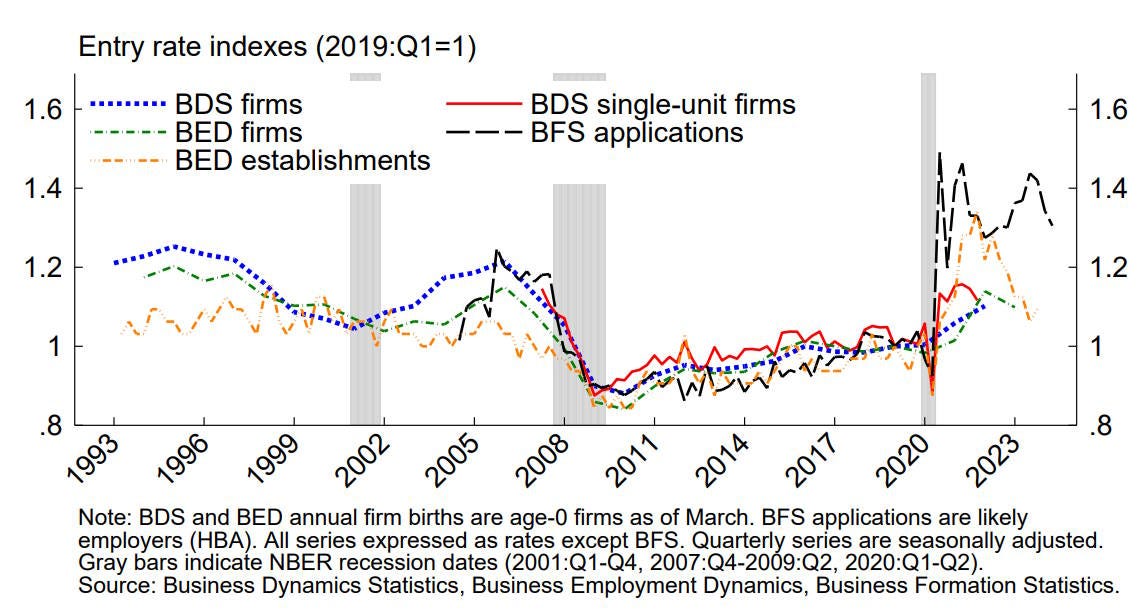
Notably, even in 2024 the trend in business applications showed no sign of reverting to its pre-pandemic level. The shift seems at least partly durable.
No one knows exactly why new business creation has surged in recent years. But one possibility is that technology has made it possible for people to start businesses with a lot fewer employees. Stripe Economics has an interesting blog post about the rise of “solopreneurs” — independent businesspeople who don’t employ anyone else at their businesses:

The upshot is that there’s a big trend to “solopreneurship”, and that the pandemic accelerated the shift:
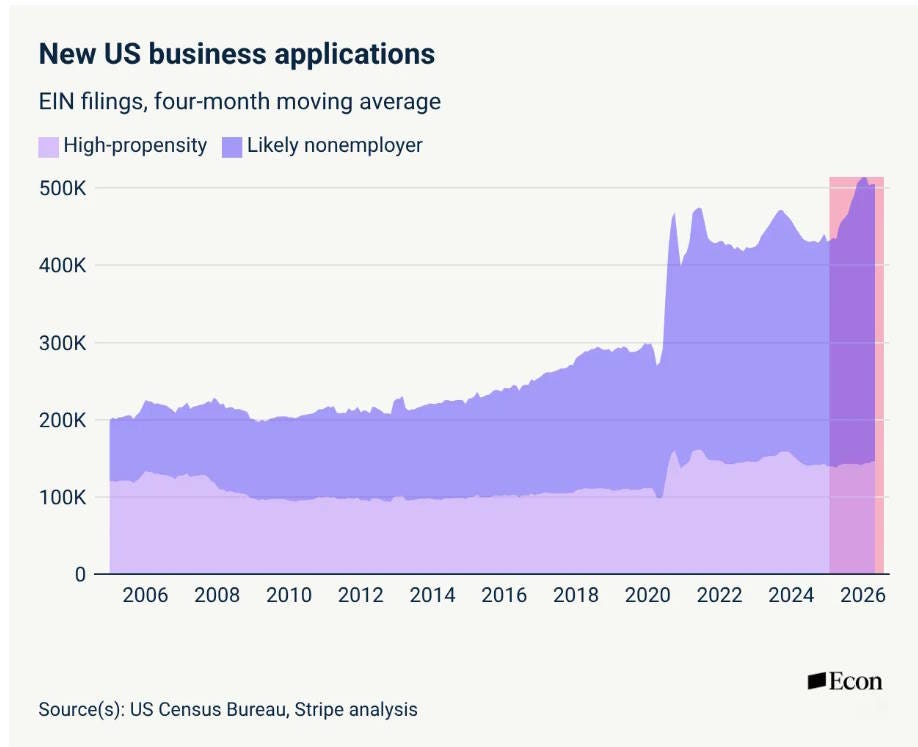
Solopreneurship has been increasing since 2008, both in absolute terms and as a percent of new business formation. Some of this is due to legal changes. The Obamacare exchanges make it easier for solopreneurs to buy their own health insurance. The Qualified Business Income deduction, the simplified home-office deduction, and other tax changes have made it more favorable to be a solopreneur.
On top of that, the internet made a lot of solo business models easier to execute, from dropshipping businesses to YouTube channels to subscription-based email newsletters. I am a solopreneur myself — Noahpinion is an S-corporation. Substack made it incredibly easy for me to sell and deliver content online, Twitter/X made it incredibly easy for me to market that content, and Stripe made it incredibly easy to receive payments — all without hiring anyone.
The team at Stripe Economics argues that this latter trend is just getting started. Thanks to AI, the number of business models that can be executed by single individuals is growing rapidly:
An agent can now help you find the best tools for your business and handle your integration with minimal support….The recent growth in nonemployer businesses shows a positive relationship with industry-level AI adoption…
Part of the reason businesses historically tended to be built by groups was that a single individual rarely possesses all the skills needed in the entrepreneurial journey. Whether it’s how to evaluate or size a market, code an app, price a product, write and execute a marketing campaign, or close a deal, AI (and AI-augmented software) can fill many of the gaps that founders previously turned to another human for. Or, as Sam Altman so succinctly put it: “revenge of the idea guys.”
We think this phenomenon is the true engine of the AI surge in business formation we’re seeing today. The availability of this breadth of on-tap assistance allows anyone with sufficient motivation to go it alone. Given this, we think the 20% figure is a floor rather than a ceiling in terms of AI impact.
This makes sense. It’s pretty clear that one big reason to have a multi-person company has always been individual specialization. But Claude is far more versatile than any human being, so in the age of AI agents, specialization will probably be less important in many cases.
Even in the (many) cases where that doesn’t allow one person to run a company all by themself, it will tend to push companies toward lower headcount. Kim and Koning have a new working paper showing that “AI-native” companies now being created tend to have about 25% fewer employees than their peers.
This is important, because it bears on the future of human employment — the question that’s currently on almost everyone’s minds. It raises the possibility that self-employment is the future of employment. It’s easy enough to imagine a future in which relying on a group of other humans for your economic sustenance won’t be as important — instead, we’ll all be like little private ship captains, ordering around our crews of AI agents.
That future is easy to envision because it’s the logical endpoint of a trend that had already been going on for quite some time: the rise of corporate outsourcing. Whether it was manufacturing supply chains strung out across dozens of countries, or companies hiring subcontractors to do their payroll or their IT or their accounting, or corporations paying SaaS providers for software products, companies generally do a lot less of their work in-house than they did half a century ago.
The rise of outsourcing — both domestic and foreign — was enabled by improvements in transportation and communication technologies. Shipping crates and the internet made it easy to turn local production networks into regional or global ones. The internet made it easy to find contractors, verify their reputability, communicate with them, and monitor them to verify their work.
That fit very well with the leading economics theory of outsourcing: transaction cost theory. First advanced by Ronald Coase in the 1930s and later refined by Oliver Williamson and others, transaction cost theory says that companies exist because it’s sometimes cheaper and easier to execute transactions in-house than at arm’s length.
Consider the process of paying the workers at a factory. In 1937, for a company to get some other company to handle their payroll would have been a very arduous process. You would have had to look up payroll contractors in the phone book, ask around to find out whether each one had a good reputation, have their representatives come by your factory to get information about how many hours each worker had worked, and so on. Far easier to just walk down the hall to your own payroll division and have them do it.
But by 2007, this calculus had switched — thanks to the internet, it was fairly easy to do all that stuff at arm’s length, online. This allowed specialization at the level of the firm rather than at the level of the division or the employee — in other words, corporate outsourcing.
That’s just a story, of course. But in general, transaction cost theory is strongly supported by empirical evidence; in cases where we can measure transaction costs, they do seem to affect the decision to in-house versus outsource. Bergeaud et al. (2023) find evidence that the internet drove a wave of outsourcing in France, for example:
Does domestic outsourcing react to technological change? We study the staggered diffusion of broadband internet in France in the 2000s, and show that connected firms increased their outsourcing expenditures while decreasing the diversity of occupations they employ in-house…Overall, we show that the deployment of new technologies stimulated domestic outsourcing in this context[.]
There are other theories about why companies choose to do things themselves versus buying them from someone else, but many of them — incomplete contracts theory, agency theory, relational contracting theory, etc. — overlap substantially with transaction cost theory. The informality, close monitoring, and long-term relationships that form within a company can all be seen as ways of decreasing transaction costs.
A lot of people are assuming that when it comes to transaction costs, AI will work like the internet, only more so. (In fact, I find “AI will be like the internet, only more so” to be one of the most common tacit assumptions in AI discourse in general.) AI can read, understand, and analyze your business’s website in an instant — or dispense with the need of a website entirely. It can scan the entire internet to assess whether your business is a trustworthy contractor, or even contact you directly to find out. It can absorb nearly unlimited reams of business data, in order to monitor that you’re doing a good job. And so on.
It’s easy to see how this might lead to a world of total outsourcing and solopreneurs. But at the same time, it’s possible to imagine that AI will increase transaction costs between companies.
The simple reason is that AI doesn’t just analyze information; it also creates it. Yes, an AI can search the web for payroll outsourcing companies and get an idea of which are reputable by researching everything that has ever been said about each. But by the same token, an AI can create a new company, give it a website, and invent a bunch of other companies and reviewers to make it look legit. And then if and when your AI pays that AI’s fake company to do your accounting or whatever, the fake company can just take all your money and vanish in a puff of smoke.
AI-driven fraud is already happening, at scale. Here’s a BBC story from last year:
Unscrupulous foreign firms are using AI-generated images and false back stories to pose as family-run UK businesses to lure in shoppers…Customers say they feel “completely ripped off”…Consumer guide Which? said the growing use of AI tools was making it possible for fraudsters to mislead the public on an “unprecedented” scale.
If human consumers can be fooled, so can human purchasing agents and procurement specialists. “OK,” you respond, “I’ll just get an AI to do the purchasing and procurement. Problem solved.”
But here we are, back in the realm of transaction costs. You might need a frontier AI and a lot of expensive tokens to check the ever-expanding galaxy of fake companies in a way that would allow you to make a reliable outsourcing decision.
Nor would it even necessarily take fraud and manipulation in order to make arm’s-length transactions between AIs unreliable. Human beings are relatively consistent over time — if I do business with you today, I can be reasonably sure that doing business with you tomorrow will be similar, because your knowledge and skills and character etc. are all going to be roughly the same.
This is not generally true with AI — at least, not with the AIs that exist today. They are ephemeral creatures; their ability to maintain the same goals, personalities, and capabilities over the weeks or months or even years of a business-to-business contractor relationship has yet to be demonstrated. So in the world where everyone doing business is an AI agent, even if your company verifies that it’s dealing with a real and honest contractor, that verification might not hold for long.
If AIs remain inconsistent over time, trust will therefore have to be reestablished from scratch every so often, and that could be expensive. In fact, we’ve already seen an example of just how expensive constant re-verification of trust can be: Bitcoin. In order to do away with the need for intermediaries like banks to verify transactions, Bitcoin has to reestablish trust between counterparties every time a transaction is performed. As Eric Budish has shown, constant reestablishment of trust is incredibly expensive in terms of electricity, which basically dooms Bitcoin’s use as a medium of exchange.
So AI doesn’t have to be an unreliable partner in order to put an end to the world of ubiquitous online contracting that we’ve built over the past three decades. All it has to be is a partner whose reliability is expensive to verify.
If AI brings about a world of higher transaction costs, due to the inherent unreliability of long-term arm’s-length dealings between AI agents, then the AI age will probably be one of bigger companies. Internal procedures for verifying trustworthiness — the AI equivalent of walking down the hall and knocking on the door of your own internal corporate division — might be the new equivalent of the informal long-term relationships that lower transaction costs within a typical human-staffed company.
In a post back in April, I predicted that Japan-style “salarymen” occupations — ever-shifting irregular bundles of tasks within a single big company — might be a more important kind of job all around the world going forward. But the transaction cost theory of the firm could give us another reason to expect the same. If only big companies can establish internal trust cheaply, then many humans — whatever kind of work they’re still doing 10 or 30 years from now — will be working for big companies.
That doesn’t mean solopreneurship is a temporary trend or a dead end. There are probably many lines of business in which long-term trust between agents carrying out specialized business processes is not a big deal. In those areas, solopreneurs will flourish. We may thus see a bifurcated distribution of company sizes and job types — a vast horde of solopreneurs, and a few monster companies employing huge numbers of wage earners.
Very interesting article.... one would think that with the automation from AI, the average size of a firm can be smaller (with some very big firms supporting the AI agents). For humans to be valuable in the economy, they need to provide something unique..essentially operating on the edge of knowledge creation. The good news is that a lot more of this can be done with the available tools. There seem to be two big missing pieces:
1) Education: How do we get everyone trained to be able to operate on the edge of human knowledge...especially with an education system designed in the 1800s. Massive reform is needed in the education sector. More likely, it will be replaced with private solutions.
2) Governance: There is a need for some public or private governance models to manage the issue of bad actors. My sense is a private solution is likely going to be the answer.
Finally, this comment caught my attention, "Solopreneurship has been increasing since 2008, both in absolute terms and as a percent of new business formation. Some of this is due to legal changes. The Obamacare exchanges make it easier for solopreneurs to buy their own health insurance. The Qualified Business Income deduction, the simplified home-office deduction, and other tax changes have made it more favorable to be a solopreneur."
I am curious about the evidence which shows that the government driven programs have had any impact... vs all the technological ones you have mentioned.
You mean…cyberpunk is right again?