


I’ve long been an industrial policy enthusiast. My favorite popular nonfiction book is Joe Studwell’s How Asia Works, a synthesis of decades of research about the economic miracles in Japan, South Korea, and Taiwan. I wrote a whole series of posts examining the successes and failures of various developing countries through the lens of Studwell’s ideas:

There are a bunch of other good books and papers about industrial policy that I’d recommend if you’re interested in the topic. These include Alice Amsden’s Asia’s Next Giant (about South Korea), Robert Wade’s Governing the Market (about Taiwan), “The New Economics of Industrial Policy” by Juhász et al. (2023), and the papers of the Industrial Policy Research Group.
Around the same time I discovered the industrial policy literature, the consensus was shifting within the big economic development agencies (the World Bank and the IMF). Whereas in previous decades, these organizations generally recommended against government meddling in the economy’s industrial structure, they’ve recently started to consider the kind of interventionist policies that Studwell recommends. In 2019, the IMF’s Reda Cherif and Fuad Hasanov wrote a paper called “The Return of the Policy That Shall Not Be Named: Principles of Industrial Policy”. They conclude that a Studwellian approach, if executed competently, can help a developing country grow faster than it would from just letting the market take its course:
We argue that the success of the Asian Miracles is based on three key principles that constitute “True Industrial Policy,” which we describe as Technology and Innovation Policy (TIP)…(i) state intervention to fix market failures that preclude the emergence of domestic producers in sophisticated industries early on, beyond the initial comparative advantage; (ii) export orientation, in contrast to the typical failed “industrial policy” of the 1960s–1970s, which was mostly import substitution industrialization (ISI); and (iii) the pursuit of fierce competition both abroad and domestically with strict accountability[.]
I was happy to see this shift — not because I’m certain that this sort of industrial policy is the secret to growth, but because I think it deserves to be in the discussion. So I’m also happy to see the World Bank now following suit, with a new report (or “book”) by Ana Margarida Fernandes and Tristan Reed entitled “Industrial Policy for Development: Approaches In the 21st Century”. The authors argue that although classic policy recommendations — macroeconomic stability, education, health, infrastructure, etc. — are still good, industrial policy can often help when layered on top of those basics.
I think it’s great to see the stigma about industrial policy going away. Not because this will lead to a wave of countries trying out such policies — that’s already happening — but because it’ll lead to more researchers taking the idea seriously. Dismissing the whole idea of industrial policy out of hand — as the World Bank and others did in the 1990s — is simply a policy of self-imposed ignorance. Countries need smart researchers to help them figure out which kind of industrial policies work and which don’t.
But as general interest in the topic has grown, my thoughts on industrial policy have also become more nuanced. As I’ve read more and written more about the idea, and as I’ve watched current events unfold, my thinking has evolved beyond “This is an important idea that deserves to be taken seriously”. So I thought I’d write a post briefly summarizing that evolution.
“Industrial policy” has become too broad of a category
One thing I always try to specify when I talk about “industrial policy” is that this term can mean a ton of different things. Most people think of it as government promotion of specific industries — autos, or electronics, or maybe just manufacturing in general. Others see export promotion — which is more about where products are sold than about which products they are — as the key industrial policy. Some people see FDI promotion as industrial policy; others don’t.
Even if we just focus on what you might call “classical” industrial policy — government promotion of specific industries — there’s a huge range of types of policies you might use. Protectionism — tariffs, import quotas, etc. — is often regarded as a tool for promoting manufacturing. That’s very different from export promotion. Direct government subsidies for favored industries are a common strategy — and one that’s on the rise throughout the world — but subsidies weren’t really used by many classic “industrial policy” success stories like Japan and Taiwan.
It’s kind of crazy that this huge diversity of policies and goals coexists under one single buzzword. It makes conversations about the topic difficult if not outright impossible. When people yell at me that “industrial policy is bad” or “industrial policy always fails”, I have no idea whether they’re talking about protectionism, or industrial subsidies, or government intervention in general.
If you read the IMF and World Bank papers on industrial policy, you can see that these distinctions really matter. The IMF paper explicitly contrasts export promotion with import substitution (protectionism), claiming that the former is very promising while the latter is usually bad. The World Bank report supports industrial parks and market-access assistance, while casting doubt on the effectiveness of subsidies and tariffs. In other words, even the people advocating industrial policy think that certain kinds are good and other kinds are bad.
In 2012 or even 2018 it made sense to talk about “industrial policy” as a single thing, because it basically just meant that researchers and policymakers should take a look at a bunch of different ideas that had been beyond the pale of orthodoxy in previous decades. But now that researchers and policymakers have actively started to look into those ideas — and to implement them on a large scale — it no longer makes sense to talk about “industrial policy”. We need to be more specific.
For developing countries, “just do FDI” looks like a viable strategy
In my series of posts on developing-country industrialization, I found a subset of countries that had clearly succeeded with a very simple, seemingly replicable formula: promoting FDI in manufacturing. I singled out Poland and Malaysia as countries that got rich in recent years simply by encouraging multinational companies to put their factories and research centers there:

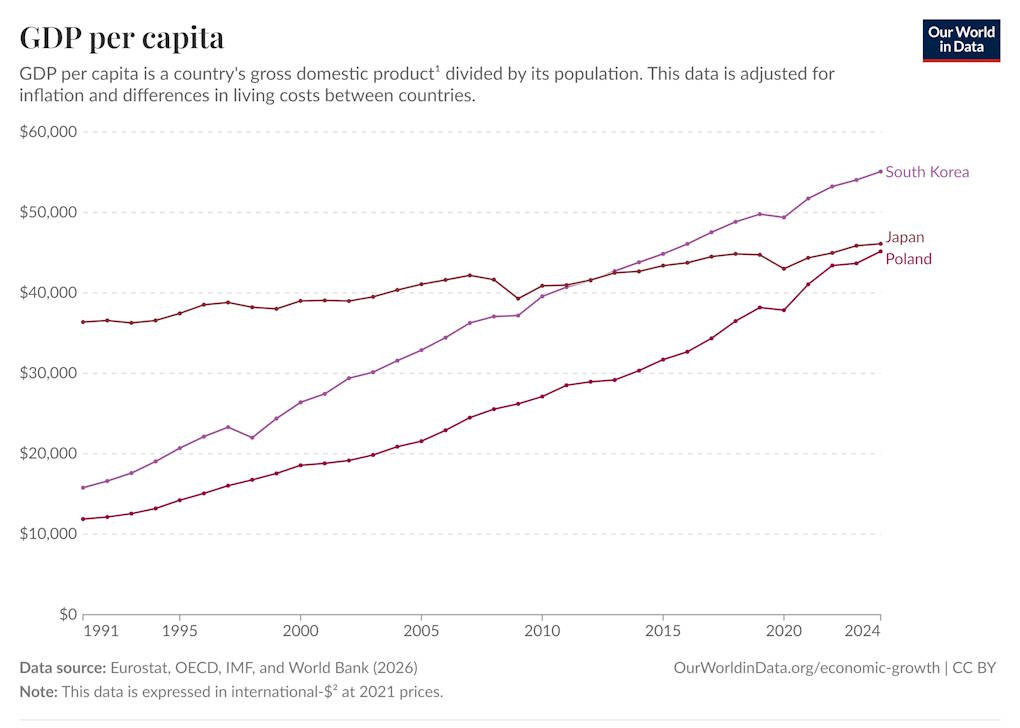
Poland, especially, has succeeded amazingly using the FDI strategy. A lot of industrial policy enthusiasts — Ha-Joon Chang, for example — used to argue that developing countries should build their own domestic “national champions” instead of relying on foreign capital and know-how. That’s what Japan and Korea did, it’s true. But you’d probably be hard-pressed to name a Polish brand. And yet Poland’s economic performance since the end of communism has been absolutely stellar — it’s about to surpass Japan’s living standards, and is now even starting to catch up to Korea:
Interestingly, FDI was also central to the development strategies of Singapore and Ireland — two of the richest countries on the planet. You’d also be hard-pressed to name a Singaporean or Irish brand. And China’s approach before the early 2010s — during its fastest era of growth — centered much more on FDI than on subsidies or on the promotion of national champions in general.
When you look at poor countries that got rich since World War 2 by building national champions, the list is pretty short — there aren’t a lot of South Koreas out there. But the list of countries that got rich, or nearly rich, by promoting FDI is getting longer by the decade. So while I wouldn’t discount the Korea strategy, I’m leaning toward the idea that the Poland approach is a lot easier to get right.
Why would it be easier to get rich through FDI than by building your own brands? I can think of a couple of reasons. For one thing, FDI is less risky — instead of having the government pick winners, you let multinationals try building a bunch of things in your country. It’s a way to let the market discover comparative advantage, while the government simply assumes that some sort of competitive advantage exists within the broad category of export manufacturing.
FDI promotion also requires good institutions. If you’re trying to get German companies to build their factories in your country, you probably need to have the kind of property rights that German companies are used to dealing with. Poland became the workshop of Europe by forcing itself to shed its communist-era institutions and become more like the EU.
Note that the new World Bank report focuses on industrial parks as its favorite industrial policy. Industrial parks are a key part of the Poland/Malaysia/Singapore/Ireland strategy — a tool of FDI promotion. I predict that for developing countries, this approach will become more recognized as the closest thing we have to a universal push-button solution for getting out of poverty.
For developed countries, industrial policy is technology policy
Right now, much of the economic discussion in the U.S. is about AI — how to promote it, how to enable it, and how to regulate it.
This is classic industrial policy. It’s picking a winner! If you rewrite regulation to allow more construction of data centers, or if you try to recruit top AI researchers, or if you use export controls to prevent a competing company from seizing the initiative in AI, or if you do any special thing to promote the industry, you are picking AI as a winner. (The fact that almost every country is picking AI as a winner doesn’t change that fact — there was a time when every country thought it was essential to have its own auto industry.) And I don’t see a lot of free-market economists disagreeing with this pick.
Nor is this the first hot new technology that the American government has specifically encouraged within my lifetime. The Telecommunications Act of 1996 selectively deregulated the internet sector, because everyone agreed that the internet would be economically important. The National Science Foundation subsidized the internet’s initial buildout, as did the High-Performance Computing Act of 1991. State governments provided telecom companies with tons of subsidies to build out wireless networks, and so on.
We picked the internet as a winner, and it was a winner. Notably, very few of the free-market enthusiasts who criticized industrial policy in developing countries raised the alarm about the U.S. picking winners in the internet age. The industrial policies we used to pick that winner fell under the rubric of things that economists had already admitted that rich countries ought to be doing — infrastructure, deregulation, and R&D promotion.
But for rich countries, technology policy is industrial policy. The emergence of a major new technology puts a developed country in the position of a developing country in a narrow, limited sense. A poor nation lacks a car industry, an electronics industry, a machinery industry, a shipbuilding industry, and so on. America in 1985 lacked an internet industry, and America in 2022 lacked an AI industry, because those technologies had just been invented.
So I think rich countries actually have a lot to learn from developing countries when it comes to technological revolutions. Building something that no one has ever built before is a task that shares a lot in common with that of building something that your country has never built before. It’s not the exact same problem, but it’s related. So the people trying to figure out how to make America competitive in AI should study the South Korean Heavy and Chemical Industry initiative, or Taiwan’s promotion of TSMC, or METI’s promotion of Japan’s auto industry.
China’s approach has big flaws
In the last few years, China embarked on an unprecedented policy experiment. The Chinese government has subsidized high-tech manufacturing industries to a far greater degree than any other country in history. This has led to a boom in high-tech manufacturing, increases in China’s global market share in those industries, a huge surge in Chinese exports (known as the Second China Shock), and to the emergence of some Chinese national champions like BYD.
But we’re definitely starting to see the downsides of this experiment. First and foremost, paying dozens of companies to all make the same products ends up creating brutal price wars that compete profit margins toward zero:


Margin compression deprives companies of R&D budgets, which must then be substituted by government research. It also leads to deflation, which exacerbates bad debts, burdening households, corporations, and the financial system.
China’s leaders realize these issues. Cutting industrial subsidies will be politically difficult, especially because the country is still suffering low demand from the bursting of its real estate bubble. But they’re starting to do it — for example, the government is phasing out subsidies for trading in old cars, leading to a predictable plunge in new car sales.
According to the standard “export discipline” playbook — which Studwell articulated, and which the 2019 IMF paper on industrial policy endorsed — this is exactly what you’re supposed to do. A wave of subsidies for export manufacturing results in a Cambrian explosion of manufacturers; the brutal global market selects the best of these; the government withdraws subsidies and lets all the inferior manufacturers die, while the national champions live and flourish and experience healthier margins.
This may work for China, if subsidies can successfully be withdrawn. But it’ll leave behind a major problem: bank debt. By some estimates, the bulk of China’s unprecedented industrial subsidies are actually in the form of artificially cheap bank loans:
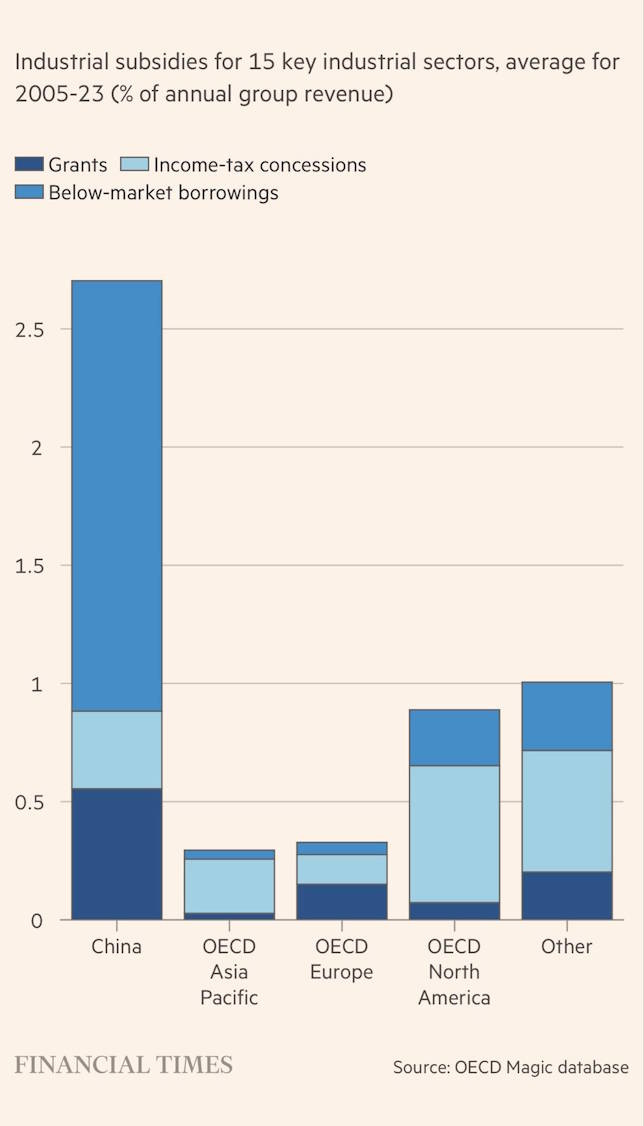
This means that if and when China forces most of its subsidy recipients into bankruptcy — just as Joe Studwell and the IMF say you’re supposed to do! — it’ll result in a huge wave of bad debts. Those bad debts will sit on the books of Chinese banks, right alongside the existing mountain of bad debts from the real estate bust.
If you believe that the Chinese state is unified, and that Chinese banks and the government are the exact same thing, and that the government simply directs borrowing without regard to profit and loss, then maybe you think bank balance sheets just don’t matter in the People’s Republic. But if you think bank managers in China have any discretionary power over lending — how much, or to which companies — then you have to think that having the bank’s books crammed with bad debts will have some kind of effect.
In particular, Chinese banks will be heavily incentivized to “evergreen” loans to zombie companies that they’ve already lent to. Those subsidized lifelines will delay the day of reckoning, allowing banks to pretend their balance sheets are healthier than they are, while diverting financing from younger, healthier companies. This is probably what happened in Japan after its bubble burst in the early 1990s.
The standard model of industrial policy — temporary export subsidies — imagines these as being provided at taxpayer expense. But if financial intermediaries are important — and most rapidly industrializing countries rely heavily on banks rather than on markets for financing — then it’s not so simple. A wave of corporate failures may be healthy for margins, but could cause years of low growth as banks are paralyzed with fear and tethered to zombie companies. And it’s not clear that state ownership and control of the banking system is an effective remedy, because even in a communist system, middle managers are still probably afraid for their personal careers (or their lives) if their institutions perform poorly.
This means we shouldn’t hail the Chinese industrial policy experiment as a success until we wait a few years. More generally, I think discussions of industrial policy tend to downplay the role of financial systems, and banking systems in particular. I plan to write a lot more about that soon.
Another way to promote a domestic industry: have your life depend on it! Ukraine now does final assembly of almost all the drones they use in combat and are signing deals with Gulf states to collaborate on interceptor drones.
If our leaders were smart we'd be seeking out their assistance too.
A few thoughts, Noah.
- Don't underestimate the capacity of countries to screw up even something simple like "just do FDI". After all, the Zona Franca de Manaus has plenty of FDI (Honda, Yamaha, Samsung are all there) and yet, because of it's fundamental problems, it's still a very costly failure for Brazil!
- Don't underestimate the politics of these policies. In a lot of countries, subsidies have a strong tendency to last a lot longer than they should as lobbying from firms/local governments/trade unions extend their length far longer than originally designed.
- Don't underestimate the issue of fortuitous geography. I think the 2 strongest cases you provide for FDI, Malaysia and Poland, plus the case of South Korea (which is a bit different) all benefited greatly from being close enough to other successful countries so as to being integrate well into supply chains and things. Latin America (sans Mexico) and most of Africa really struggle in comparison.
That said, I very much welcome your key message here: Industrial Policy can be successful and more countries should consider doing it carefully. With the emphasis being: carefully.
Also 100% agree with the issue that Industrial Policy has far too many things under it's banner. Import Substitution is dramatically different from Export led Growth and it's probably a good a idea to focus more on specific policies than this huge umbrella.
Also appreciate your thoughts on China.
Finally, as a encompassing point here. One can potentially find that any tool can be used well if used wisely. That's true for virtually any policy one can think of. The key issue is: wisely. I think one question that I haven't seen answered yet is: which types of industrial policy are the most likely to work well in bad/unwise/hard political environments. After all, a country with a wise/good government is already doing a lot right, in all likelihood; the biggest difference can, hopefully, come in countries without that benefit.