



Donald Trump is flailing. Despite easy battlefield victories, the Iran War is quickly turning into a quagmire; the regime has not fallen, and threats against oil traffic through the Strait of Hormuz are causing gasoline prices to soar and threatening to reignite inflation. This is on top of Trump’s existing unpopularity due to the cost of living and the violent lawlessness of ICE. The electorate is moving solidly toward the Democrats; even groups that traditionally supported Trump are starting to get fed up. Unless Trump somehow manages to cancel the midterms, it seems certain that his party is going to take a huge loss.
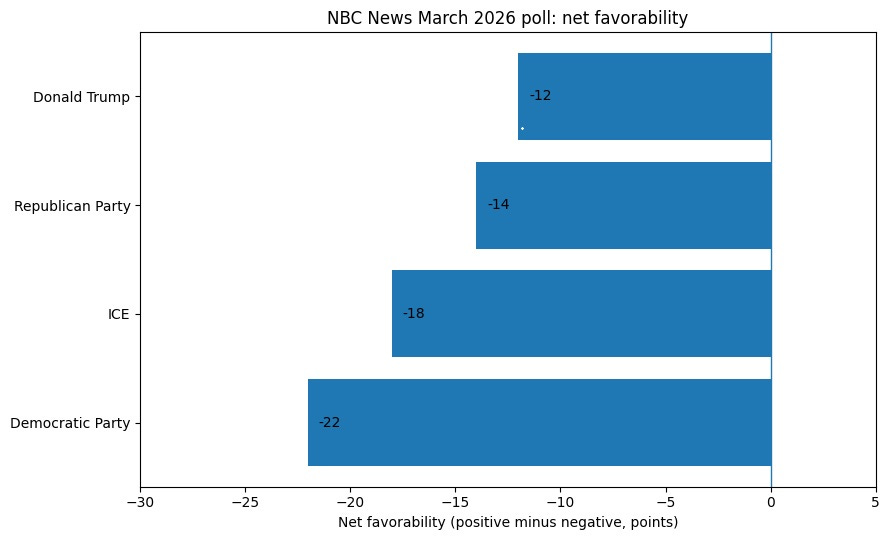
And yet if Democrats want to really capitalize on this epic failure of Trumpism — if they want to hold power for more than just one more backlash cycle — they will need an ideology that’s more appealing than what they have now. The Democratic Party’s favorability rating is still extremely low. An NBC News poll from two weeks ago found that the Democrats’ net favorability was worse than the GOP, Donald Trump, or even ICE itself:
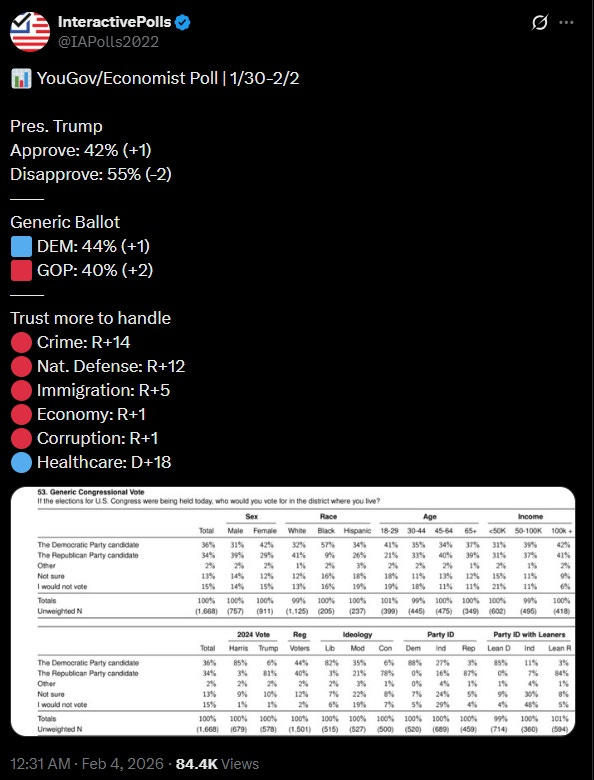
Many progressives claim that these low approval ratings are due to progressive voters disapproving of the Democrats for failing to fight Trump hard enough. That’s probably a factor on the margin, but it ignores the Democrats’ deep unpopularity on core issues. For example, a poll from six weeks ago found that voters preferred Republican approaches to Democratic ones on immigration, crime, and most other issues, even though they planned to vote for Democrats:
And polls consistently find that Democratic voters themselves would prefer that their party took more moderate stances, especially on social issues such as crime and trans issues.
In other words, most of the Dems’ unpopularity probably doesn’t come from their lack of aggressiveness against Trump; it mostly comes from the fact that progressive ideology is unpopular.
In fact, many progressives probably don’t even realize that their values are out of step with the country. On a survey by the Cooperative Election Study, Democrats, Republicans, and Independents all basically agreed that Republican voters are very conservative. But Democrats saw themselves as moderates, even though Independents and Republicans saw them as leaning strongly to the left:
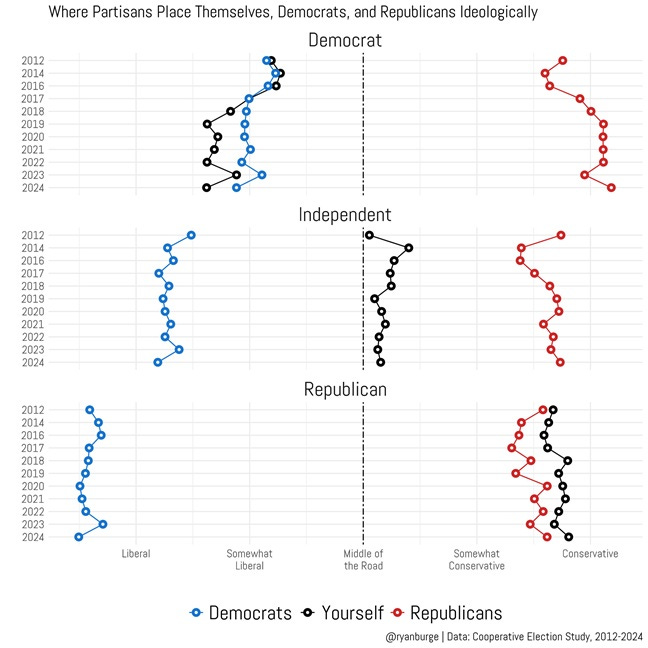
This is evidence that a lot of progressive Democrats are living in a bubble with regards to the overall country’s values. The simplest explanation is that progressive institutions — universities, nonprofits, etc. — and deep blue cities have concentrated educated progressives so much that they don’t interact with the masses of Americans very often, and hence don’t realize how far out of step their values are with the values of the electorate.
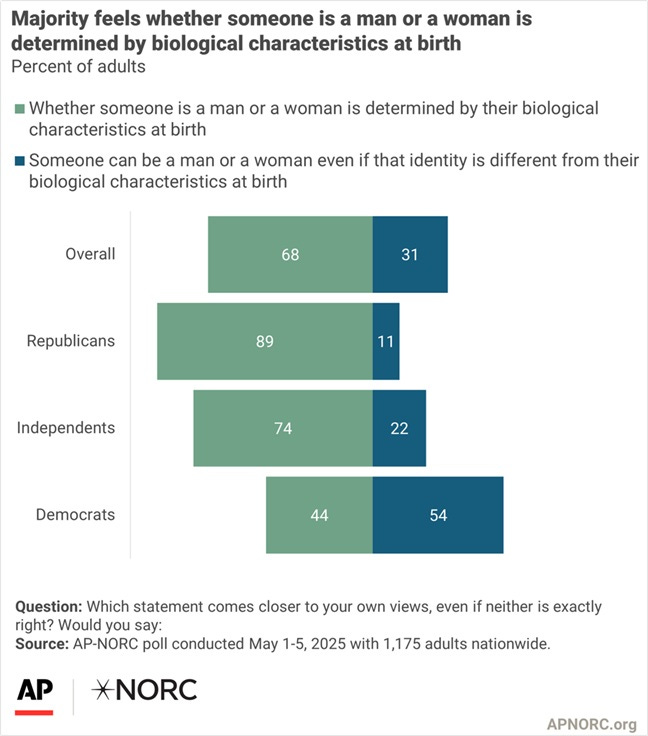
A prime example of such an issue is trans rights. While 54% of Democrats say people are able to change their gender, 74% of Independents say gender is determined at birth:
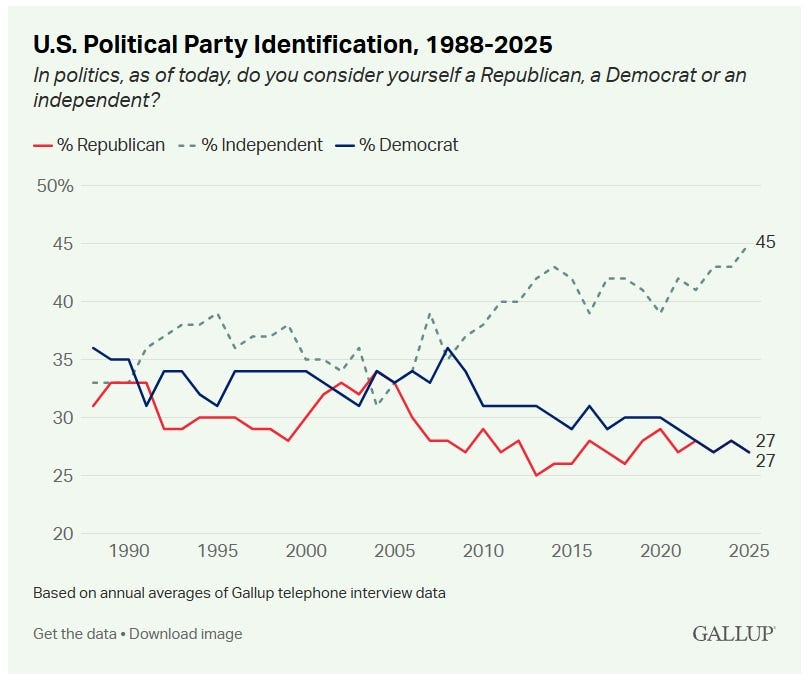
Independents are the real ball game. Not only are they all-important swing voters, but they’re a large and growing plurality of the electorate, as moderates leave both of the major parties:
And in fact, polls find that support for many of the trans movement’s key demands has gone down in recent years, even among Democrats.
Does this mean Democrats should moderate and compromise on social issues like trans rights? In the past, this is often what they did. After the electorate became moderately less pro-choice in the 1980s, Democrats compromised on abortion by saying it should be “safe, legal, and rare.” Before gay marriage gained majority support, Democrats — including Barack Obama — often supported “civil unions” as a halfway measure.
Today’s progressives are less inclined to compromise or beat a strategic retreat. The dominant idea seems to be that there is a “long arc” of history that bends towards their current positions on sociocultural issues. This idea comes from Martin Luther King, Jr.’s famous quote that “the arc of the moral universe is long, but it bends toward justice.”
To some progressives, recent history bears out the idea that the moral universe has an arc, and that it bends in their direction. Support for gay marriage steadily climbed over time, until liberals no longer had to bother with “civil unions” or other half measures. The core successes of the civil rights movement were not reversed.
If history works this way, why compromise today? Just stand your ground and stick to your principles, and eventually history will judge you favorably when the consensus inevitably catches up. I think progressives are thinking this way right now, as evidenced by their refusal to even entertain the notion of budging on the issue of trans women in women’s sports — an issue where public opinion is strongly on the side of the GOP.
Now don’t get me wrong — I don’t think the issue of women’s sports is a make-or-break issue for the Democrats. I just think it’s emblematic of a larger attitude that progressives are always on the right side of history, and that compromise and moderation are acts of cowardice rather than strategic necessities. In fact, some recent research I’ve seen suggests that it’s actually racial discrimination, asylum seekers, and public order where Dems would benefit most from moving to the center:
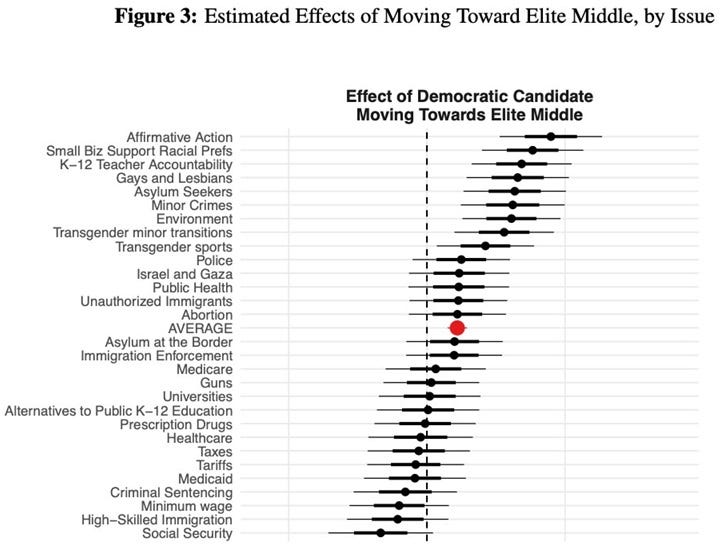
The danger is that “long arc” thinking will prevent Democrats from compromising on any of this, leading to another backlash cycle in 2028 or 2032 that brings an increasingly radicalized GOP back into power.
“Long arc” thinking isn’t necessarily wrong. There’s plenty of evidence that over time, societies all over the world — not just America — have evolved toward greater tolerance, inclusion, and personal liberty along many dimensions. The most likely reason is economic growth — as societies get richer, they tend to shift from harsh, conservative “survival values” toward more liberal values of “self-expression”.
But to think that this tendency will inevitably move society in the direction of progressives’ current ideas makes a number of mistakes.
First of all, believing that the “arc of history” is independent of human action is a dangerous assumption that removes human agency. History is contingent — the Equal Rights Amendment failed ratification by only three states out of 38, and never really got a second shot. If Hillary Clinton had won a few more votes in 2016, Roe v. Wade wouldn’t have been overturned, and affirmative action in college admissions would be legal to this day.
That means that even if you believe strongly that you’re morally on the right side of history, you still have to be strategic about picking your battles. Liberal victories like civil rights and gay marriage didn’t just cruise to victory on an inevitable tide of history; they required savvy strategizing by movement leaders and intellectuals. Sometimes those strategies involved boldness and pushing the envelope of what had been deemed possible; sometimes they involved compromise, strategic focus, and moderation.
It was the great mistake of communism to believe that History made them inevitable. Marx believed that vast social forces would inevitably push society toward communism; Marxists invested this prediction with a quasi-religious belief. This caused them not to worry enough about the mistakes they were making along the way; when the Cold War ended and it turned out that History wasn’t coming to save them, Francis Fukuyama wrote a whole book making fun of their misplaced faith.
The second reason “long arc” thinking is dangerous is that it automatically equates current progressive ideals with the ultimate moral destination of society.
Looking back to liberal victories naturally entails a selection effect. Yes, civil rights and gay marriage won the day and were ultimately enshrined as basic rights in American society — and, increasingly, in global society as well. But that doesn’t mean that every right that liberals and progressives fight for ends up being equally enshrined. There have been many losses and reversals — not just in the short term, and not just due to backlash, but due to society deciding that certain movement goals are not actually basic human rights.
For example, take abortion. Public opinion on abortion has fluctuated, but hasn’t changed since 1990, and fairly little since 1970:
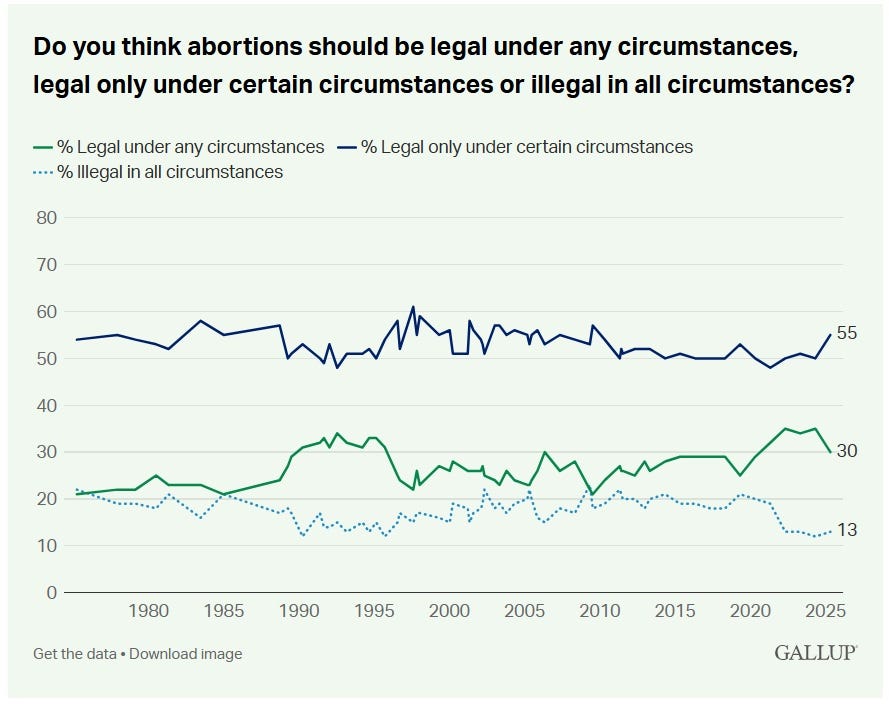
The recent dramatic overturning of Roe v. Wade in 2022 has led to a stalemate, with abortion rights more restricted than they’ve been in over half a century. There was surprisingly little public backlash to the change — no dramatic nationwide marches, no riots, at best a small electoral bump for Democrats in 2022. By the time the GOP swept to power in 2024 it was almost forgotten.
An even more dramatic example is immigration. In the 1870s, America was extremely open to immigration, with essentially no federal controls and a patchwork of weak state controls on people coming into the country. Fast forward to 2015 — before Donald Trump’s election, and a supposed golden age of immigrant mobility — and we see a policy landscape far more restrictive than that of 140 years earlier. Border fences, continual mass deportations, restrictions on immigrant use of welfare and public services, and so on were all in place. There was no arc of history bending toward the right of free movement across national borders.
Even the civil rights movement — the template and paragon of liberal American movements — didn’t win everything. In the 1960s and 1970s, affirmative action in college admissions was a core goal of the civil rights movement. In 2023, the Supreme Court ruled it illegal. There was no public outcry; a solid majority of Americans favored the Court’s decision. DEI policies have instituted racial hiring discrimination in some companies, but this is on the wane after the policies grew increasingly unpopular.
Another example is busing. Mandatory integration busing was a core policy and a core demand of the original civil rights movement, but it was abandoned in the 1990s and 2000s.
In other words, looking back at modern American history, it’s clearly not the case that the country always trends toward what liberals or progressives want or demand. Sometimes rights movements win, sometimes they lose.
A key reason is that what constitutes a “right” is highly contested, and the ideas of tolerance, freedom, and equality don’t always clearly come down on the progressive side. Female athletes might view it as a form of liberty to have sex-segregated locker rooms where they don’t have to be exposed to penises. Asian and White college applicants might view it as a matter of tolerance and equality to be able to apply to jobs without being discriminated against on the basis of their race. Many societies have become less tolerant of public disorder and minor crimes in recent years, out of concern for their citizens’ freedom to walk the streets in safety.
It’s easy to trick yourself into thinking that “rights” always win out in the end, because of the selection effect — when we look back at what society eventually decided was an inalienable right, we’re looking only at movement victories. The losses didn’t get enshrined as “rights”, so we tend to ignore the fact that liberals and progressives fought long and hard for things they never ended up getting.
If you’re a progressive, and you believe deeply that racial preferences in hiring, leniency toward petty crime and illegal immigration, and trans women on women’s sports teams are basic human rights, I can’t tell you to change your values or go against your conscience just to win some elections. If you feel you have to stick to your guns, then stick to your guns. But if there are some progressives out there who are open to the idea of strategic compromise, I think now would be the time to do it. This nation really can’t afford to keep ping-ponging back and forth between an unpopular Democratic party and a mad rightist personality cult every two to four years.
Perhaps progressives have always been this way and I just couldn't see it from the inside, but the hubris has become pretty staggering. There's just zero theory of mind - anyone that disagrees must clearly be bought off, somehow, or part of a conspiracy, or simply rotten to the core.
The problem with a highly moralized, Good People vs. Bad People theory of politics is that it has no mechanism to deal with conflicting interests - the very core of politics - even among the (according to them) Good People. The concept that the interests of biological and trans women might occasionally be at odds, and that a compromise may be needed, is met with hands-over-ears "I can't hear you!!"
It seems like the parties are ripe for some sort of re-alignment, as in the progressive and new deal eras. Democrats are theoretically a working class party that struggles to gain support of actual working class voters. Republicans are theoretically a free market party that is increasingly falling in love with "slopulism" ideas and dumb conspiracies. No idea what a re-alignment would actually look like, but this is really weird time for American politics where nothing the parties do makes much sense to me.