


A week ago, my friend Yaroslav requested that I write more about economics and less about politics. So I deeply and humbly apologize to Yaroslav for writing another politics post.
In the past week or so, some people have claimed that the wheels are coming off the Trump presidency. For example, here’s Max Burns, writing in The Hill:
It doesn’t take a political genius to recognize that things are in free fall over at the White House…Defense Secretary Pete Hegseth is facing mounting Republican criticism over a potentially illegal order to kill the survivors of a Caribbean boat strike. Attorney General Pam Bondi’s Department of Justice is in disarray after three failed efforts to prosecute former FBI Director James Comey and New York Attorney General Letitia James…Trump’s approval rating cratered to a new low of just 36 percent in late November following months of open-air dysfunction and his repeated failure to address fundamental problems like rising consumer prices.
It’s true that Trump has had a string of setbacks recently. Indiana rejected Trump’s proposed redistricting plan, which would have used gerrymandering to give the GOP 2 more seats in Congress. The GOP-dominated Indiana state legislature openly defied Trump’s threats to cut off the state’s infrastructure funding unless they accepted the gerrymandering plan. It was a pretty remarkable act of defiance from state-level Republicans, and could indicate that Trump’s power to bully his own party into line is eroding.
Meanwhile, Democrats have been performing strongly in off-year elections:
Democrats were declared winners of the Miami mayor’s race for the first time in nearly 30 years, winning the race easily by 18 points. And…the party also flipped a Georgia state House district that Trump had carried by double digits last year…The results in Miami and Georgia were merely the latest in a series of ominous signs for the GOP’s electoral picture…Democrats also flipped the mayor’s race in suburban Roswell…Democrats…continue to over-perform in special elections by more than they ever have in the Trump era…when the districts have been somewhat competitive, the results have been strong for Democrats. This year they’ve flipped four state legislative seats that had favored Trump by double digits a year ago…Democrats have now flipped more of these seats in special elections than in any year since 2020, when they won back the presidency.
This presages a potential blue wave in the 2026 midterm elections, which is undoubtedly why Trump is so desperate to push through state-level gerrymandering plans.
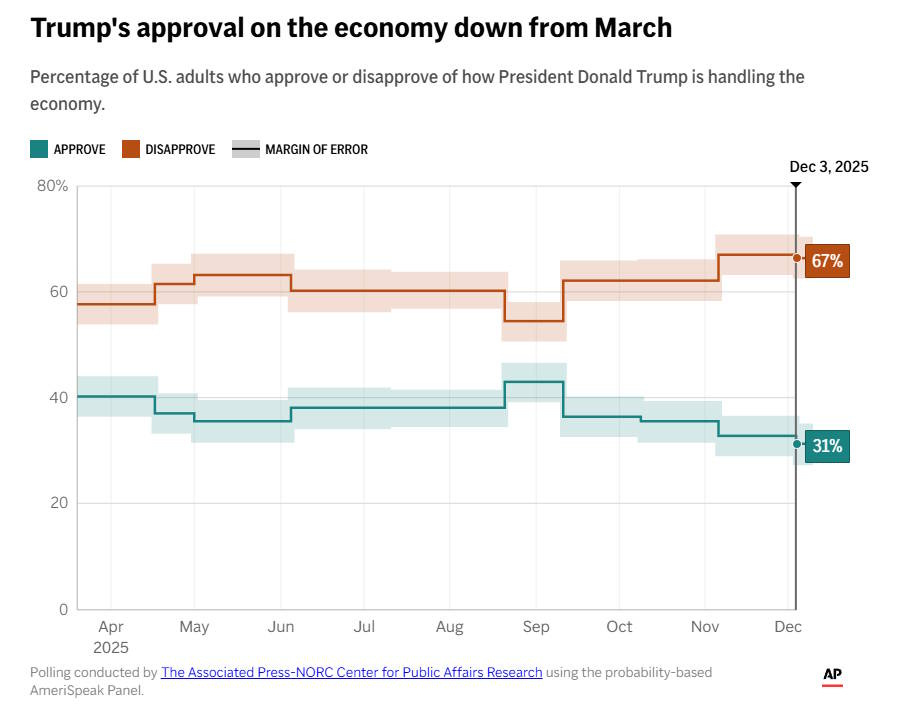
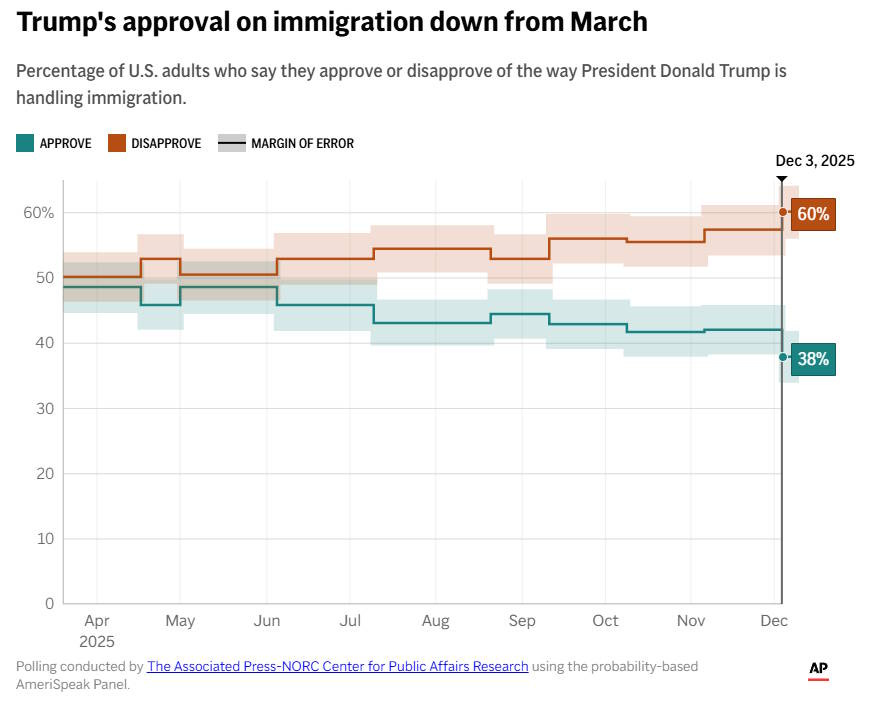
These concerns were bolstered by a recent AP-NORC poll that had some very poor numbers for Trump, including on the economy and on immigration — the two main issues that Trump won on in 2024:
These developments do seem to reinforce the notion that Trump’s post-election honeymoon is over. But I wouldn’t be too quick to label him a lame duck, or to conclude that his power over the GOP is breaking.
Americans are grumbling, but not yet raging
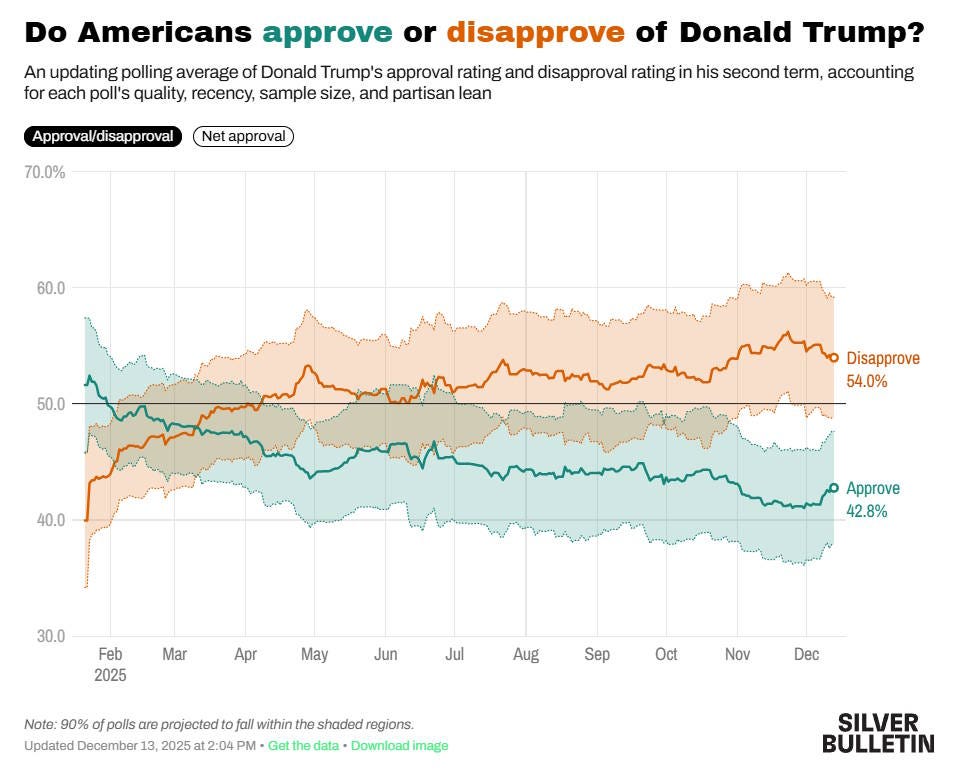
First of all, the AP poll is just one poll. Overall, Trump’s approval rating has drifted downward, and he had a bad November, possibly because of the government shutdown. But since the shutdown ended, his approval has rebounded somewhat, and is still above 40% in the poll averages:
And while it’s true that Democrats will probably do well in the midterms — as the opposition party often does — a Democratic victory in Congress would not make Trump a lame duck. Democrats will not get a two-thirds supermajority, so they will be unable to override Trump’s vetoes. This means their ability to curtail Trump’s power — for example, by revoking his tariff authority — will be limited. And Trump has mostly governed by executive order in any case; Congress can pass laws that supersede the EOs, but again, not without a supermajority.
As for immigration, it’s not clear how much Trump’s deteriorating approval rating on that issue will hurt him. Those lower numbers are probably a response to the steady drumbeat of stories and videos of ICE apprehending and detaining U.S. citizens, demanding that citizens carry “immigration papers”, and generally treating people badly. But there has been no wave of popular unrest in response to those abuses, as there was to videos of police shootings in the 2010s. Overall, Americans appear to still be exhausted from a decade of street conflict.
And Trump still gets decently high marks on border security, as distinct from immigration overall:
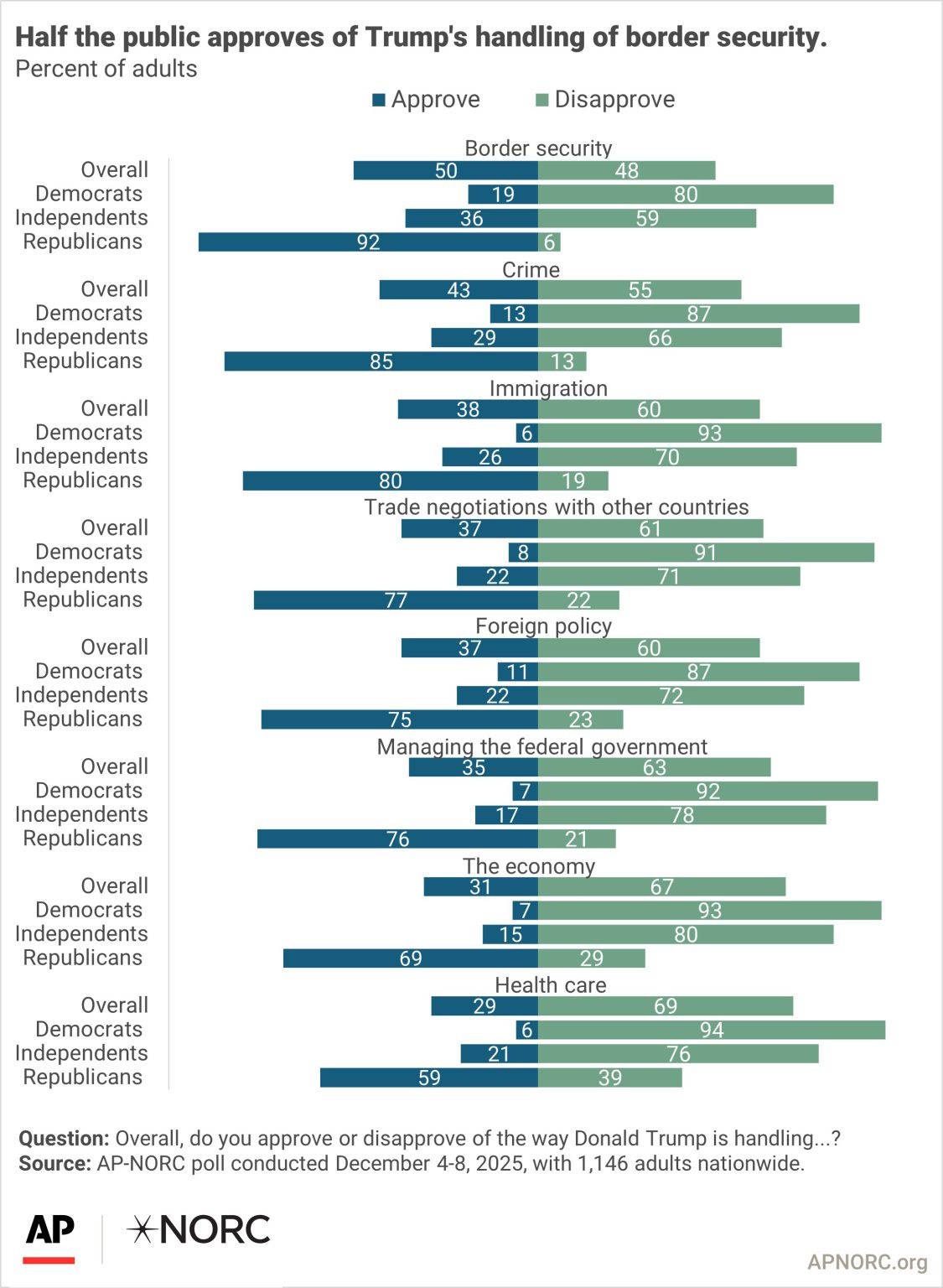
It’s not clear whether voters care about “immigration” or “border security” more; it’s possible that many voters view Trump’s ICE raids and illegal renditions with distaste, but are willing to forgive those excesses because Trump delivered on his core promise of securing the border:
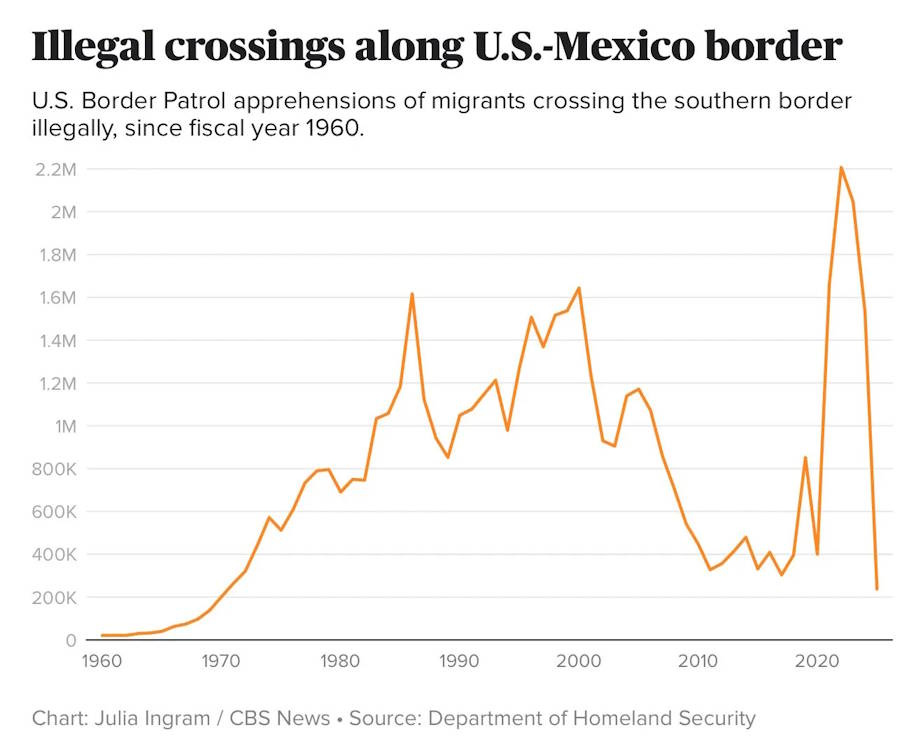
It’s possible that the racial profiling inherent in Trump’s ICE raids will drive away the Latino voters that began to join the Republican coalition in 2020 and 2024. In fact, Trump’s approval is slipping with Latinos. But for now, the immigration issue doesn’t seem to be a big liability for Trump.
And many of Trump’s other outrages, missteps, and bad policies simply don’t seem to be breaking through to the public consciousness. Avid news-readers might be aghast at Trump’s attempts to bully Ukraine into accepting an unfavorable peace deal, or at Pete Hegseth’s probably-illegal orders to massacre people on boats in the Caribbean. They might be disturbed by Trump’s plans to sell advanced Nvidia chips to China, or by rumors of an invasion of Venezuela. They might be outraged at any of the administration’s numerous corruption scandals. But a lot fewer Americans are reading the news:
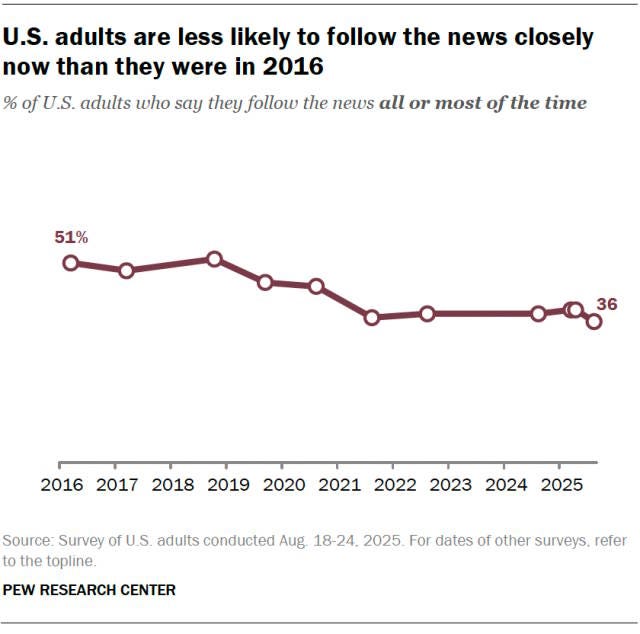
It seems to me that people can get mad about A) outrages they read about in the news, and/or B) bad stuff that happens to them in real life. With Americans tuning out the news after a turbulent decade, there is simply less scope for (A). That leaves (B). And most of the bad things Trump is doing have little or no immediate ramifications for the daily lives of average Americans.
I said “most”, but not “none”. One possible exception is the measles epidemic, which is now affecting thousands of people in South Carolina and causing hundreds more to be quarantined. This is a purely manmade epidemic; measles can be eliminated by widespread vaccination, and in fact was declared eliminated in the U.S. for many years. Now, because some Americans are choosing to forego the vaccine, the country is on track to lose its measles elimination status.
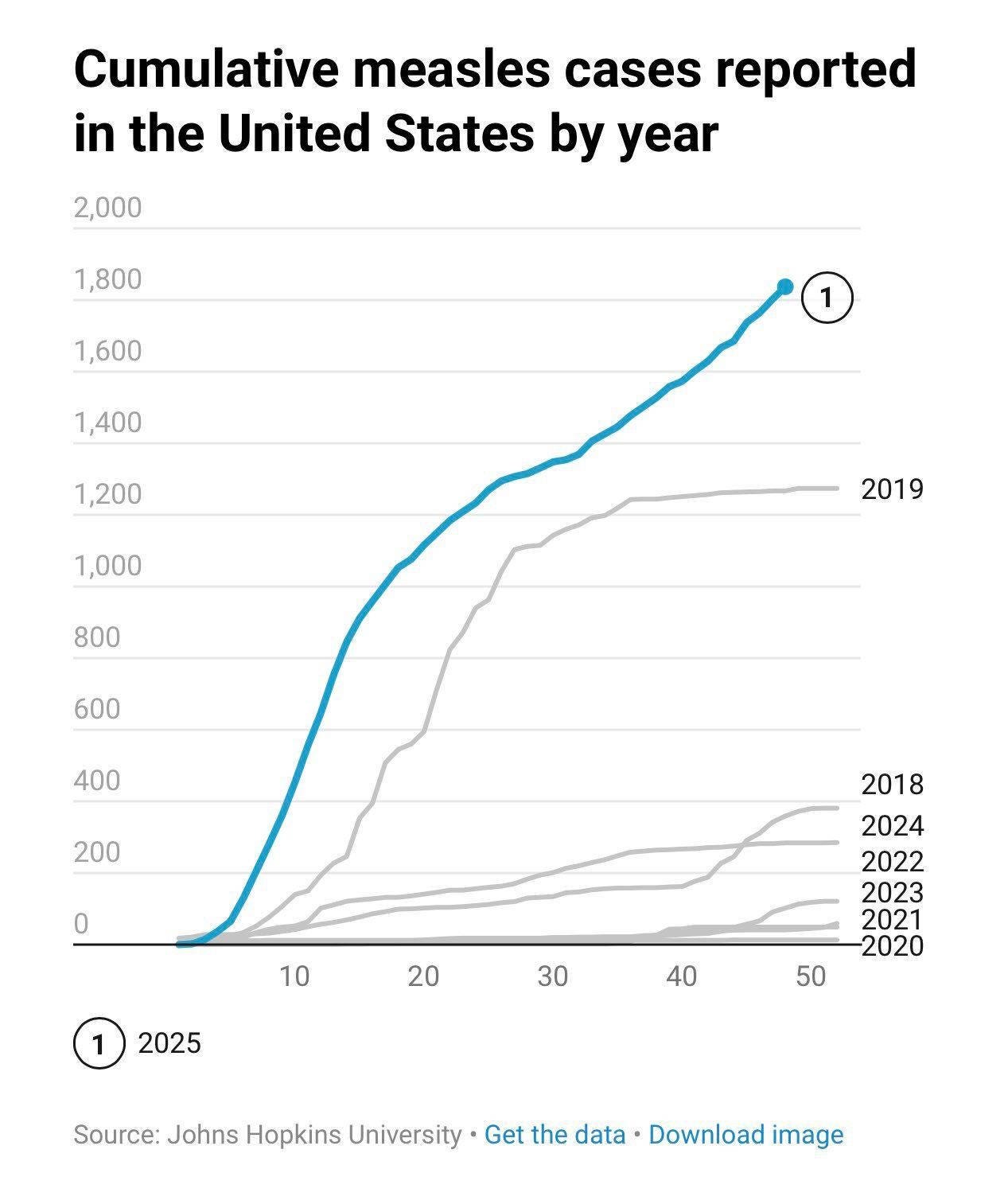
RFK Jr., Trump’s Secretary of Health and Human Services, has spread falsehoods about the measles vaccine, and even Fox News is blaming him for the outbreak. So if the disease keeps spreading, this is one thing that could disrupt normal Americans’ daily lives and cause them to sour further on Trump.
But by far the biggest thing that affects Americans’ daily lives — and where they seem to be souring on Trump’s rule — is the economy.
Trump’s economy
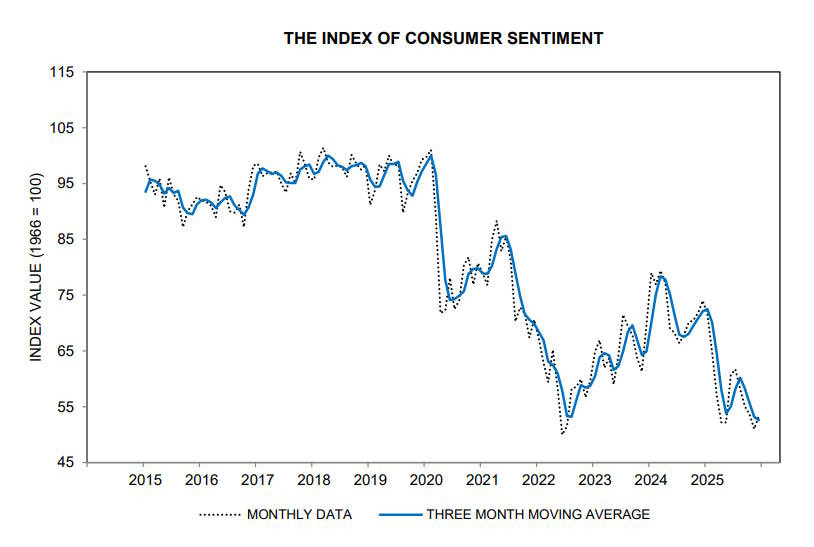
Americans are very, very unhappy with the state of their economy right now. Consumer sentiment is even worse now than at the lowest point in the Biden administration:
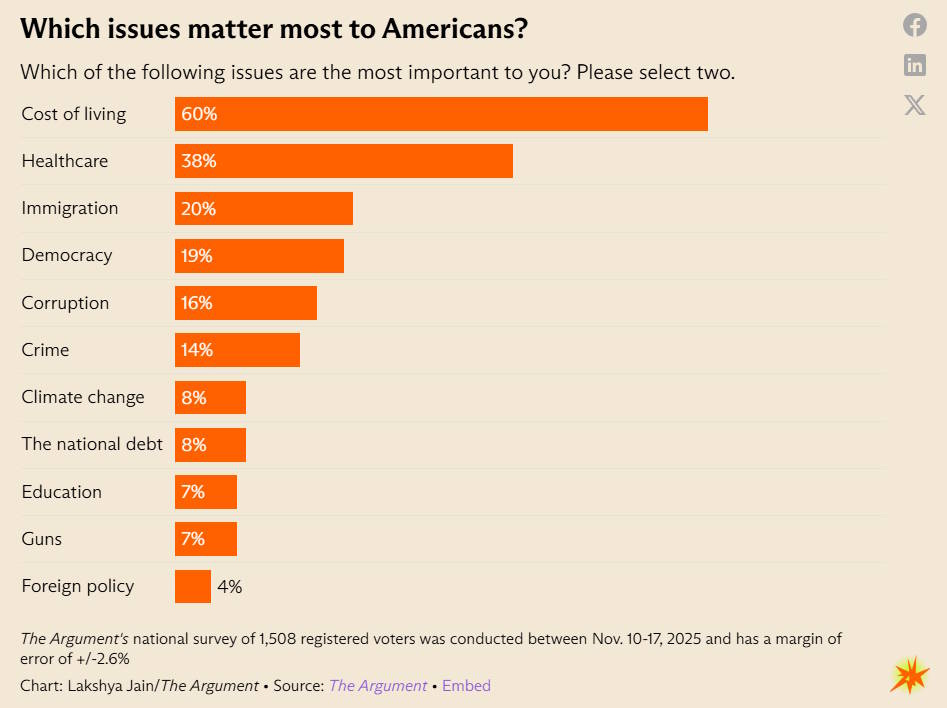
Why are Americans upset about their economy right now? Because they feel like life is getting less affordable. Polls pretty consistently show that the cost of living tops all other concerns:
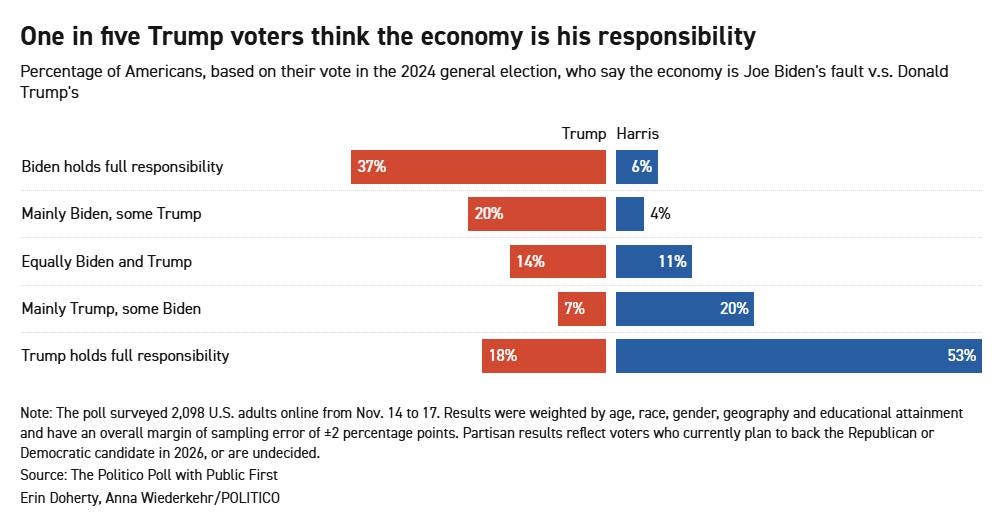
And Americans increasingly seem to blame Trump for this:
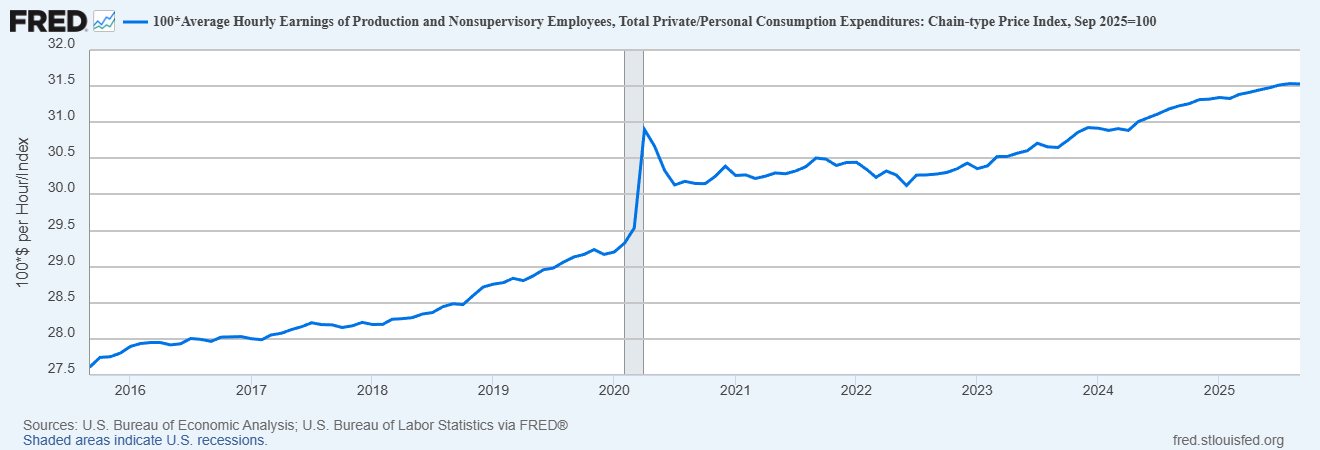
Is the affordability crisis real? Well, it depends on your perspective. Real wages for production and nonsupervisory workers — i.e. wages adjusted for the cost of living — are a good measure of purchasing power. And these have been rising steadily since 2022, meaning that life in America has been getting more affordable — at least, on average.
And although inflation is a tiny bit above target and may be rising again, it’s still far lower than in 2021-22, and pretty low by historical standards:
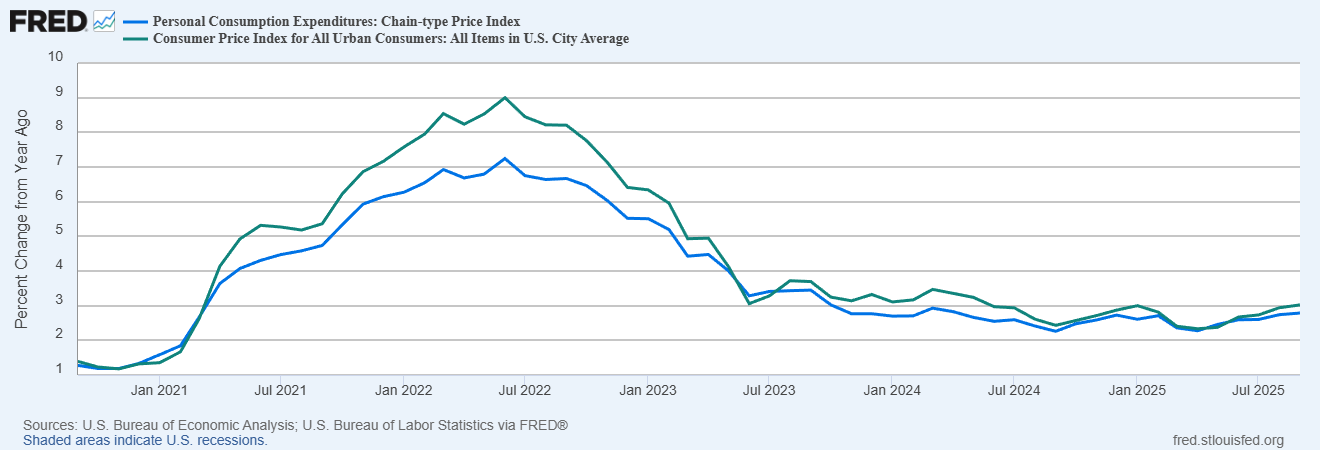
Why are Americans so apocalyptically negative about affordability in the Trump economy, when the objective indicators seem fairly benign? There are lots of possibilities here. People might be mad about high mortgage rates that make it hard to buy a new home. They might be finally venting their rage over decades of rising costs for big-ticket service items like health care, college, and child care (even though many of those costs seem to have plateaued or even decreased in the last few years). They might simply be using inflation as a politically neutral-sounding way to express their disapproval of Trump on sociocultural issues.
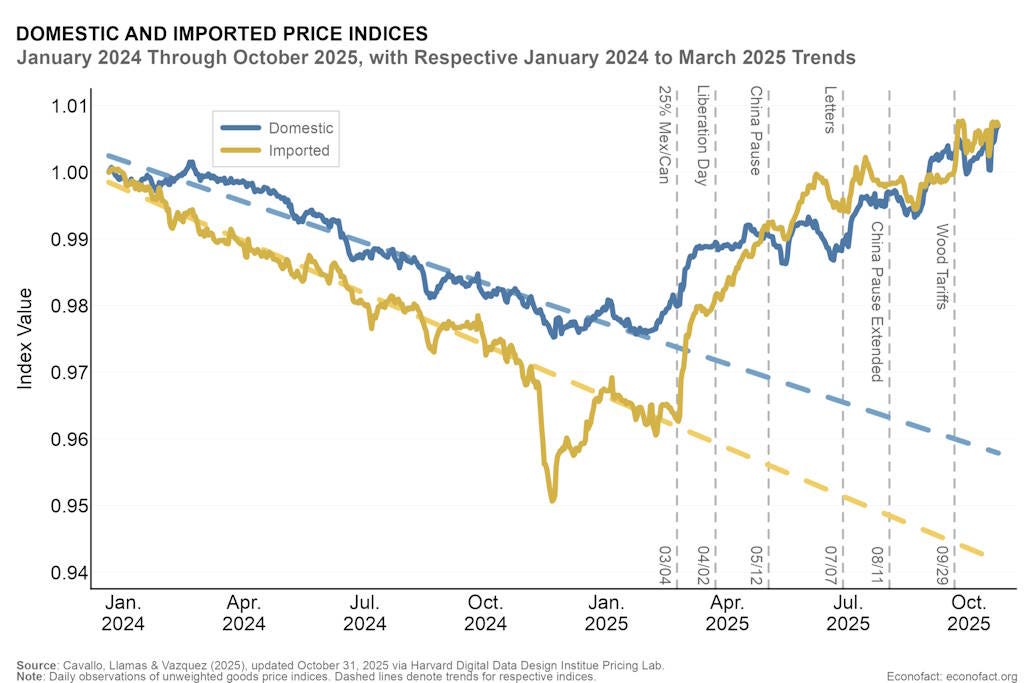
One possibility is that Americans are mad that Trump just doesn’t seem to care about affordability. His tariffs are probably contributing a relatively modest but real amount to inflation:
And when confronted about rising prices from tariffs, Trump has responded by sneeringly telling Americans to be satisfied with less:
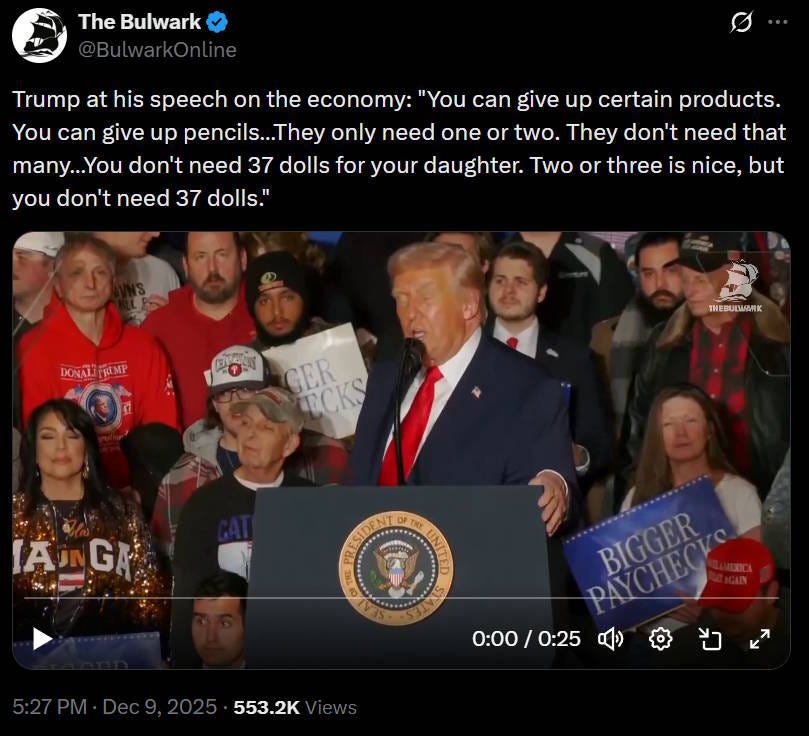
“Be satisfied with fewer toys for your kids” is not the kind of message Americans like to hear, especially from a guy who lives a lavish, super-rich lifestyle. Trump has also called the affordability crisis “a hoax.”
CNN has poll results showing that it may be Trump’s perceived inactivity and lack of sympathy on affordability that is angering some voters:
[I]mportantly, a large reason for that negativity [about the economy] appears to be not just the state of affairs, but Trump’s perceived neglect…Recent polling from CBS News and YouGov shows 75% of Americans and 57% of Republicans say the administration hasn’t focused enough on lowering prices. Again, that’s a clear majority … of Republicans.
And Trump’s macroeconomic policy threatens to make the situation even worse. He consistently calls for the Fed to cut interest rates more. Rate cuts would, of course, fuel inflation, especially if they convinced American business that Trump’s Federal Reserve no longer prioritizes price stability.
Why does Trump want rate cuts? Well, lower rates push up the value of stocks, bonds, and other financial assets, which Trump and his family own a lot of. This motivation might be why Trump’s Treasury Department is tweeting out charts touting bond price increases in 2025:
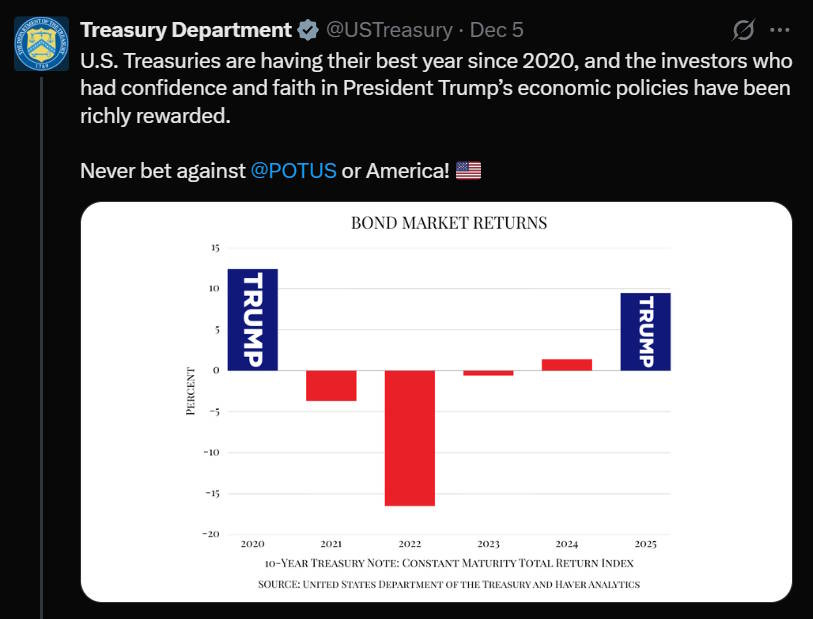
Of course, bond prices go up when interest rates go down. And interest rates typically go down when the economy is in distress. Just look at the chart and realize that the only other blue bar besides 2025 is 2020, when the pandemic was raging.
It’s possible that Trump’s macroeconomic team is just confused, and doesn’t know how any of this works. But it’s also possible that they value interest rate cuts as an inherently positive, good thing.
It’s also possible that Trump still views unemployment, rather than inflation, as the main threat to the U.S. economy. The labor market is still fairly strong, but deteriorating mildly, with rising layoffs. And right now the AI boom is propping up the macroeconomy; if that boom goes bust, the resulting financial and economic crisis could cause unemployment to soar. Trump may be trying to get ahead of that scenario. Or he may simply have an instinct that tells him that price hikes are less important than jobs.
Either way, Trump’s nonchalant attitude toward inflation could end up being his undoing. So far we haven’t seen any event that hurts lots of Americans and causes Trump to lose popular credibility, as Hurricane Katrina did to George W. Bush in 2005. A rise in inflation could be that event.
So while Trump’s presidency isn’t headed for the ash-heap of history just yet, it is showing major signs of strain. If Trump keeps abusing and hollowing out the economy, eventually some sort of strain or shock will be able to tip it into crisis.
My less nuanced opinion here from rural America is that there is a bit of Trump fatigue setting in, even among the die-hards. They aren't ready to embrace Democrats (I don't see that happening in my lifetime) but the Truth Social rants and the rambling public statements aren't landing like they used to. He's less of a messiah now and more background noise. That doesn't mean they've abandoned him, like Noah said, his border policy is still touted as a particularly strong accomplishment. However, he isn't seen as the end and be all of statesmanship, like he was in 2017/2018.
I see the MAGA movement waning a bit even here in the hinterlands. That doesn't mean it's over, but the more extreme edges are crumbling.
Three big reasons why "affordability" is such a pain point.
1. Housing. If you want to BUY a house, that has gotten steadily less affordable for decades, but especially since the pandemic.
https://lawliberty.org/a-henry-ford-for-housing/
2. The inflation of 2020-2022 hasn't been reversed. It was always unreasonable to expect that it would be. Disinflation rather than deflation was the thing to hope for. But he encouraged unreasonable expectations for lower prices, and now people are mad that he's not delivering on that.
3. Bag job markets. While the unemployment uptick is modest, job openings are down, and people are staying employed by clinging to their jobs. The data isn't great for tracking this, but it seems to take more time and effort to get a job. We're not seeing an epic wave of mass layoffs, but there are enough to be ominous.