

I’m a little late to this story, but New York Times columnist Nikole Hannah-Jones wrote a very complex and interesting post about sending her daughter to a crappy New York City public school. She was motivated by egalitarian impulses, but it turned out to be bad for her daughter, and later she felt guilty about making her child pay the cost of her own social experiment.
Now, I went to public schools myself, and I’m generally biased toward public schools. Not everyone has a negative experience like Hannah-Jones; Matt Yglesias sent his kid to a low-income public school in D.C. and had a good experience. The people who respond to Hannah-Jones’ article by saying that America’s public schools in general are failing are just wrong. In general, American schools get pretty good value for the money they spend, and American kids do well on international standardized tests.
But some of our public schools are really bad, and Hannah-Jones unfortunately encountered one of these. The school only pretended to teach her daughter, giving her great grades when she actually didn’t understand the material at all:
Algebra…was a subject [my daughter Najya] believed she knew…Najya had earned A’s in the class…One night early in the semester as we were eating dinner, Najya gushed about how easy the [standardized] test had been. “I know I got an A, or at least a B,” she said smiling. A few days later, she came into the house, ran to her room without speaking, slammed the door and sunk to her floor, sobbing. She’d failed it.
This became an unbearable pattern. She’d come home glowing about an algebra exam because she “really knew the material this time” and my stomach would tie into knots. A few days later, I’d trail her upstairs to find her crumpled on her bed. “I studied so hard. I just feel so dumb.”
Giving students good grades when they don’t understand the material is the hallmark of a crappy school. In fact, this epidemic of fake grades is spreading; University of California professors are complaining that their students can’t do middle-school math. This is partly UC’s fault, for dropping standardized tests as an admission criterion, and letting in unprepared students. But blame also lies with the crappy schools who hand out A’s without actually teaching.
What can fix our crappy schools? Hannah-Jones blames a lack of funding for low-income predominantly Black schools:
[N]ationally, schools in predominantly nonwhite districts receive $23 billion less in annual funding than their heavily white counterparts, according to a 2019 analysis by EdBuild. In everything that we measure, these schools have less, even though the economically struggling student bodies they serve need more. And so the test scores and poor academic performance that typify these schools reflect not just the disadvantage of the students but, more essentially, the disadvantage of the schools.
This is absolutely ridiculous, and represents a very basic math error. Obviously what should matter here is spending per student, not total spending. We spend more on predominantly white districts than on predominantly nonwhite districts because there are a lot more predominantly white districts in America!
Brookings came out with a great report on school spending equity this year. It turns out that although there’s some inequity in the middle of the distribution, it’s also true that poor, predominantly nonwhite schools in America (the rightmost bar on these charts) actually get a lot more funding per student than other schools, even when you adjust for the local cost of living:
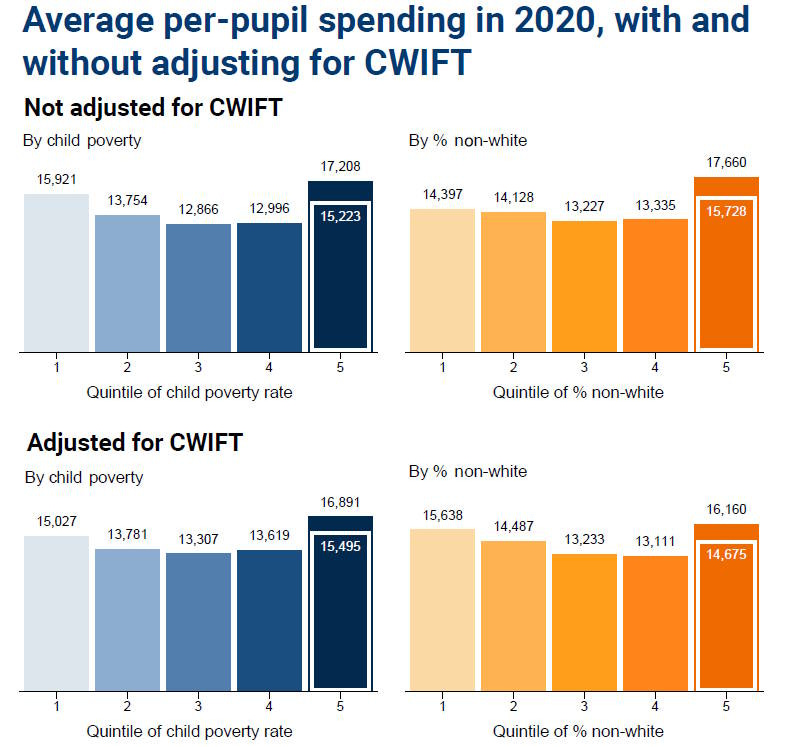
Note that this chart excludes NYC, where things are even more lopsided. And we’ve been pouring increasing amounts of money into the poorest, least-white schools in America — especially in NYC — since the turn of the century:
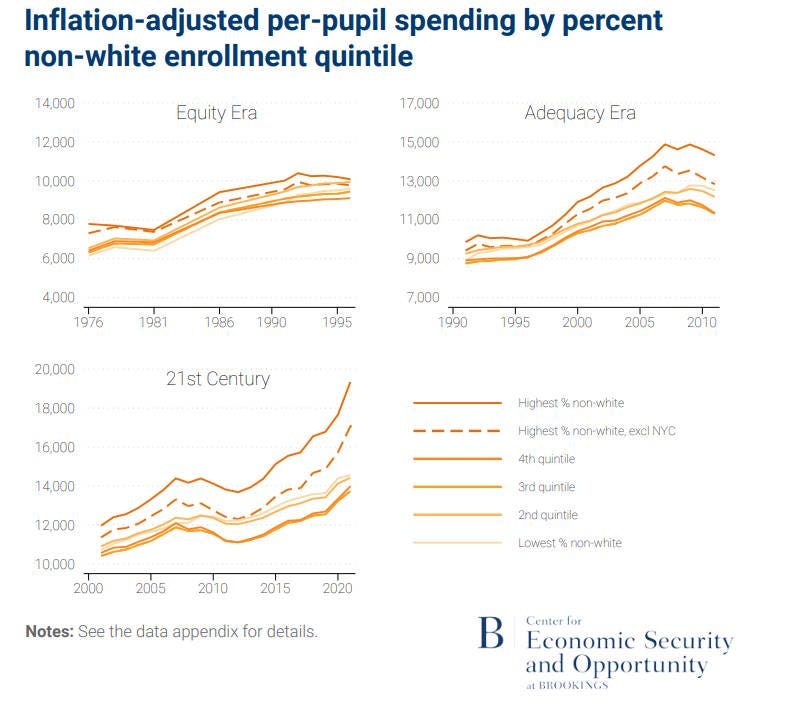
This is not to say that even more funding wouldn’t help poor mostly-Black schools. These schools might just need a lot more money to begin with. And funding increases have helped these schools in the past.
But we need to ask: What will the schools do with the money? If they just spend it on things that don’t matter, while handing students like Nikole Hannah-Jones’ daughter straight A’s without actually teaching the material, then we’ll just be throwing good money after bad, and people will get mad.
What do schools waste money on? Some people have pointed the finger at administrative bloat:


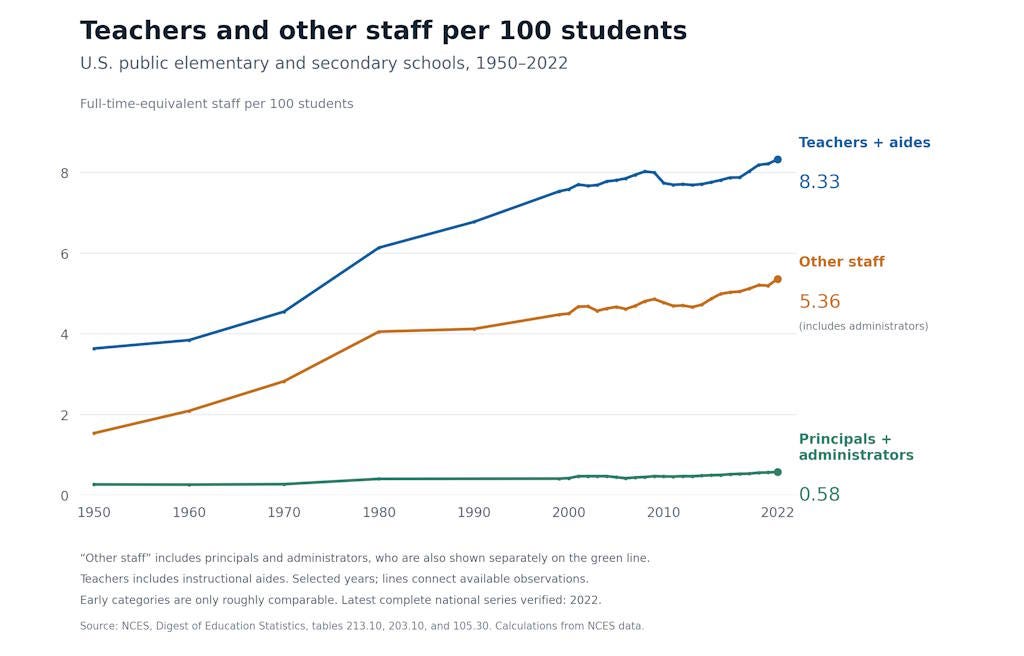
But historically, K-12 schools have hired a lot more teachers than administrators:
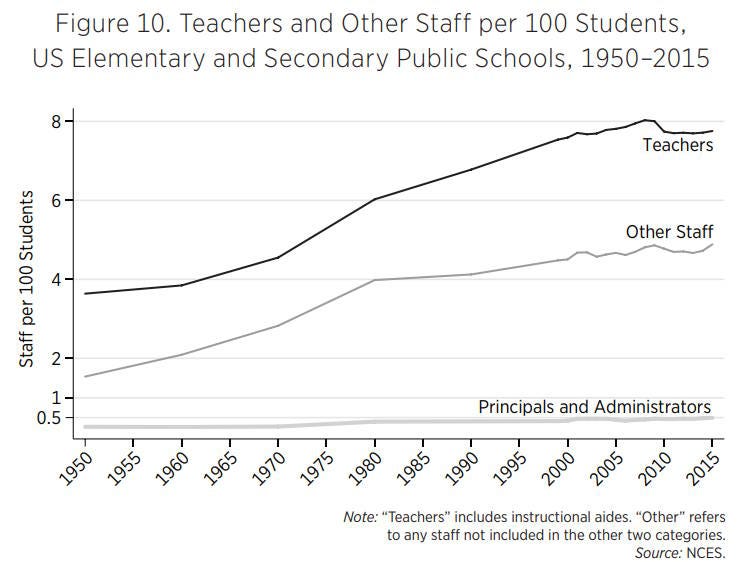
Administrative hiring has picked up a bit since that chart came out, but so has teacher hiring. “Teachers per student” is still comfortably ahead, and rising:
If the number of teachers per student is going up, it must mean class sizes are going down. Indeed, America has been engaged in a multi-generational effort to give public school students smaller classes:
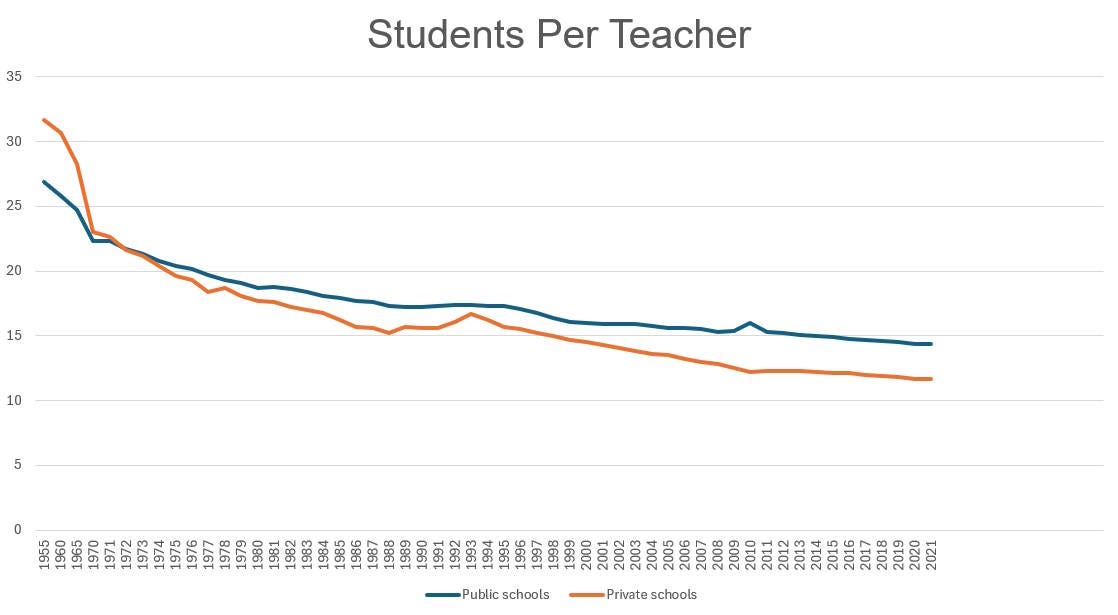
Major efforts to reduce class size continue. The state of New York recently passed a law mandating maximum class sizes, forcing New York City to hire lots more teachers — at the cost of about $1 billion to the city budget.
I’ve been hearing all my life that smaller classes will improve the quality of education. People still regularly make this argument. For example, in 2023, in the Washington Post, Valerie Strauss wrote:
[A]nybody who has been in a classroom knows the virtues of classes that are smaller rather than larger even without the research that has been shown to bear that out…a 2014 review of major research…found class size matters a lot, especially for low-income and minority students.
Diane Ravitch agreed.
But does the evidence really support the idea that smaller classes are better for students? Not really. The 2014 review that Strauss linked to, by Diane Schanzenbach, cites only a few quasi-experimental studies. Most prominent among these is Dynarski, Hyman, and Schanzenbach’s 2013 analysis of STAR, a pilot program in Tennessee that reduced class sizes, which found significant positive results:
We found that assignment to a small class increases students’ probability of attending college by 2.7 percentage points, with effects more than twice as large among black students. Among students enrolled in the poorest third of schools, the effect is 7.3 percentage points. Smaller classes increased the likelihood of earning a college degree by 1.6 percentage points and shifted students toward high-earning fields such as STEM (science, technology, engineering, and mathematics), business, and economics.
Most other quasi-experimental evaluations of class size also rely on pilot programs, since reducing class sizes is expensive. But Schanzenbach also cites a very important study from 1999 by Angrist and Lavy that covered the entire country of Israel. Israeli public schools capped class sizes at 40, because of an obscure rabbinical law known as Maimonides’ Rule. If enrollment in a class randomly had more than 40 students, you had to divide the class. Angrist and Lavy found that when the rule was triggered, students did better academically. This is a paper I learned about in grad school.
But what Schanzenbach didn’t know is that Angrist and Lavy’s 1999 result hasn’t held up. In 2019, Angrist and Lavy, together with Leder-Luis and Shany, published an update to their study called “Maimonides’ Rule Redux”. They report that the effect of class sizes disappeared in the 2000s. They fail to find a reason why, and speculate that their earlier result may have simply been a historical anomaly:
The Maimonides Rule identification strategy for class size effects generates precisely estimated zeros in large Israeli samples for 2002-2011…The estimates of zero class size effect in more recent data contrast with the substantial negative class size effects reported by Angrist and Lavy (1999)…On balance, it seems fair to say that the 1991 results are unusual in showing strong class size effects, while the null effects reported for 1992 have emerged as more representative of the causal relationship between class size and test scores in Israel.
That would be consistent with the finding of Hoxby (2000), who looks at the impact of similar (though less biblical) maximum class size rules, and finds zero effect. Schanzenbach dismissed Hoxby’s result as “an unresolved puzzle”, but it turns out that it might have been the norm rather than an exception. Filges et al. (2018) do a more systematic meta-analysis (including four papers that evaluated Tennessee’s STAR program), and find that reducing class sizes has basically no beneficial effect:
Overall, the evidence suggests at best a small effect on reading achievement. There is a negative, but statistically insignificant, effect on mathematics. For the non-STAR studies the primary study effect sizes for reading were close to zero but the weighted average was positive and statistically significant. There was some inconsistency in the direction of the primary study effect sizes for mathematics and the weighted average effect was negative and statistically non-significant. The STAR results are more positive, but do not change the overall finding. All reported results from the studies analysing STAR data indicated a positive effect of smaller class sizes for both reading and maths, but the average effects are small. [emphasis mine]
And remember that the positive evidence — mainly STAR, but also a similar program in Wisconsin — generally comes from small pilot programs. A well-known problem in economics is that when you scale programs up from small-scale to large-scale, beneficial effects often disappear. Chingos (2012) reports disappointing results from Florida’s statewide class size reduction policy:
I estimate the impact of Florida's statewide CSR policy by comparing the deviations from prior achievement trends in districts that were required to reduce class size to deviations from prior trends in districts that received equivalent resources but were not required to reduce class size…The results from both the district- and school-level analyses indicate that mandated CSR in Florida had little, if any, effect on student achievement.
Although Jepsen and Rivkin (2009) do find very small positive effects1 from California’s statewide policy, they also identify a major stumbling block for class size reduction — a lack of qualified teachers:
[T]he increase in the share of teachers with neither prior experience nor full certification dampened the benefits of smaller classes, particularly in schools with high shares of economically disadvantaged, minority students.
Teacher quality matters a lot! In fact, this is a clear conclusion from the education literature. Review papers like Jackson et al. (2014) and Hanushek and Rivkin (2011) find big positive effects from teacher quality.
And there just isn’t an infinite supply of good teachers. Even if we were to dumb down standards and hand out teaching certifications essentially for free, that wouldn’t make teachers actually better at their jobs. Our obsession with shrinking class sizes is causing us to use up the available pool of good teachers, and start hiring bad ones. That tends to cancel out any potential positive effect from smaller class sizes.
This also happens through the sneaky mechanism of budget constraints. Any given education budget can be used to raise teachers’ salaries — which will attract a higher caliber of worker to the profession — or to increase the number of teachers. Our obsession with using budgetary increases to increase the quantity of teachers, rather than to pay teachers more and raise the quality, looks like a miscalculation.
We should be spending more money on educating our poorest and most disadvantaged students. But that money should be spent less on flooding those schools with ever more teachers of questionable quality, and more on raising pay to attract highly competent people capable of making a big difference in disadvantaged kids’ lives. If we did that, then stories like Nikole Hannah-Jones’ might be more of a rarity in America.
About 0.03 standard deviations. For references, 0.03 standard deviations on the SAT would be about 3 points out of 1600.
We also need to hold back students who are not ready to graduate. I know it can be tough on those students, but auto-graduating everyone isn’t preparing them for academic development. If they can’t grasp 3rd grade math and reading, they’re going to struggle in 4th grade, and so on. They’ll start to lose motivation as they can’t figure out why they’re always struggling when teachers have told them that they are ready for the next year.
Finally, there’s only so much even good teachers can do if parents aren’t willing or able to provide a good learning environment at home. I know some teachers only assign minimal homework because anything that can’t be done during study hall wouldn’t be completed anyway because parents aren’t checking in with their kids. That’s no way to ensure kids retain in-class instruction.
We argue a lot about schools. I can’t quote a bunch of studies but from my limited sample (one daughter is a teacher), it seems a lot of the issues in schools are down stream from issues outside the school building (poverty, kids showing up hungry, parents on drugs, unstable home life with frequent moves, etc, etc.). Good teachers certainly matter. My daughter has been at it for 15 years and is a saint. She moves mountains to get help for her kids (she is a deaf educator). She also deals with endless insanity on the administrative side.