

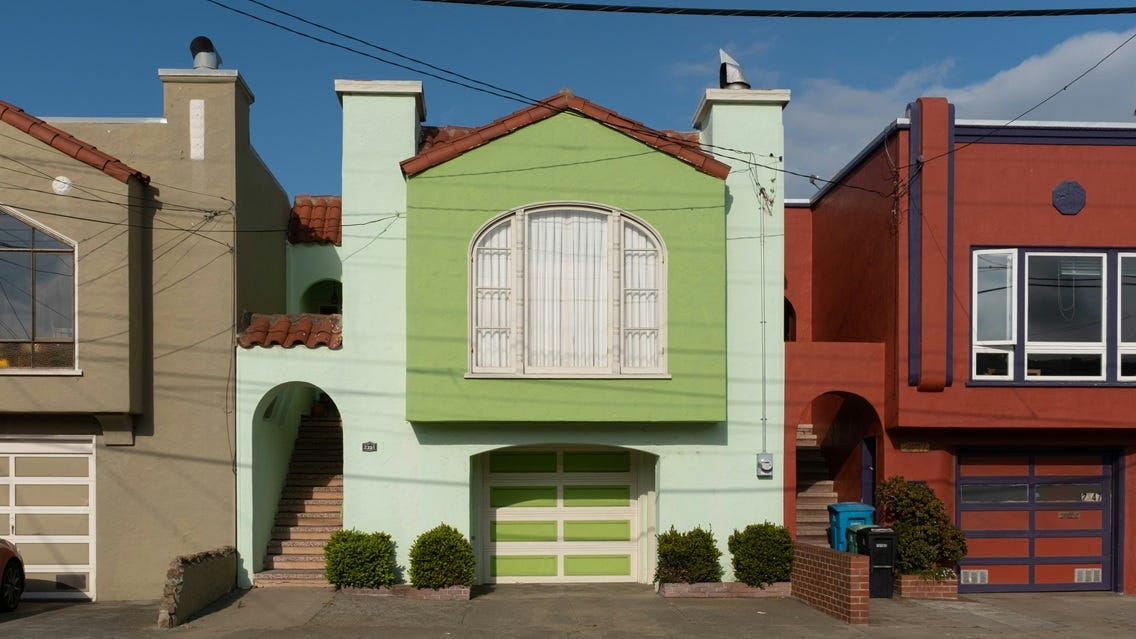
The other day I did something I’ve never done before: I made a major political donation.1 I gave $10,000 to GrowSF, a political advocacy organization that focuses on local elections in San Francisco. They’re going to use the money to support Alan Wong in the upcoming special election for District 4 supervisor.
Usually, I’m pretty pessimistic about the ability of political donations to affect the course of society. The influence of money in politics is exaggerated in general, and the amount that I’m personally able to contribute is pretty modest; in almost all cases, I think I’ll probably have a bigger impact just by writing blog posts. But in this particular case, I think I might actually be able to make a noticeable difference by donating a little bit of money — especially because it gives me a good excuse to write about the political situation in San Francisco.
Basically, for a number of years, San Francisco was the poster child for a style of progressive urban governance that has been failing in cities across the country. I wrote about this governance debacle shortly after Trump was elected in 2024:

In the 1990s and 2000s, America’s big cities had an urban revival. Pragmatic liberals like Michael Bloomberg in New York City and Ed Lee in San Francisco were some of the most important leaders of this revival. They recognized the value of business as the city’s tax base, and they recognized the importance of public order for maintaining a livable urban environment. They were not perfect; they failed to build sufficient housing, setting the stage for the urban housing crisis of the 2010s and 2020s, and they continued or accelerated the unfortunate trend of outsourcing city government functions to nonprofit organizations. But overall, they were successful in turning American cities into places that people actually wanted to live in again.
As people — especially people with money — moved back into America’s cities in the 1990s and 2000s, the housing crisis worsened, because cities didn’t meet the increase in demand with an increase in supply. But at the same time, America was sorting itself politically — the big cities leaned increasingly to the left.
That political shift enabled the rise of a new, radical kind of urban progressive ideology. If the old liberalism had been complacent about the need for housing supply, the new progressivism was downright hostile to it; drawing on the anti-gentrification movements of a previous generation, hardline progressives embraced the mistaken idea that allowing the construction of new apartment buildings raises rents:

In fact, an overwhelming amount of evidence supports the fact that allowing new housing reduces rents for everyone. But in refusing to hear that evidence, urban hardline progressives have essentially allied themselves to an old-money NIMBY gentry that wants to keep cities frozen in amber with development restrictions.
At the same time, the new urban progressive ideology became extremely tolerant of public disorder — property crime, low-level violent crime, public drug markets, and threatening street behavior. Cracking down on these social ills was viewed as unacceptably harmful to the perpetrators; in other words, hardline progressives came to view anarchy as a form of welfare policy.
Penalties for minor crimes were reduced, enforcement of public drug markets was curtailed, and citizens were even forbidden from defending their own businesses from criminals. “Tent cities” were tolerated despite being riddled with violent crime, police budgets were slashed, progressive prosecutors like San Francisco’s Chesa Boudin prosecuted fewer crimes, dangerous repeat offenders were regularly allowed back onto the streets, and so on. Inevitably, poor people were the ones most heavily impacted by the epidemic of crime and drug use that this anarchy enabled.
Together, high housing costs and rampant public disorder made America’s big blue cities no longer the envy of the world. Meanwhile, hardline progressives simply doubled down — responding to high housing costs with yet more restrictions on development, and responding to disorder with yet more tolerance of disorder, all while funneling increasing portions of the city budget to well-connected nonprofits that often turned out to be ineffectual and corrupt.
In San Francisco, this hardline progressivism did not come from the mayor’s office. Most policy decisions in SF are carried out by — or must be signed off on by — the powerful Board of Supervisors. The Board of Supervisors writes the laws, approves and amends the city budget, confirms mayoral appointments, and exercises veto power over almost any major reform effort.
For many years, San Francisco had a moderate liberal mayor but a hardline progressive majority on the Board of Supervisors. Mayors wanted to build more housing and crack down on disorder and crime, but the progressive supermajority on the Board would not allow them to do so. Mayors like London Breed often took the blame for the city’s descent into unaffordability and chaos, but the prime culprit was always the hyper-progressive Board.
Under the aegis of hyper-progressive city government, San Francisco had the highest property crime rate in the nation in the late 2010s, and became one of America’s least affordable cities. The pandemic only accelerated these trends — the city’s population crashed and failed to recover, the streets became open-air fentanyl markets, transit ridership plummeted and didn’t bounce back, and housing production crashed from low levels to almost nothing. Malls closed, businesses pulled out, and downtown felt like a post-apocalyptic wasteland long after most other cities had recovered their verve.
Then, in 2024, an election changed everything. The change everyone knows about is the election of Daniel Lurie as mayor.
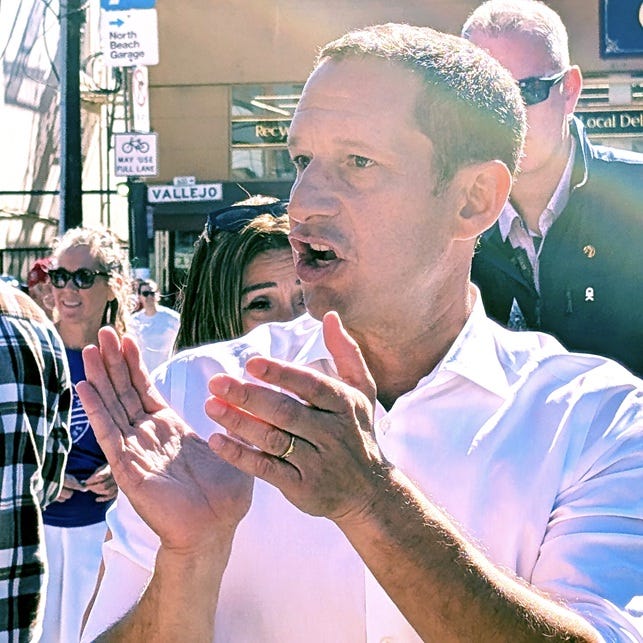
Lurie made public order his #1 task. Within a year, crime had plummeted:
[O]verall crime in [San Francisco] went down by 25% in 2025, with the number of homicides reaching a level not seen in more than 70 years…Property crimes were down by 27%, while violent crimes were down by 18%…The mayor added that the city planned to keep on hiring new officers, following an executive directive he signed in May. In October, the department reported the largest surge of recruits in years…
The department also credited the Drug Market Agency Coordination Center in leading to more than 6,600 arrests in connection with drug-related activity. Officers said they had also seized more than 1,000 firearms and more than 56 pounds of fentanyl…Meanwhile, retail theft operations have led to key arrests, resulting in reductions in larcenies and retail thefts.
Other notable crime trends touted by city officials include a 16% decrease in shootings, robberies being down 24%, car break-ins down 43% and vehicle thefts being down 44%.
On the ground, the change is absolutely palpable. In 2023 I would see thieves ripping pieces out of car engines in broad daylight. Almost every day I walked past throngs of drug users (and probably dealers). Every woman I knew was harassed on the street or on the train. There were needles and human feces on the ground everywhere. Stores were boarded up, train cars ran almost empty, tent cities lined side streets and the spaces under overpasses. Now, most of that is gone — the streets aren’t clean, but they’re closer to NYC than to a developing-country slum.
Progress on housing has been slower, due to the dense thicket of existing regulations and entrenched NIMBY interests that must be hacked through in order to actually get new housing built. Lurie passed a landmark upzoning plan, which doesn’t go nearly far enough but is a huge improvement on anything in recent decades. Now permitting is accelerating:
San Francisco’s infamously slow building permitting process may be getting faster…A city study published Thursday found that between January 2024 and August 2025, the timeline on permit approvals for new housing in San Francisco was cut by half — from an average of 605 days down to around 280 days…And permit applications that were filed within that 19-month window had even shorter turnaround times, at 114 days on average…
[A] state-commissioned report published in 2022 found that San Francisco was the slowest California jurisdiction to approve permit applications for housing projects…[But] Mayor Daniel Lurie has…focused on improving the city’s buildability, launching his landmark ‘PermitSF’ initiative to centralize the application process last year. In February, his office introduced an online portal that allows people to apply for certain types of permits.
It will take years for those permits to turn into actual homes. And the reforms that Lurie has managed to enact are only the tip of the iceberg in terms of what’s needed — much of which needs to be done at the state level.
But overall, things are looking up. Lurie’s approval rating reached 73% half a year into his mayorship (compared to 28% for his predecessor). In November it was still 71%. Everyone loves Daniel Lurie — and so do I. He’s not perfect, but no mayor has ever been perfect. His successful policies range far beyond what I’ve listed here — he’s added homeless shelter space, cut taxes on apartment buildings, removed anti-police activists from the Police Commission and appointed a better police chief, encouraged conversion of offices into homes, created free childcare policies and various early childhood programs, implemented policies to protect pedestrians and cyclists, cut various forms of red tape for housing and small business, streamlined business permitting, worked toward balancing the budget, and so on.
But here is the real point: Almost none of this would have been possible if the Board of Supervisors had still been controlled by hardline progressives.
The same election that brought Daniel Lurie into the mayor’s office also changed the composition of the Board. The “progressive” faction, which had enjoyed a supermajority on the Board, suffered a major defeat, with progressive stalwarts like Dean Preston being unseated by moderate liberals like Bilal Mahmood. The moderate liberal faction — which would be labeled strongly progressive in most of America, but who are regarded as centrists in San Francisco — gained a slim 6-5 majority on the Board.
Though Lurie has gotten most of the credit for SF’s turnaround, that slim Board majority was absolutely essential. The new laws Lurie has passed would not have been passed, nor would Lurie’s personnel appointments have been confirmed, had the Board been 6-5 in favor of the “progressives” instead of 6-5 in favor of the moderate liberals. A one-seat swing toward the hardline progressive faction would have meant a San Francisco that was still mired in all of the old urban dysfunction that progressive cities have been struggling with for a decade and a half.
And now that one-seat swing may actually happen, and San Francisco’s recovery might be derailed. District 4’s supervisor Joel Engardio, an important moderate liberal voice on the Board, was recalled last fall over his support for a highway closure. Lurie appointed Alan Wong to fill in the District 4 spot, but now Wong is facing a special election on June 2 to keep that seat. It’s a crowded field, and some of Wong’s rivals are very well-funded.
The other candidates in the race — Natalie Gee, David Lee, and Albert Chow — are all more opposed to Lurie’s pro-housing agenda than Wong is. If Wong loses, San Francisco’s reforms under Lurie so far probably won’t be repealed — at least not immediately. But the majority on many issues would flip back to the “progressives”, and further reforms would become much harder if not impossible. This would be especially harmful to the housing agenda, where upzoning efforts look promising but will require more years of sustained effort to reach fruition.
This is why I decided to give $10,000 to an organization supporting Alan Wong.2 I don’t live in District 4, and I’m sure his opponents are very nice people, but this election is about more than just District 4 — the composition of the Board of Supervisors determines the destiny of the entire city of San Francisco. The Outer Sunset will benefit from a moderate liberal majority on the Board, but so will the rest of us.
My city’s chronic inability to build sufficient housing has hollowed it out. It has forced huge numbers of middle-class people, working-class people, and artists to move far away from the city, leaving SF to the rich and the rent-controlled. It has contributed to the homelessness epidemic, forcing people onto the streets and into the arms of the drug dealers. Under Daniel Lurie and the 6-5 moderate liberal majority on the Board of Supervisors, we were just now starting to address that gaping, decades-long deficiency. And now we could throw it all in the trash.
Over the past year, San Francisco has shown the nation a way out of the quagmire of hardline “progressive” governance that is hollowing out so many of our cities. But if this one supervisor race goes the wrong way, and Alan Wong loses, we could end up being a cautionary tale about how difficult it is for American cities to reject that self-destructive approach.
I have made very small campaign donations in the past, on the order of $100.
If you’d also like to donate to that organization, here’s a link where you can do that.
Happy to be part of SF YIMBY who also endorsed Wong. Its tough to get the urbanist crowd out to D4, a notoriously "suburban" and anti density district in the context of SF, for canvassing but we are gonna try. Hope the GrowSF Endorsement gets Wong the positive media and we can provide some volunteers
First of all Noah, I must commend you for taking on your home team. We need more people in both parties to take them on.
I also wish you luck. While I was born in SoCal, I loved SF. Brunch in Sausalito was spectacular on sunny days.
One final note, your desire for a center left pragmatic public official is highly understandable. I would love to see a Rockefeller Republican run, a Nikki Haley. MAGA is flat out nuts.
Anyway, for your party, I have to believe that in order to stave off the aggressive progressive wing of your party, Moderates are going to have to get a little aggressive, call them out. Explain why their polices fail, but most of all, they have themselves been incompetent in managing a city.
As for Republicans? I must admit I don't get them. As a Reagan Republican, I am lost. I don't understand populist economics on the right or the left. Apparently, it is untethered from simple math. In words of my native SF language of yesteryear. Keep on Keeping on