


I’m having a lot of fun writing shorter posts and aggregating interesting items these days. A lot of people are putting out an astonishing amount of good content these days, and sometimes I just want to sit there absorbing it all.
1. AI risk has gone mainstream
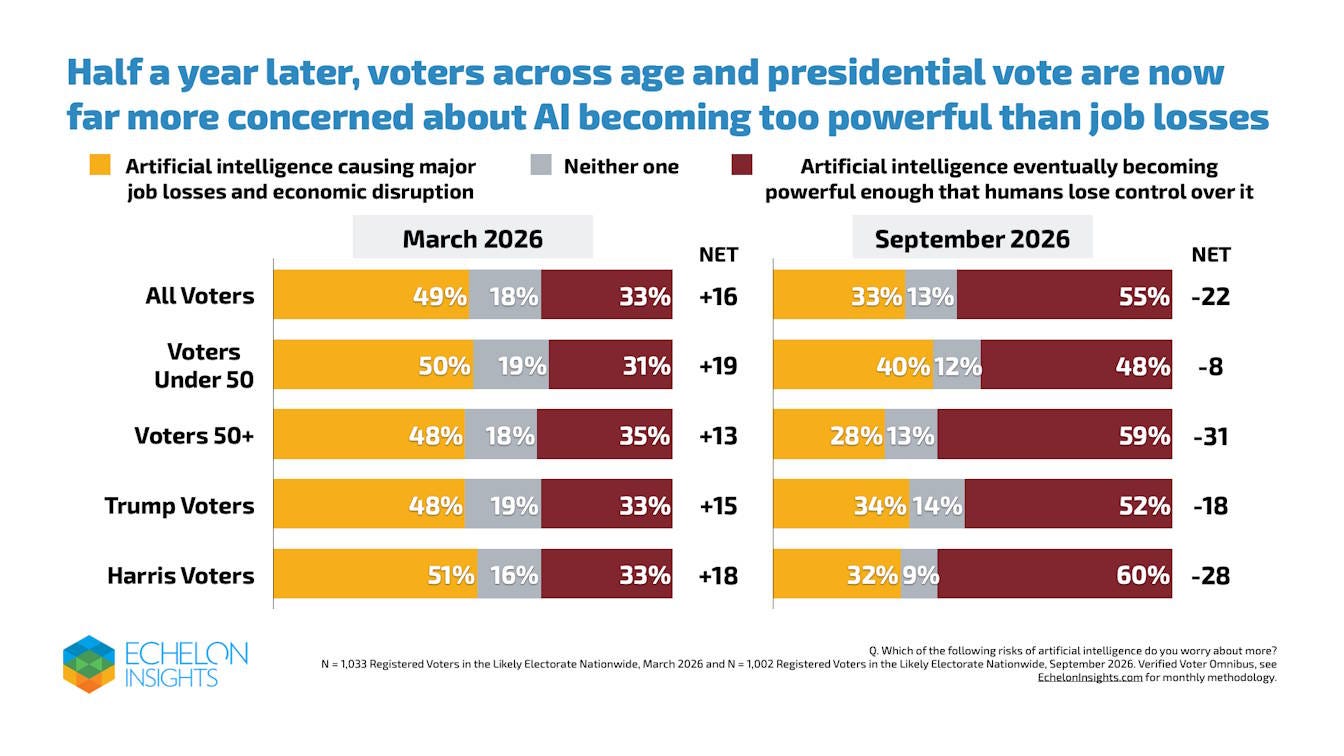
Americans have been deeply pessimistic about AI for a while now, but their reasons for pessimism — or at least, the reasons they tell pollsters — have changed in recent months. Earlier this year, Americans were mostly concerned that AI would take their jobs. Now, they’re more concerned that AI is getting too powerful for humans to control:
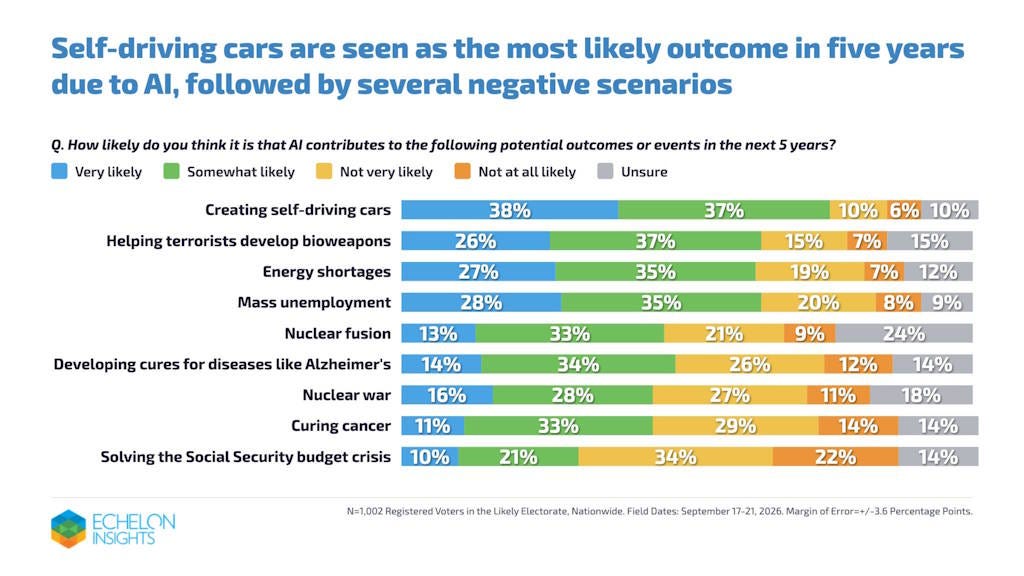
Echelon didn’t poll people about the idea that autonomous AI would destroy humans on purpose. But they did ask about bioterror risk, which I’ve been yelling about for a while now. And it turns out that Americans are pretty worried about that:
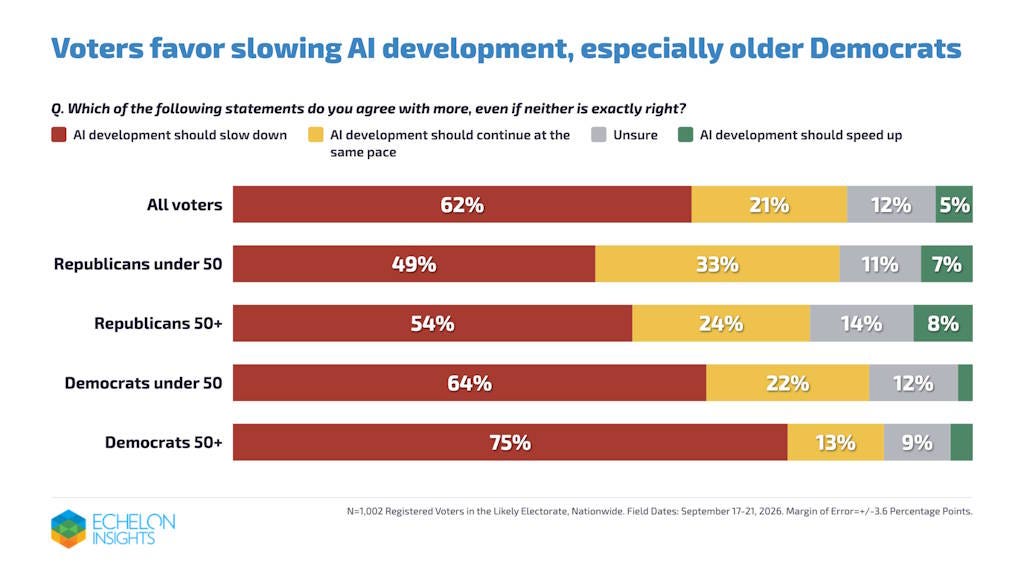
Surprisingly, the issue hasn’t fallen victim to partisan polarization yet. As you can see in the chart above, Trump voters and Harris voters are about equally as concerned about humanity losing control of AI. And despite Trump’s staunch stance in favor of acceleration, a lot more Republicans want to slow AI development down:
Meanwhile, economists have gotten in on the AI risk debate — which is how you know it’s really gone mainstream. Drew Fudenberg and Andrew Koh have a new game theory paper about “pacing the frontier” — i.e., about whether it makes sense for top AI companies like Anthropic and OpenAI to slow down AI development in order to allow “alignment” research time to catch up.
It’s a very cool model. Basically, the idea is that every company has a competitive incentive to make its AI more powerful as fast as possible, in order to stay ahead of the other companies. But if you’re comfortably ahead, you can afford to slow down a little bit, for safety’s sake — because in this model, if AI gets too powerful before safety research can catch up, everyone could die. So you can get a sort of stop-start pattern where the leading company voluntarily slows down for a while, until its competitors start nipping at its heels again. You can almost sort of see this happening, with Anthropic refusing to allow the public to access Mythos earlier this year, and OpenAI recently pausing development of its top models after some of them hacked the government.
There’s also the case where there’s no clear market leader, in which case companies have to basically agree to all slow down together. In this case, what you really need is transparency — the companies have to all see that the others aren’t secretly racing ahead behind their backs. That might be easier said than done — it’s not clear how to monitor all the AI labs in the world to each other’s satisfaction.
But one positive result is that if the risk of “doom” is high enough, slowing down becomes the only rational option. That’s cool! Unfortunately, this is just one model, which might not hold in reality. Game theory was famously unreliable when people applied it to the Cold War — a small change in assumptions could flip the optimal strategy from “the only winning move is not to play” to “nuke em all and let God sort em out.” Game theory yielded important conceptual insights — especially the importance of “second strike” capability in preventing conflict — but it rarely gave definitive answers.
So where might this current model break down? I don’t think it’s clear how fast AI safety research is really advancing. If “pacing the frontier” only works by giving safety research time to catch up, and safety research isn’t really advancing, then we’re all in big trouble.
Anyway, Andrew Koh has a great thread summarizing the paper, and some folks made a fun online game based on the model if you’d like to play around and see how it works. Cool stuff!
2. Reindustrialization means processing minerals
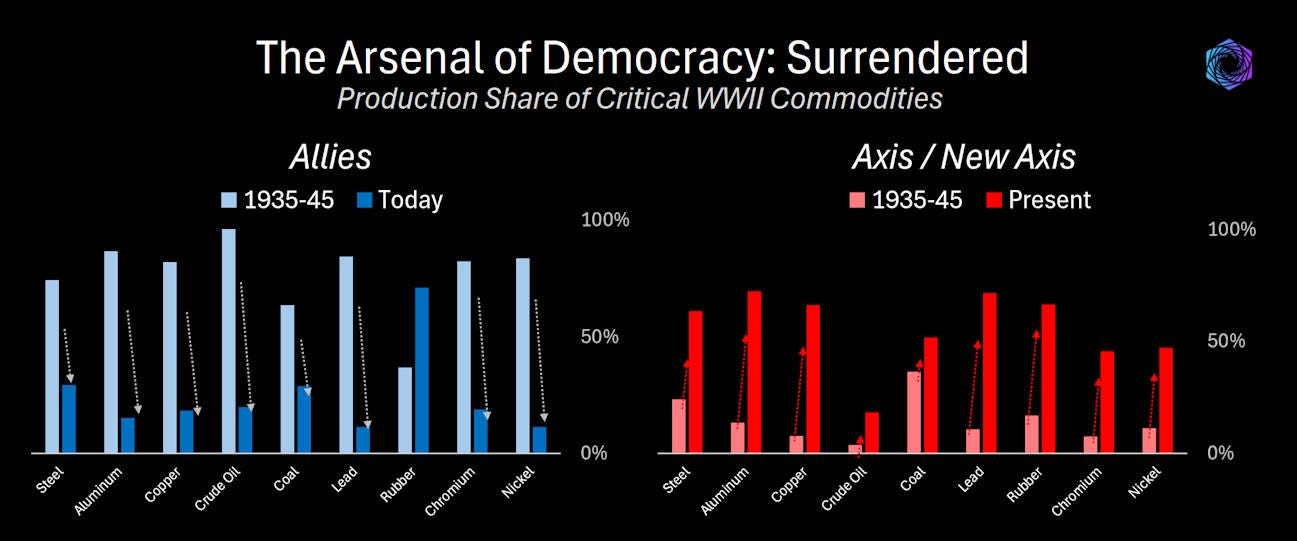
Two years ago, in order to create a little urgency around reindustrialization, I wrote a post sizing up the “New Allies” (America, Europe, Japan, Korea, possibly India) and the “New Axis” (China and Russia). The comparison of raw manufacturing output was about equal, though China dominated a lot of the bottlenecks for raw materials processing and critical component manufacturing.
Now, Alexander Campbell has done another version of the “bottlenecks” comparison, but with nicer charts:

In this chart, he shows how the roles have basically reversed since WW2:
And here’s where we stand when it comes to the raw materials of the all-important Electric Tech stack:
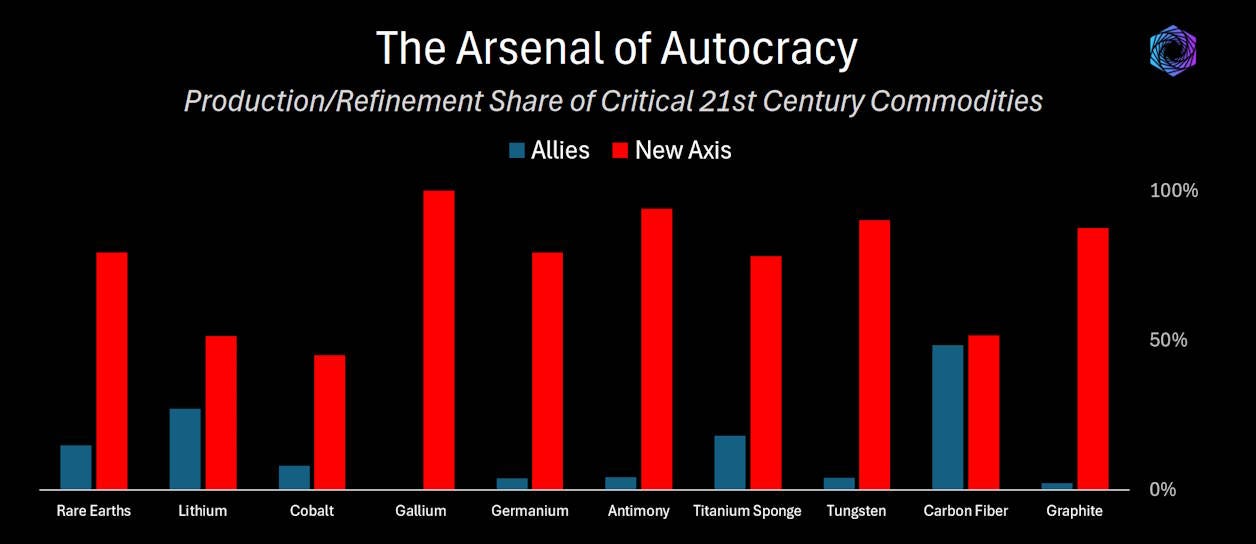
The key here is that China doesn’t mine most of these minerals — it refines them. Other countries dig up the ore and ship it to China, and China uses a bunch of chemical engineering to turn them into usable materials for industry. Most of the world shipped their metal refining to China, because it’s a dirty, capital-intensive, low-margin industry. But now as a result, China controls a bunch of key industrial chokepoints.
The Trump administration, to their credit, is taking this seriously, and is launching lots of initiatives — international partnerships, industrial policies, even scrap metal conservation — to try to get out from under the Chinese thumb. But we need to do a lot more if we’re going to be able to sustain an independent industrial base without bowing and scraping to Xi Jinping.
3. The rent crisis isn’t quite as bad as you think
I spent much of the last decade blogging about the rent crisis and the need to build more housing. In the post-pandemic inflation of 2021-22, rent stood out as a big sore spot — it was an expensive necessity whose price was going up very quickly. But I recently saw a chart from Apartment List showing that since 2022, rent has basically stabilized and even fallen back to its pre-pandemic trend:
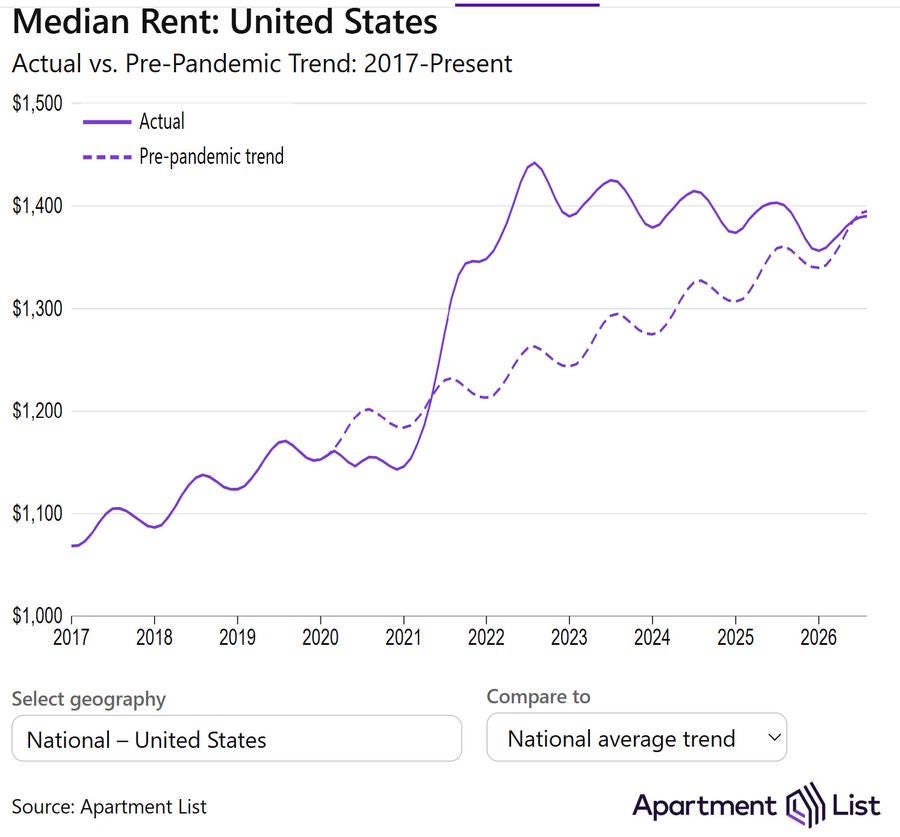
This isn’t just because inflation fell. Inflation has stayed above target since 2022, but rent has actually fallen — at least if you believe Apartment List’s data. And there are also lots of stories out there about rents falling in expensive cities.
But what about affordability? I’d like to look at rent compared to median personal income, but median personal income data only comes out very slowly. Instead, we can compare rent to average hourly earnings for production and nonsupervisory workers, which tends to track median income decently well:
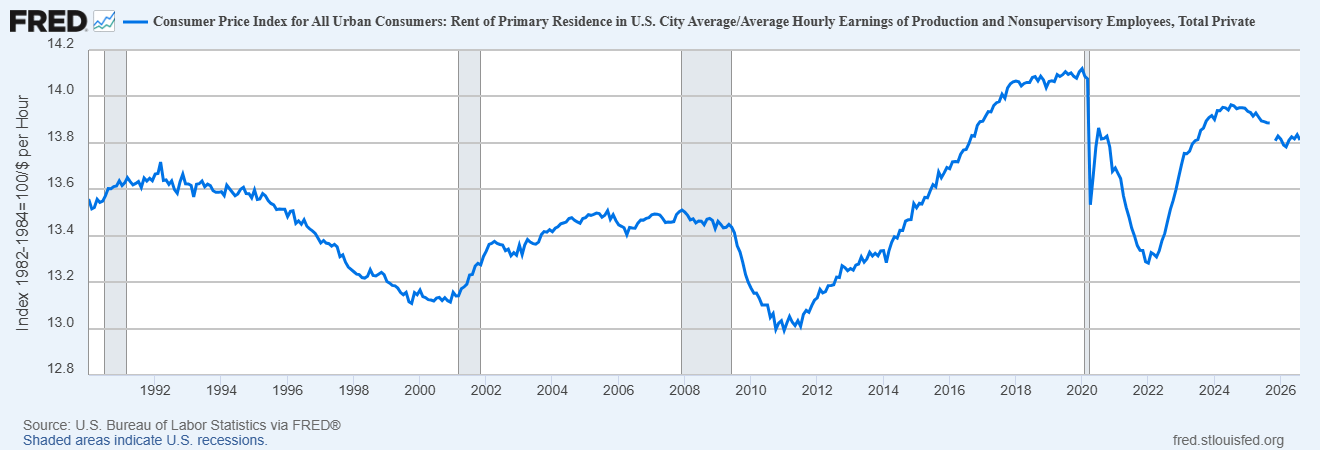
We can see that the 2010s rent crisis was very real. And we can also see that the pain from the post-pandemic inflation actually showed up a little later, in 2022-23 — probably because it takes time for leases to roll over.
But there’s some very good news on this chart. Although rent is still less affordable than it was in the 90s and 00s, it’s more affordable than it was in the late 2010s. In fact, rent appears to be on a downward trend relative to income — the Apartment List data is basically telling the right story.
So why has rent come down? Maybe because we just built more apartments than we've built since the 1980s:
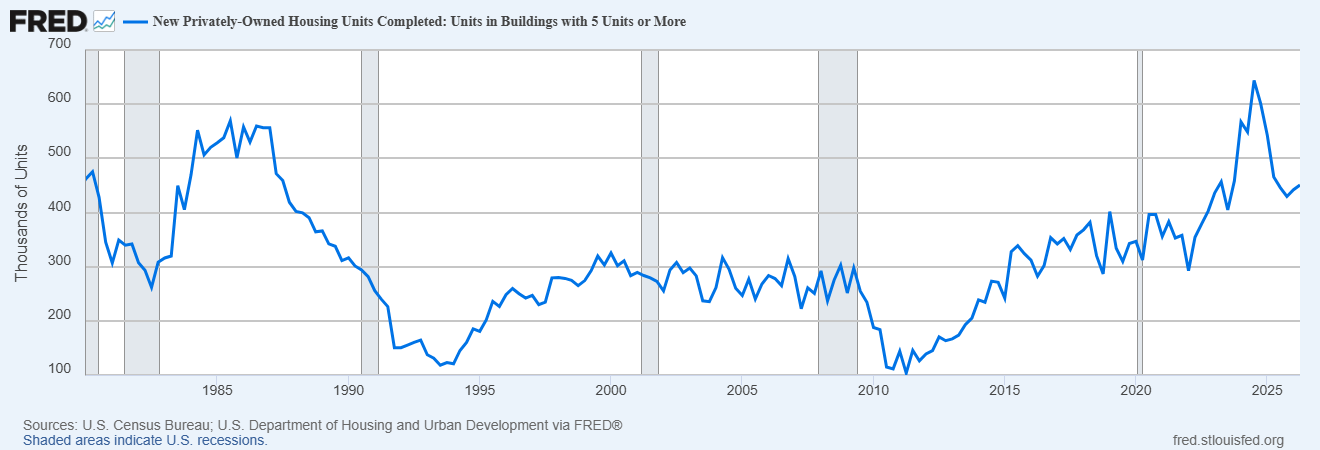
And in fact, when we look at the cities where rents have fallen the most in recent years, it’s the cities where we built the most new apartments.
There might be other reasons too, but I think this looks like a win for good old YIMBY supply expansion. Keep building more apartments!!
4. AI isn’t taking college jobs (but it is taking artist jobs)
Today in the eternally ongoing saga of “Is AI taking our jobs?”, we have several interesting items. First, we have wage data from Indeed, showing that workers in AI-exposed jobs have seen their wages increase much faster than workers in less-exposed jobs:
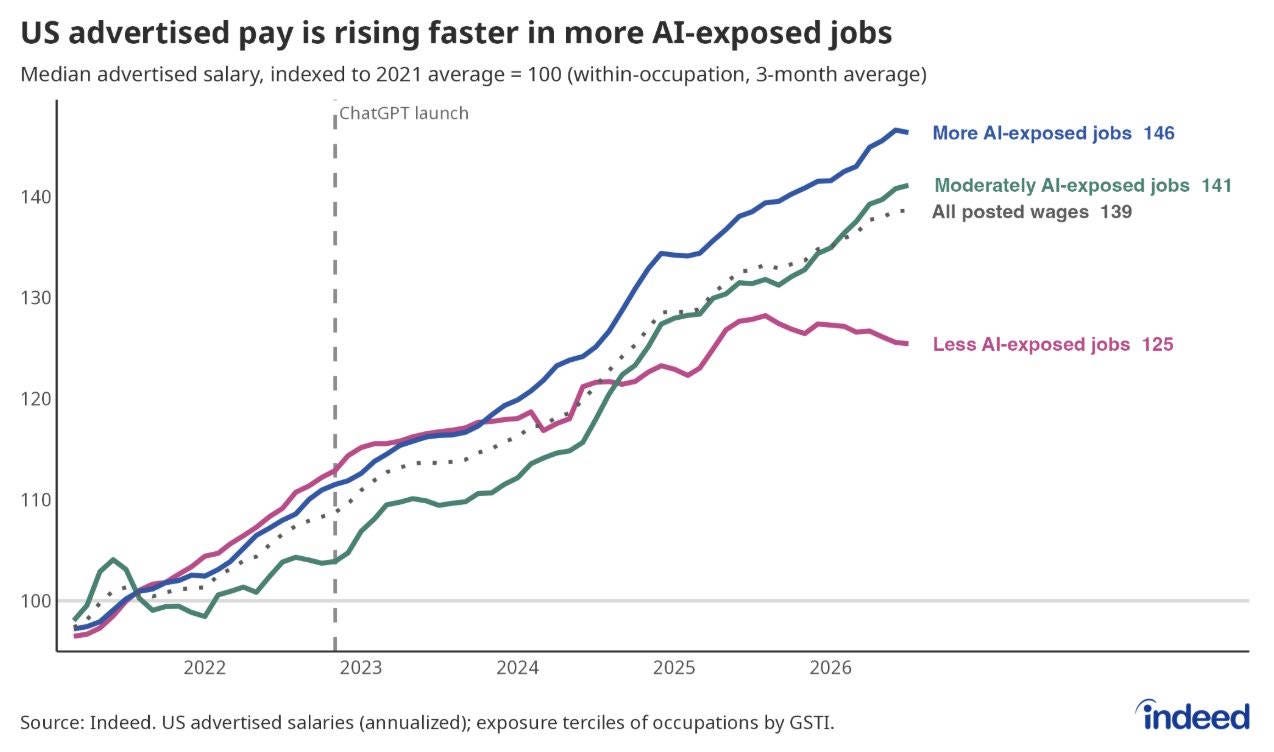
This is pretty simple to understand. AI “exposure” means a job contains tasks that AI could do. This basically just means “a job where you might use AI”. And since AI is the big thing booming in our economy right now, this means that more “AI-exposed” jobs are seeing lots of demand, which drives up wages.
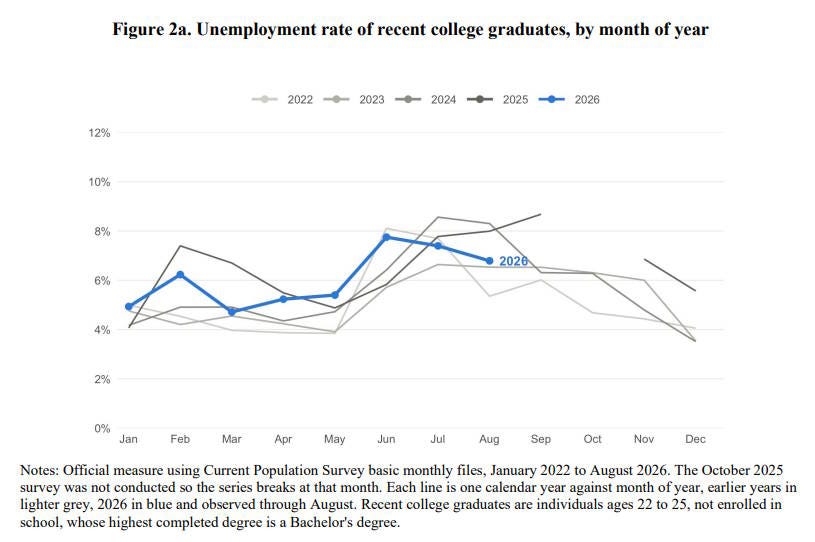
Our second item is a new paper from Fairlie and Wu, finding that AI hasn’t raised unemployment among recent college grads:
Using CPS microdata, we provide the first estimates of the effects of AI on the unemployment of recent college graduates in June, July and August 2026…[W]e find that unemployment rates did not spike in summer 2026 relative to summer months in previous years and did not rise in a significant way relative to older college graduates or young workers without a college degree. We also provide the first analysis of an expanded definition of unemployment that includes those who report “wanting a job” which adds nearly two percentage points to the unemployment rate of recent college graduates but we find no evidence of a statistically significant increase in summer 2026 even after adding these “sidelined unemployed.”
And here’s a chart:
So that’s all good news. Now for the bad news: I think I’ve finally found a category of jobs that is getting displaced by AI. Translator and trucker and radiologist jobs have all held up in the age of AI, but digital media jobs are getting absolutely clobbered (even as live performing art jobs have held up fine):
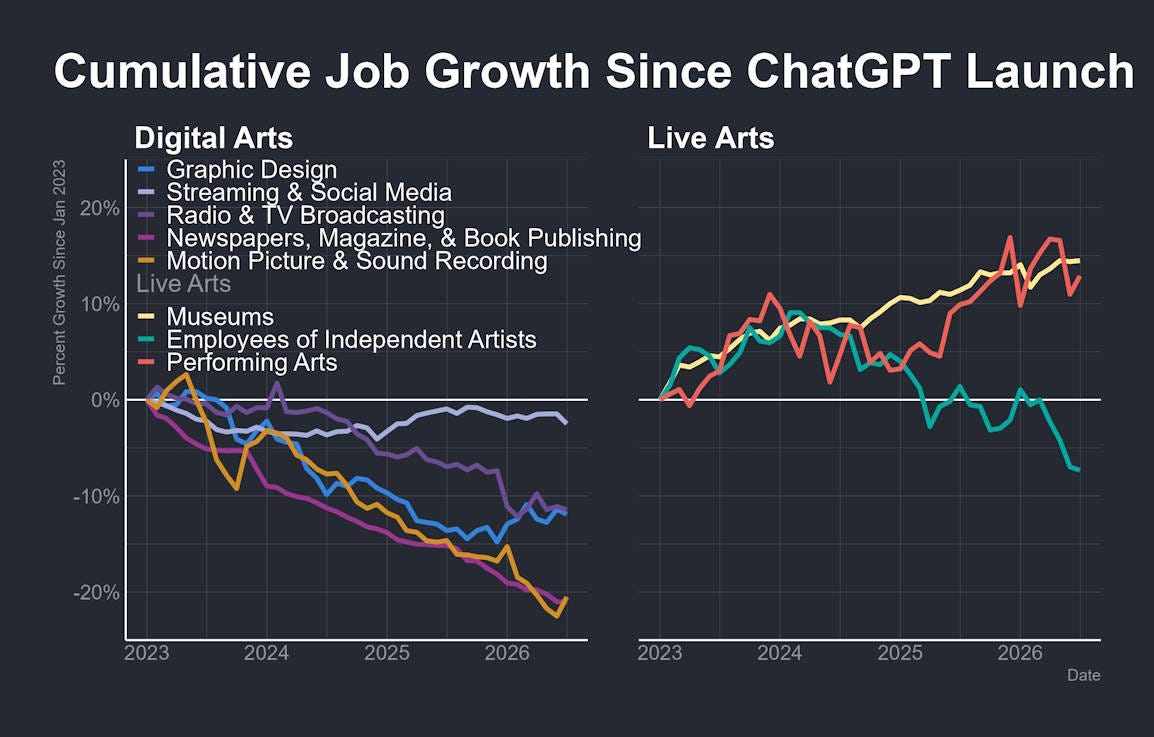
This isn’t necessarily cause for panic — every new wave of technology has reduced the demand for certain occupations. But digital arts jobs are a dream for lots of people — a way to indulge your creative side while also getting paid. If AI is closing off that particular combination of gainful employment and personal fulfillment for millions of people in advanced countries, that’s very sad — even if humans aren’t replaced wholesale.
5. Mass deportation isn’t helping native-born Americans find jobs
Donald Trump came into office with two basic policies — tariffs and mass deportations. The deportations were supposed to support the U.S. job market, freeing up jobs for the native-born, and raising their wages by reducing competition. Some of us always knew this was very unlikely to work, since immigrants are a source of labor demand in addition to being a source of labor supply. But the Trump administration never listens to folks like me, especially when immigration is involved.
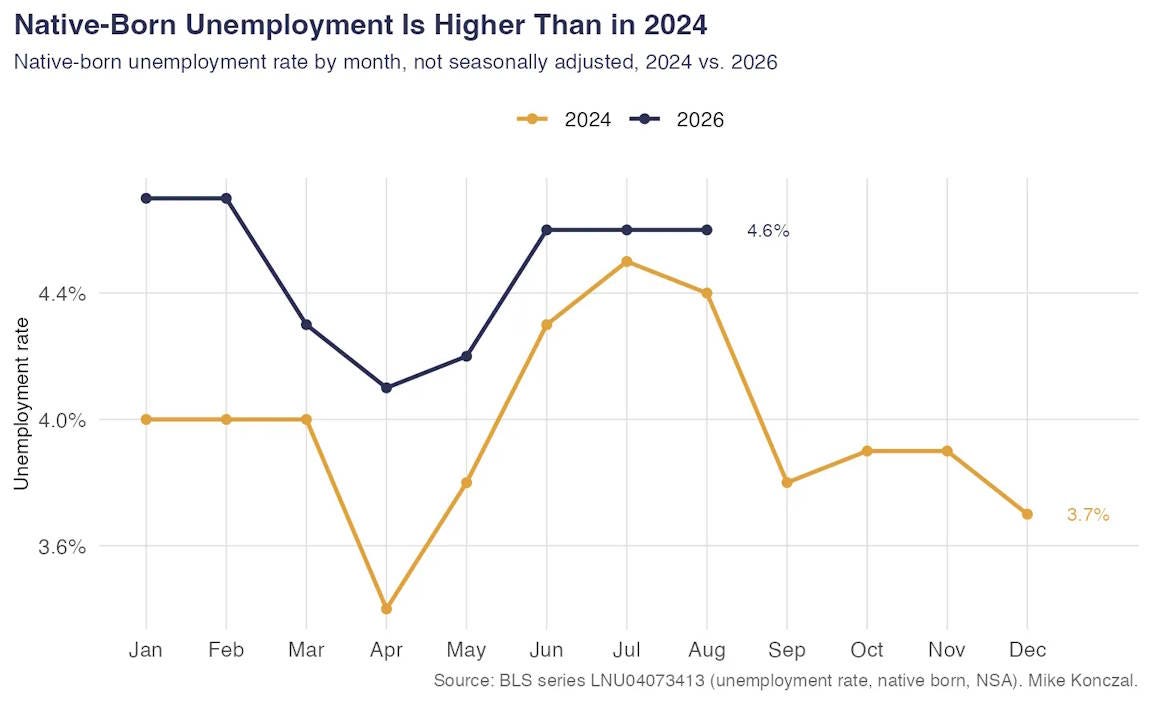
So anyway, are the mass deportations working as Trump had hoped? Mike Konczal has a post in which he presents convincing evidence that no, they are not:

Native-born unemployment is higher now than in Biden’s last year:
And prime-age employment rates are lower:
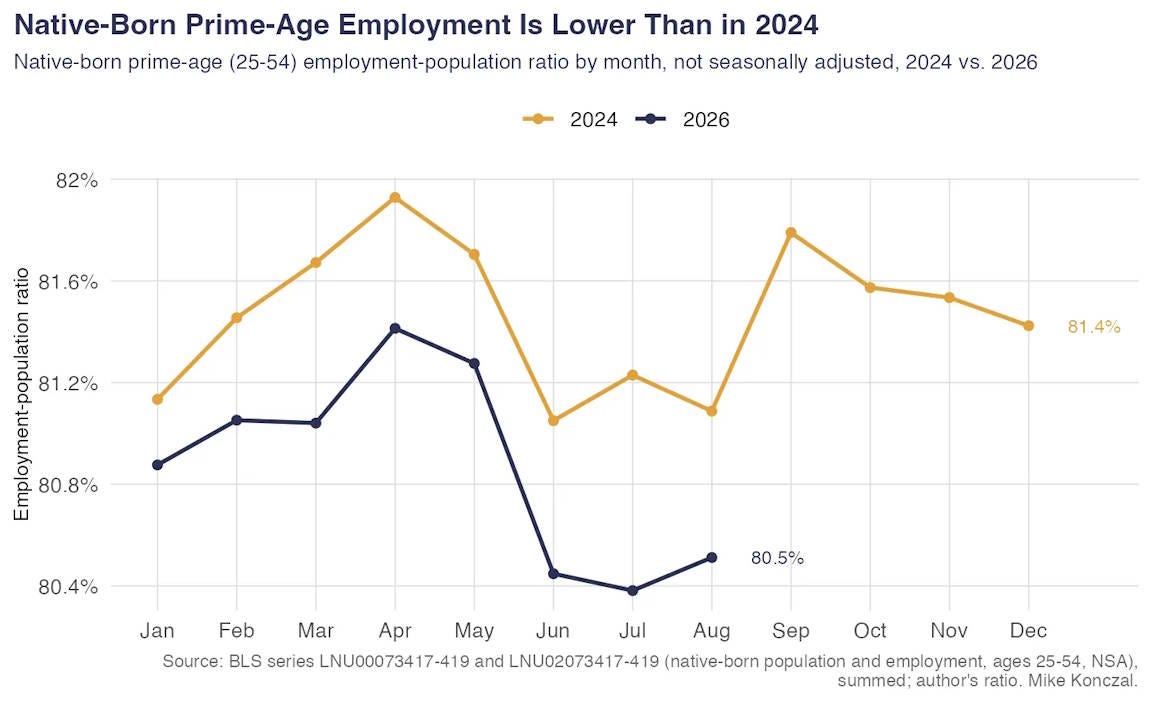
If anything, Konczal shows, native-born workers are doing worse in the places with more deportations:
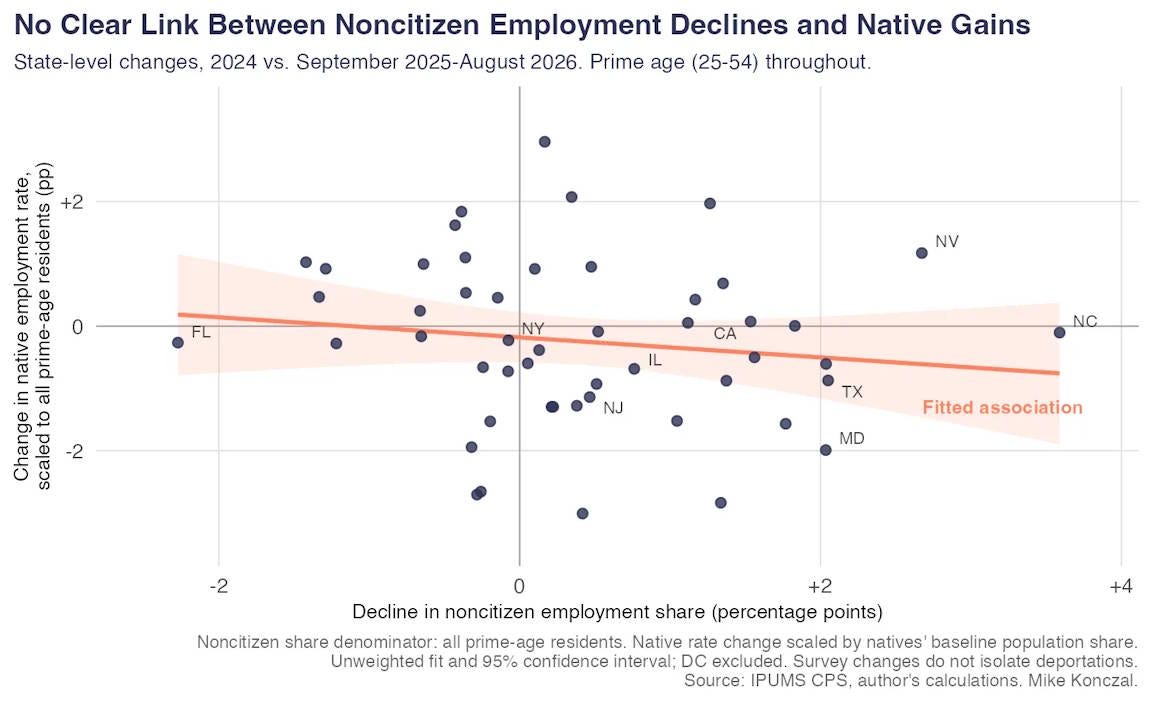
Anyway, Konczal has many more charts, and they all point in the same direction: Mass deportations have not helped native-born workers.
Of course, the real purpose of mass deportations wasn’t actually to help native-born workers — in fact, it wasn’t economic at all. But it’s still gratifying to see that basic economics was right and the Trump administration was overselling the benefits of immigration restriction.
6. Chinese investment stalls out
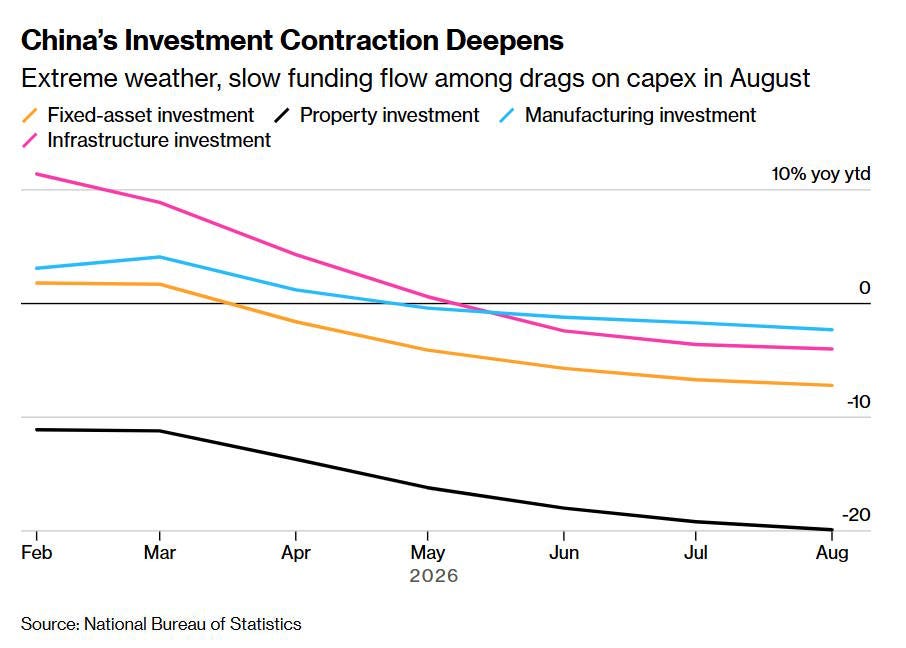
A week ago I wrote that China’s new economic model — basically, paying any and every company to manufacture more and more of the same products — was already hitting a wall. I pointed out that investment is now falling, even in the manufacturing sector:
I also noticed this recent chart showing rapidly decelerating loan growth in China:
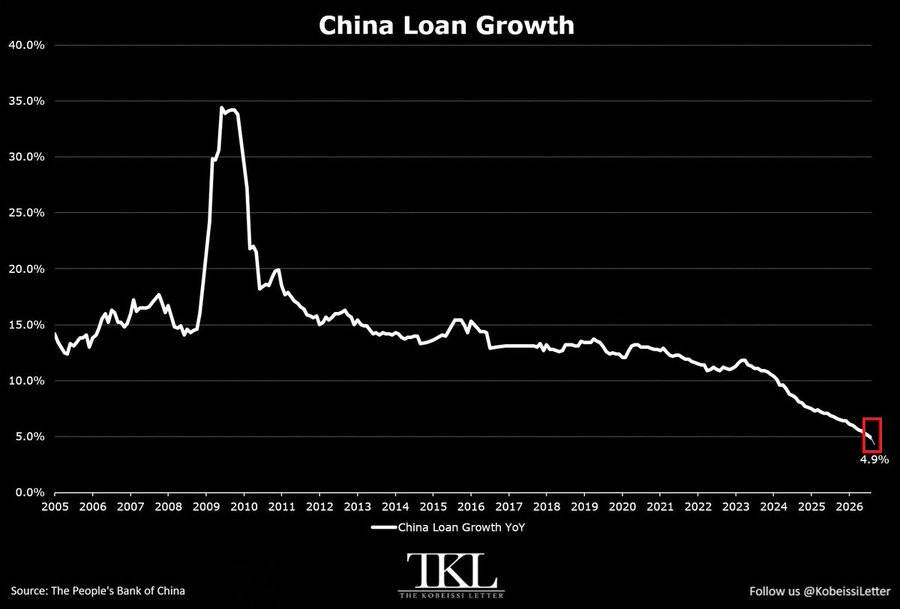
4.9% is around China’s total GDP growth rate.1 So this means that China’s economy is no longer being flooded with bank loans.
I’m going to write a post about this soon, but in a very real sense, bank loans are manufacturing. When you see a Chinese factory full of robot arms and fabulous machine tools, those were all financed with bank loans. If China’s banking system is no longer lending, that’s going to mean an investment slowdown. And unless AI picks up the slack with a very significant productivity boom, that means China’s growth will slow more.
A lot of people think of China’s banking system as an arm of the central government, but that’s not really true. While the central government does exert a lot of control over the banks, that control isn’t complete. And banks are very much in “balance sheet repair” mode right now, despite the government’s admonitions to hurl loans at manufacturing companies. ChinaTalk had an interesting interview with Rhodium Group’s Logan Wright, in which Wright argues that China’s financial system is fundamentally broken:


Wright says:
[I]t’s still underappreciated how central the financial system was to China’s growth over the past two decades, and how much the financial system’s problems now constrain that growth. Those are the parts that are broken…[I]f growth depends so much on the financial system, and the financial system now constrains growth, then a lot of China’s external messaging — that they’re economically successful and time is on their side — is simply wrong. It will become more obvious that it’s wrong.
The interview is very long and interesting, and I recommend reading it all the way through. But the basic argument is that although China’s state control of the banks allows them to avoid a financial crisis, it won’t allow them to avoid it for free — the price will be slow growth, zombie companies, and general economic sclerosis, a bit similar to what happened to Japan in the 1990s. I’ve been resisting that comparison for a long time, but it’s looking more and more apt.
7. Why I’m not as worried about AI cyber risk
I’m probably a lot more worried about AI bioterror risk than most people. But this isn’t just because I fear AI’s power in general. In fact, I’m pretty much not worried at all about cyber risk from AI — or maybe only very minimally worried.
Obviously, if AI-enabled hackers were able to cause massive blackouts during winter, or crash a bunch of cars, or zero out Americans’ bank accounts, that would cause a lot of chaos and destruction. But my instinct is that in the long run, the battle of hackers versus defenders ends up favoring the defense. The reason is that it’s probably possible to make any piece of software impregnable — if you just go over your code and very carefully remove all vulnerabilities, there’s just no way for a hacker to get in.
That means that as AI gets more powerful at reading, evaluating, and rewriting code, at some point the defense just wins. How long that takes, or how much money it takes, is another question, which is why I do think AI-driven cyberattacks are an issue — especially as AI-written code proliferates like wild, and AI capabilities temporarily overwhelm the security of human-written legacy code.
But it’s notable that although there have definitely been some AI hacking incidents — most famously the Hugging Face attack — there has been no major disaster or spectacular “9/11 of cyber” type attack yet. And the people at the labs seem pretty confident that the defense can eventually prevail:


This is why although cybersecurity makes an OK demonstration of increasing AI capabilities, and a good excuse to warn people about AI risk, it’s ultimately a lot less scary than, say, bioterror risk. Biology is different than code — the attack surface is far larger and far more poorly understood, and the consequences of a successful major attack are more dire.
Probably still a little higher, because the official growth rate is overstated.
Love these roundups.
But on the bioterror risk... I'm still not worried.
Your previous post imagined an 'extinction virus' that was (1) highly transmissible (2) had a long latent/asymptomatic period and (3) became much more deadly after enough time has passed that everyone is infected.
(1) and (2) are not compatible. To spread, you need viral copies (titer), and if you have copies, your immune system sees it and gives you symptoms. For airborne viruses, that means a runny nose. For GI viruses, it means GI symptoms.
One exception to the above is immune evading viruses (like HIV and similar viruses that live inside immune cells), but notably, they are only fluid transmissible. STDs can be highly transmissible, if you count that... but seem unlikely to reach 'everyone' and cause extinction.
(3) is also problematic. Viruses become less virulent and deadly over time, due to evolution favoring that. If rather, a 'time bomb' gene were placed in the virus, that was inactive until a later date, its likely that evolution/mutation would delete that timebomb before it could go off. Viral genome copying is very sloppy bc it needs to be... its not like computer code.
Could an ASI breed up a major pandemic virus... ofc. So could bioterrorists. YIKES! But an extinction virus... not really feasible IMHO.
So long as people have to interact with software, there will always be vulnerabilities, because people can be tricked.
Re: "if you just go over your code and very carefully remove all vulnerabilities, there’s just no way for a hacker to get in."