



One thing I’ve learned, in my time as a pundit, is that many people claim to have read books that they have not actually read. This is true of giant dense tomes like Thomas Piketty’s Capital in the Twenty-First Century, but also — perhaps surprisingly — true of light, quick reads like Ezra Klein and Derek Thompson’s Abundance. The text of Abundance is only 222 pages long, and the font is large. And yet none of the book’s progressive critics seem to have any idea what Klein and Thompson actually wrote. For example, Aaron Regunberg, a lawyer who has been on a crusade against the abundance movement, writes:
[Y]es, abundance is about defeating progressives and remaking the Democratic Party as a libertarian, Never Trump Republican Party. Great, can we stop pretending it’s anything but that?
This is, of course, complete nonsense. To believe that Ezra Klein and Derek Thompson are libertarians or Republicans requires never having read anything that either of them wrote (or at least, pretending not to have done so). But most importantly, Abundance is all about how the government should have more power to build green energy, provide health care, and accomplish other progressive goals. You can argue with that idea, but you can’t call it libertarian in good faith.
But my favorite example comes from David Austin Walsh, America’s favorite angry history postdoc, who said all kinds of nasty things about Abundance before admitting, quite openly, that he hadn’t actually read it:


The Abundance critics continue to do a remarkably poor job of engaging the book or the abundance movement in general on an intellectual level. In general, they tend to be poorly informed, lazy, and sloppy.
And those critics aren’t winning. At the elite level, Democrats are embracing the abundance idea, and there’s plenty of grassroots interest too. I recommend the recent excellent writeup in the Wall Street Journal by Molly Ball. Some excerpts:
Democratic politicians are rushing to embrace the new [abundance] mantra. New York Gov. Kathy Hochul, Minnesota Gov. Tim Walz, Maryland Gov. Wes Moore and Colorado Gov. Jared Polis have all name-checked it publicly. New Jersey Sen. Cory Booker discussed it at length in his recent 25-hour Senate speech. Former Vice President Kamala Harris and the U.S. Senate’s Democratic caucus are among the many politicians who have recently sought the authors’ counsel. Not one but two congressional caucuses have recently formed to push legislation advancing the ideas laid out in the book…
It isn’t just party elders who have bought into the idea. Local Abundance clubs have formed in multiple cities and on college campuses…The book by Ezra Klein and Derek Thompson has been a surprise hit, with a sold-out national tour, hundreds of thousands of copies sold and two months on the bestseller list since its release in March.
But a recent poll suggests that although there’s lots of interest in the abundance idea, the message is still less appealing than populist red meat. Although you might think a poll by some pressure group calling itself “Demand Progress” might be biased toward populist causes, I found the wording in the questions to be reasonably fair:
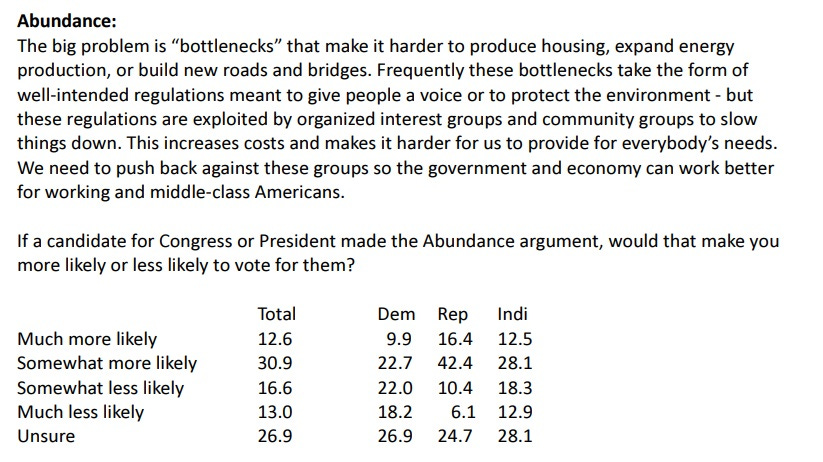
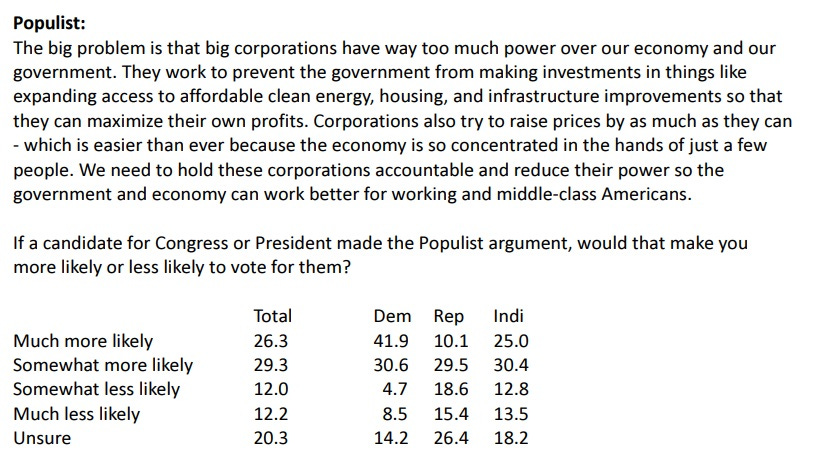
Could I write a new phrasing for the “abundance” statement in this poll that would probably get more support? Sure, of course I could. It would go something like this:
The big problem is that Americans don’t have enough of the basic necessities of life. We need more housing so people can have cheap rent, more health care so it doesn’t bankrupt us, and more energy so we can get to work and heat and cool our houses. We need a stronger, more efficient, more capable government, and we also need less of the burdensome regulations that stop everything from getting built. Only once everything gets cheaper will this economy really work for middle-class and working-class Americans.
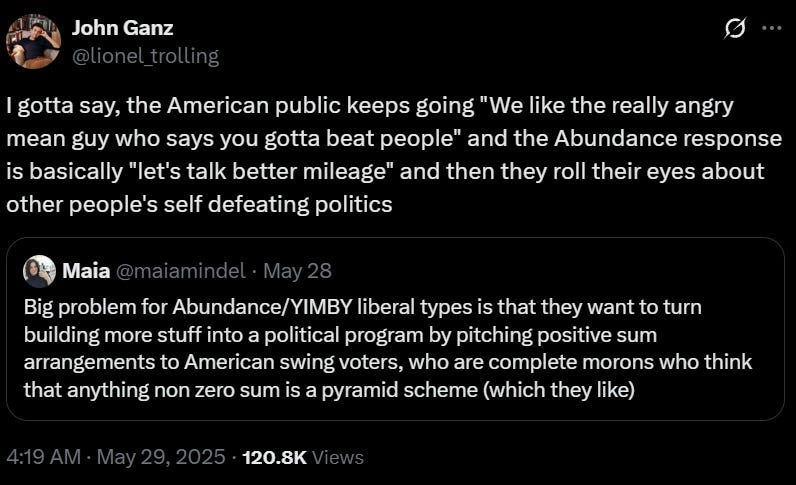
I bet that would get at least marginally more support than the somewhat academic wording in the poll. But the fact is, the “populist” statement was unambiguously popular with Democrats and Independents. Americans want to have a villain, and they want to get mad. This tweet by John Ganz is snarky, but it’s not fundamentally wrong:
When Obama won the presidency in 2008 — the most decisive presidential election victory of the 21st century so far — he offered sunny optimistic “hope and change”, but he also ran on anger and outrage against the Iraq War and the financial crisis.
To win power in America, you have to make people want to “throw the bums out”.
A couple of people have recently asked me to give my advice on how the Democratic party can be remade along more abundance-friendly lines. Well, I’m no political strategist or consultant, so take my advice with a grain of salt. But my instinct is to say that the abundance liberals need to get mad. And they need to get mad not at progressive NIMBYs and pressure groups, but at Donald Trump and the MAGA movement.
When Joe Biden was in power, “the groups” were indeed an impediment to the progressive agenda — and to American prosperity. But Joe Biden is no longer in power, and so the nature of the threat has changed completely.
Right now, Trump is trying to put massive tariffs on everything that American consumers and American manufacturers buy from overseas. In response to complaints that this will make Americans poorer, Trump has told people to suck it up and make do with a life of scarcity:
Donald Trump on Wednesday acknowledged that his tariffs could result in fewer and costlier products in the United States, saying American kids might “have two dolls instead of 30 dolls”, but he insisted China will suffer more from his trade war…“You know, somebody said, ‘Oh, the shelves are going to be open,’” Trump said, offering a hypothetical. “Well, maybe the children will have two dolls instead of 30 dolls. So maybe the two dolls will cost a couple bucks more than they would normally.”
And his Treasury Secretary also told Americans that consuming less will make them happier:
Bessent, in an appearance on Fox News’s “The Ingraham Angle,” defended Trump’s recent suggestion that the U.S. needs a cultural shift on consumer spending. He argued that because of the rising cost of goods due to Trump’s sweeping tariffs, children in the U.S. could have an improved life in the long term, a subtle dig at overconsumption…Trump and top officials in recent days have changed their tune on the economy, suggesting Americans should buy less and will probably pay more as a result of the tariffs.
This should be an easy message to run against. “Trump and the Republicans want you to have less; we want you to have more! How dare Trump try to take away your daughter’s dolls?!” What American isn’t going to nod their head to that message?
And yet the progressive faction that has gone into frantic defense mode against abundance liberalism has basically refused to take up that message. Instead, they focus all their fire on “oligarchy” and “monopolies”. I’m all for robust antitrust, but is this really the time to tell Americans that their true enemies are Facebook and Google, instead of Donald J. Trump? When Trump is out there telling people to give their kids fewer toys, is it really time for Dems to go all-in against…Kroger and Wal-Mart?
In fact, as I wrote two months ago, progressives have been startlingly reluctant to denounce Trump’s tariff regime. Bernie Sanders criticized the tariffs, but in a sedate and nuanced way that lacked his usual populist fire. Some Democrats even praised tariffs in general, criticizing Trump only on the manner of his implementation.
If that’s going to be the Democratic message against Trump in 2026 and against Trump’s successor in 2028, it’s going to be a disaster. Progressives managed to summon some “anti-oligarchy” fire when Elon Musk was running around tearing up the civil service. But now Elon is out of government and out of favor with Trump, and tariffs have moved to center stage. And Americans are justifiably angry about those tariffs. We are not a people who likes to be impoverished in the service of some ideological project. Tariffs are the reason Trump’s approval ratings are significantly lower than they were in March.
If you can’t fight Trump on tariffs, what can you fight him on?
The abundance movement is perfectly positioned to raise its battle flag against Trump. MAGA has morphed into a rightist echo of Europe’s degrowth movement — a farrago of ideological nonsense that tells you that your kid has to be poor because otherwise capitalism will steal your soul. It’s like Jimmy Carter’s “sweater speech” in 1977, but much much worse — instead of environmental responsibility and energy conservation, Trump is telling us to consume less simply because he thinks trade is icky. This is the exact antithesis of abundance, and it’s folks like Ezra Klein who need to be leading the charge against it.
Furthermore, most of what Trump is doing to attack the progressive economic agenda is also an attack on abundance. Trump is canceling EV credits and solar subsidies, because he thinks the energy technologies of the future are hippie nonsense. This isn’t just going to throw workers in red states and purple states out of a job; it’s going to mean higher electricity bills, especially in states like Texas and Iowa that have been going big on renewables. Republicans in Congress are preparing massive Medicaid cuts, which will result in more expensive health care. Trump’s cuts to federal research will mean fewer life-saving medical treatments for Americans in the future. Trump’s zeal to mass-deport immigrants has the potential to raise grocery prices. And so on.
Trump is the anti-abundance President. Which means that abundance liberals need to train their fire on Trump, rather than spending all their time snarking at progressive critics who didn’t read their book. No, the progressive critics didn’t read the book, but pointing that out won’t make abundance liberalism the standard-bearing ideology of the Democratic party.
What will make abundance liberalism the standard-bearing ideology of the Democratic party is to take the lead in the fight against the party’s external enemies. This is what Barack Obama did in 2008 — he won the primary against Hillary Clinton primarily because he, instead of Hillary, became the avatar of Democratic anger against the Iraq War. But becoming the standard-bearer doesn’t always mean putting hot-button wedge issues front and center — candidates who emphasized deficit reduction and middle-class prosperity dominated the 1992 Democratic primary, because this was the most effective line of attack against George H.W. Bush.
Abundance liberals can also take a page from history here. The progressive movement of a century ago focused on bringing costs down for average Americans. Fighting monopolies and trusts was part of that effort, for sure. But so was reducing tariffs. Bob La Follette crusaded against tariffs, and the progressive muckraker Ida Tarbell — depicted at the top of this post with lasers shooting out of her eyes — wrote a whole book about why tariffs are bad.
Sunny optimism and wide-eyed futurism, of course, has its place. This is what Ronald Reagan employed in 1984, with his “Morning in America” ad. But Reagan was running for reelection, not trying to overthrow the existing power structure; he had already done that four years earlier. In 1980, Reagan harnessed anger against the scarcity of the Carter years — the inflation, the high interest rates, the seeming acceptance of permanently expensive energy. He ran as an angry abundance candidate, and won a crushing victory.
Now of course that doesn’t mean that abundance liberals should — or will — push Reaganesque policies! Bringing tariffs down and cutting regulation of the private sector will be part of their agenda, sure. But the centerpiece of abundance liberalism is stronger government — a government that has the capacity to push through major expansions in housing, energy, transportation, health care, and so on. Like the original progressive movement, abundance liberalism seeks to use big government as a tool of human welfare.
But in any case, the basic point here is that abundance needs to go on the attack against Trump. Republicans have gone all-in on the idea that Americans need to learn to live with less. “Antimonopoly” progressives want to fight this with price controls and rent control, but Americans are justifiably skeptical of this solution — and Trump will just co-opt those ideas anyway, as he co-opted tariffs and degrowth from the left. Only abundance liberals are perfectly positioned to lead the charge against Trump’s mad economic schemes. It’s time to bring out the rakes and pitchforks.
There are plenty of moderate erstwhile Republicans like me who have a fondness for Reagan but who are nevertheless enthusiastic about having a government that can actually do stuff. We’re old and no longer libertarian extremists and don’t hate poor people. We’ll happily vote for a Democrat that says sane, responsible things about the economy and doesn’t push culture war.
You may not be a political strategist, but you are singing the same tune as the ones I read. Sarah longwell says democrats need to be less PROgressive and more AGGressive.