

I grew up in the 1980s in a small house with only one bathroom shared between four people. The floor was linoleum. There was a carport instead of a garage, and we had one beat-up used Toyota Tercel hatchback. I don’t remember when we got our first color TV, but when I was young we had a black-and-white one that my grandmother gave us. Our furniture was all second-hand and we kept the couches covered up with worn old blankets.
When I was young, I mowed lawns for money. As a high school kid, I signed up to pick cotton by hand (!!) for an agricultural research project at Texas A&M University, for minimum wage1. I have also worked as a cashier. Twice in my life, I have been a member of a labor union, and I have marched in a strike.
I have never once considered myself part of the working class.
Why not? Because I have never thought of class as being defined by a present snapshot of someone’s lifestyle or material circumstances. Instead, I always thought of class as being about someone’s potential. And I grew up always knowing that my economic potential went far beyond the rather humble circumstances of my early childhood.
For one thing, my family was upwardly mobile. My grandparents could probably be called “working class” in their youth — my grandmother worked in a sweatshop as a teenager, my grandfather wore cardboard in his soles because his family couldn’t afford shoes. But after World War 2, thanks to the GI Bill and rapid economic growth, my ancestors advanced into the middle class, with jobs like optometrist, athletic coach, and registered nurse. My father had a PhD and a tenure-track academic job that promised to pay a lot more after a decade of work. We weren’t rocketing up the income distribution, but we were clearly climbing.
Our humble lifestyle in the early and mid 1980s reflected this future orientation. Our family income was probably around the 35th-38th percentile,2 but this was because we were a one-earner family. My mother chose to spend the first seven years of my life as a housewife — which she did in order to make sure my sister and I got a thorough, accelerated education. We lived an abstemious life in part because we saved as much money as we could.
What were we saving for? My college education, and my sister’s. We were smart kids; we knew we would go to good schools, and we did.3 We knew our college educations would allow us to get good jobs that paid more than our parents ever made. And we were right.
As for the union membership, I was part of the grad student instructors’ union at the University of Michigan, and the professors’ union at Stony Brook. When I marched in a strike in 2008 to secure a raise and health benefits, I was already getting paid to complete a PhD that would eventually increase my earning power even more. Even as I scarfed free food from charcuterie boards at departmental events to save money, I was building up my future earning power at a rapid clip.
Class in some countries is about the past; you can be a shabby aristocrat if your grandfather was the Earl of Whatevershire. In American policy discussions, class is often implicitly about the present — where you lie in the income and wealth distributions this year. But on some level, everyone knows that class in America is really about the future.
Milton Friedman had a theory that sort of gets at this idea, in fact. It’s called the Permanent Income Hypothesis. “Permanent income” is the income you can expect to make over the course of your life. If you’re a shabby grad student living off of cup ramen, your current income is low, but your permanent income is high, because you know you’re probably going to make a lot of money in the future.4
But class in America isn’t just about the money you will make in the future; it’s about the money you could make if you wanted. I know schoolteachers who live modern middle-class lifestyles despite having graduated from the best schools in the country. They could have gone to work for companies and made decently big bucks, but they preferred a more laid-back lifestyle. Whether their children should count as middle class or upper class is an interesting question, but they themselves are clearly the American equivalent of Europe’s shabby aristocrats, because they forsook the upper-class lifestyle voluntarily.
Meanwhile, there are millions upon millions of Americans for whom working in high-paying salaried jobs was just never an option, and never will be. They will spend their entire careers driving long hours in a truck, or stocking shelves at a store, or installing smoke alarms in people’s houses, simply because this is the best they can do.
This explains at least part of why most low-income Americans traditionally consider themselves middle class. They expect to be middle-class at some point; they don’t think they’ll be trapped driving a truck or stocking a shelf forever.5 And it could also explain why the number of Americans calling themselves “lower class” rose in the 2000s and 2010s, as growth in incomes temporarily stagnated and the potential for rapid downward mobility became clearer after the financial crisis:
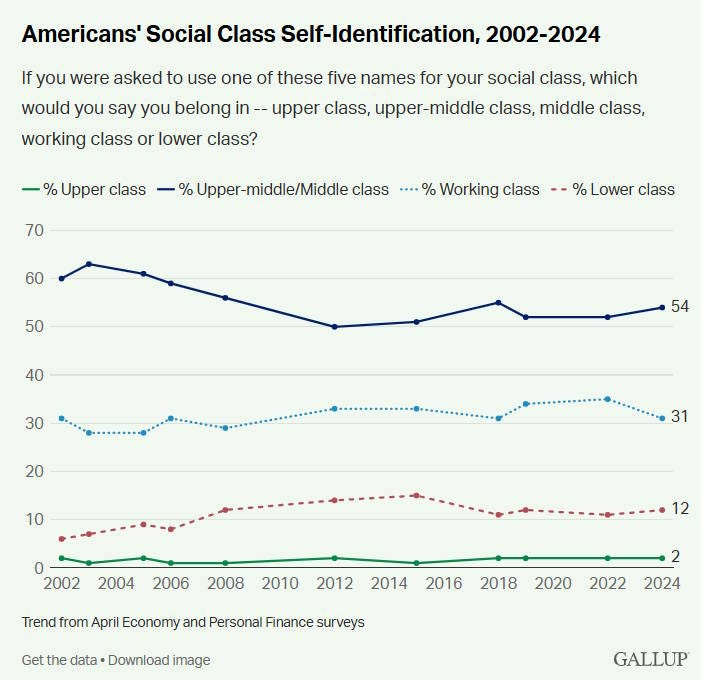
I’m being very approximate here, of course, and I’m speaking for the country more than I probably should. In fact, America has less class consciousness than many other societies, and when we do talk about the idea, there’s rarely agreement on what it should mean. I wrote about the contested nature of class in American society two years ago:

But I’m speaking from my own personal experience because I think it illustrates something important about class in America. Although we disagree about what the concept should mean, most of us feel deeply uncomfortable with a notion of class that ignores future possibilities. When we see a guy proudly wear a United Auto Workers jacket even though his only UAW experience was as a grad student instructor at Harvard University, something about it feels deeply inauthentic:
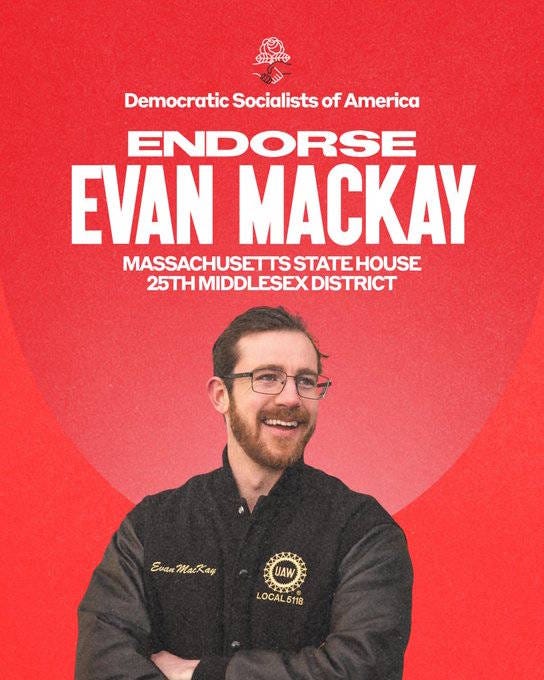
There’s nothing wrong with this, of course. It’s not fake; the UAW really does include grad student unions these days. And MacKay could easily be doing this not out of rank political opportunism, but from a sincere desire to express solidarity with union workers from all walks of life.
And yet Evan MacKay is really not in the same boat as people who stand on an assembly line, even if those people make more money than he does. He could, if he wanted, go work in private equity and live in a mansion on Cape Cod. Your typical UAW member could not do that. There’s a sense in which his jacket’s implicit claim of “we’re all in this together” papers over that harsh reality.
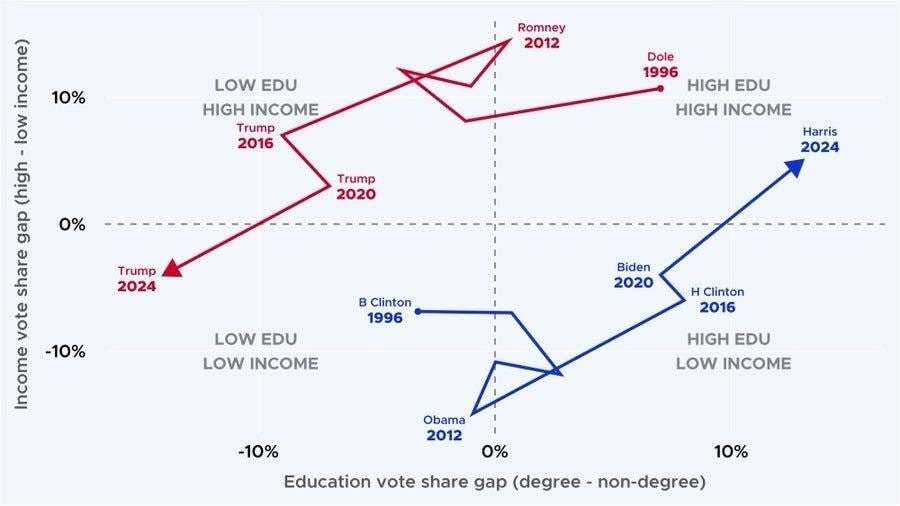
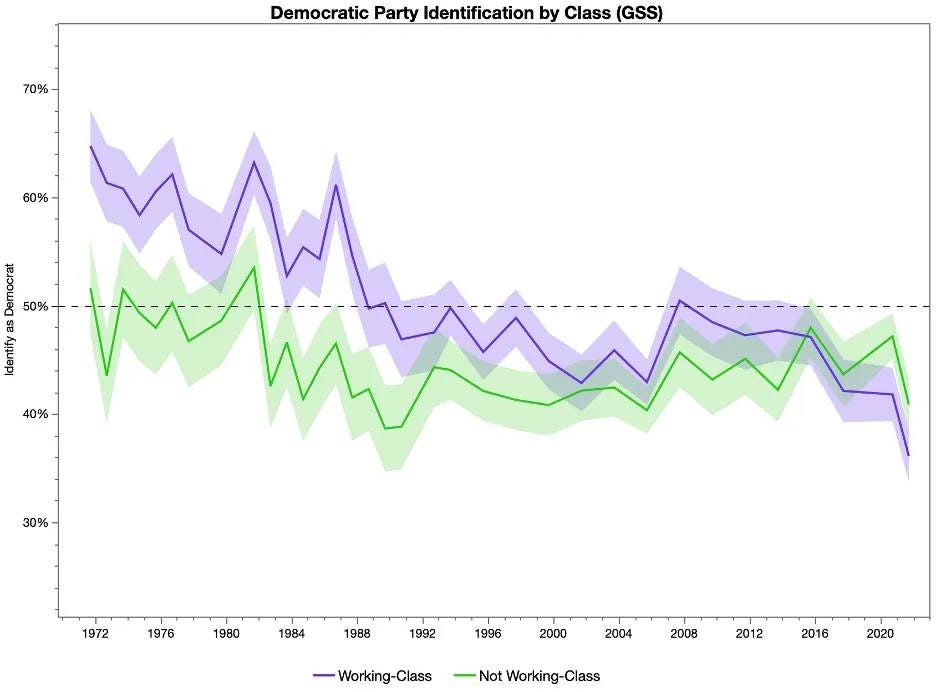
Progressives have had an extremely tough time appealing to Americans with low incomes and low education levels. Decades ago, those people tended to vote for Democrats; in 2024, they broke solidly for Donald Trump. Even as they’ve become more and more progressive, the Dems have become the party of well-educated high earners:
Even people who identify themselves as “working class” have been abandoning the Democrats:
Joe Biden tried very hard to win over labor unions, but the Teamsters — once a Democratic stalwart — refused to endorse him.
The socialist faction might style itself a friend of the working class, but it faces the same problem. Zohran Mamdani won his mayoral race thanks to the support of higher-income, educated voters, while his defeated “establishment” opponent did better with lower-income people, Blacks, and Hispanics. Other socialist victories have seen a similar pattern.
This is not actually a new problem. A century ago, in The Road to Wigan Pier, George Orwell complained bitterly that the British socialists of his day were middle-class intellectual elites who failed to win over the working class because they were completely out of touch:
The first thing that must strike any outside observer is that Socialism, in its developed form is a theory confined entirely to the middle classes. The typical Socialist is not, as tremulous old ladies imagine, a ferocious-looking working man with greasy overalls and a raucous voice. He is either a youthful snob-Bolshevik who in five years' time will quite probably have made a wealthy marriage and been converted to Roman Catholicism; or, still more typically, a prim little man with a white-collar job, usually a secret teetotaller and often with vegetarian leanings, with a history of Nonconformity behind him, and, above all, with a social position which he has no intention of forfeiting. [emphasis mine]
Half a century later, Barbara and John Ehrenreich wrote something similar about the American left in their essay on “the professional-managerial class”. The “PMC”, as it has become known, was beginning to dominate the political left even in 1977; today, it arguably forms the Democratic Party’s most important voter base. The DSA faction that’s now becoming more influential within the party is disproportionately drawn from this class — 80% of DSA members had college degrees in 2021, and more than a third had postgraduate degrees (more than twice the national average).
Although they might not have realized it, what the Ehrenreichs were describing was a result of the rising economic importance of human capital. The “youthful snob-Bolshevik[s]” Orwell described in the 1930s were few in number, but the growth of knowledge industries has made this group of people far more numerous — and far more influential in our culture and our politics.
Because of its Marxist inheritance, the idea of the working class is very important to American socialists. But that’s been increasingly hard to square with the fact that voters with lower income and lower education have been steadily drifting away from the Democrats, and form relatively little of the DSA’s membership. One response has been for some socialists to paint themselves as the actual working class. This is a less charitable interpretation of Evan MacKay’s UAW jacket, and it’s also something that has come up in casual conversation. This is from my post back in 2024:
In January 2017, I was at a house party in Berkeley. People were discussing why Hillary Clinton had lost to Donald Trump, and one woman — a law student at the University of California — declared that it was because Clinton had ignored the “working class”. I asked her to describe someone in the working class. She imagined a “sex worker” who had a bunch of student loans and a humanities degree that she wasn’t able to use… I had expected her to describe a unionized auto worker or steelworker or a stereotypical Midwestern guy in a hard hat,…I was utterly unprepared for her to instead describe someone from her own educated progressive social circles…To this law student, the “working class” was simply those of her friends who were most down on their luck.
But on some level, I think this just doesn’t ring true, even within socialist circles. Class in America is just too deeply connected with earning potential and human capital; most people can’t really bring themselves to believe that someone with a diploma from a good school is “working class”, even if they happen to be pulling an unlivable wage as an adjunct professor and sleeping in their car at the moment.
So socialists are always on the lookout for champions who seem more authentically working class. They thought they found such a champion in Graham Platner, who recently dropped out of his Maine Senate race due to rape allegations. This is from a New York Times story about how Platner was recruited:
Last July, in a small town in coastal Maine, three progressive, self-styled recruiters of economic populists showed up at the blue-shingled house of Graham Platner, a little-known oyster farmer and Marine veteran who lived largely off government benefits…They knew his name from local labor organizers and activists, and they had watched a video on the internet of him talking about oysters. Struck by his left-leaning ideology, his working-class affect and his gravelly voice, they became convinced that he could win a Senate seat in Maine — and quickly persuaded Mr. Platner of the same…The recruiters — Dan Moraff, Leanne Fan and Morris Katz — told Mr. Platner he was “the one,” a “hero of the movement,” “a historical figure” who could be “leading a revolution,” according to half a dozen people with knowledge of their conversations.
Is Platner actually working class? You can argue it either way. He went to a good college but dropped out due to psychological issues. He’s the son of a lawyer and an architect, but failed to make much money with his oyster farming business, and mostly lived on welfare benefits. He doesn’t fit cleanly into the kind of class categories I described above.
But the people who picked him do! Dan Moraff and Morris Katz are both educated scions of rich families — Moraff’s ancestor founded the company that became Toys “R” Us — while Leanne Fan is a sociology PhD student. If the NYT’s reporting is correct, they appear to have picked Platner based entirely on stereotypes and vibes — he seemed rough and tough and down on his luck, so they assumed he was a real working class guy who could connect with other working class guys. This seems to have convinced them that Platner was a messianic figure who could bring wayward working-class voters back to the Democratic fold.
As many people have said, if Trump is “a poor person’s idea of a rich person,” Platner is basically the opposite — a rich person’s idea of a working-class person.
This episode doesn’t make me particularly optimistic about Democrats’ ability to reconnect with their rapidly vanishing blue-collar base. I don’t think it’s impossible, of course. But it would probably require moderating on social issues — DEI, immigration, etc. — instead of just running candidates that pattern-match to the kind of people that bullied rich lefty kids back in junior high.
The Platner saga also makes me a bit pessimistic about American society as a whole. Although we don’t talk about class much, it’s separating us more and more, and the cultural gap is now so big that lots of Americans seem unable to even imagine what Americans from other social classes are like.
The integrating institutions that once pushed us together across class lines — church, the military, schools in mixed-income neighborhoods — have waned in importance. College has grown to fill some of that void, but less than half of the country is really prepared to handle the rigors of a college education, and so it ends up dividing our society more than it unites it. Mass media has fragmented into the millions of little social verticals that make up the internet. We’ve sorted ourselves geographically — knowledge workers live together in progressive urban enclaves on the coasts, while blue-collar types inhabit the small towns and down-market suburbs.
I read Tocqueville, and I miss the roiling, fluid, egalitarian young democracy that I never knew. I think back to my childhood, in a little house on a dusty side street in a small Texas town, and I feel like I can just barely recall the fading embers of that stubbornly classless democracy. Something happened between then and now. We let the Old World sneak up on us.
In case you’re wondering what picking cotton by hand is like, it sucks. Other than my teenage friends and myself, the only people willing to do it were illegal immigrants from Mexico. Working alongside illegal immigrants, knowing that it was just a summer experience for me but would be their job for the rest of their life, gave me a deep respect for illegal immigrant laborers. Yes, they violated my country’s sovereign border, but they did it so that they could do backbreaking low-paid menial labor for their whole lives, just to feed their families back home. And they worked harder than my friends and I did, even knowing that their future would probably never get any better than that. Those are the people whose lives of backbreaking labor put cheap food on your table.
For households, it was more like the 45th percentile. My dad’s salary was almost twice the median personal income of the time. Part of the reason my childhood sounds a bit shabby is that the whole country was a lot poorer back then; one-bathroom houses without garages weren’t so unusual.
I went to Stanford; my sister got into Harvard but turned it down to go to the University of Michigan, because of my family’s quixotic belief that public schools are good. That turned out to be a very expensive decision on her part; Stanford, with its incredibly generous need-based financial aid policies, charged me zero tuition, while my sister had to pay out-of-state tuition despite a merit scholarship. Fortunately, my family had saved money, and so was able to pay for my sister’s college without making her take out student loans.
Friedman’s hypothesis turned out to be wrong — he thought only permanent income mattered for consumption, but it turns out that temporary ups and downs matter too. But expectations of future income are a factor that determines people’s current behavior, so Friedman’s intellectual effort wasn’t wasted.
For the upper-class and rich people who identify as “middle class”, it’s probably more of a combination of A) humility/social desirability bias, and B) the fact that they’re comparing themselves to other rich people in their social circles.
"The integrating institutions that once pushed us together across class lines — church, the military, schools in mixed-income neighborhoods — have waned in importance."
Noah, I'm quite a bit older than you, 63, if I might give two huge integrating institutions in the 1960's and 70's; entertainment and news. In the 1970's almost everyone had a local newspaper subscription. You needed one well before then internet just to know the sports news and movie schedule, and local sales and coupons. But even if you had no interest in the news, you could not help but be exposed to reality based news just picking up the newspaper from your porch and seeing the headlines -- and it was pretty much all reality based. Almost no one got their news from Orwellian Republican sources. Whether you had The Detroit News, The Arizona Daily Register, or The Los Angeles Times, it was all reality based. We all shared the same basic facts, and that was also true whether you watched anchors Joe Glover and Robbie Timmons on ABC channel 7 in Detroit, or Walter Kronkite at the national CBS Evening News.
And we all watched the same three networks for TV shows. Almost Everyone watched the Fonz and Archie Bunker. Even music had just a very limited number of radio stations. People of an age group really shared that. It was not fractured into a hundred different boutique musics.
Great article; i found myself perfectly described. I think it is (past) time for Democrats to stop grouping people by class, just like Republicans have rejected (if somewhat hypocritically) grouping people by race. Democrats should be campaigning on their namesake: democracy — their view of the purpose and basis of government. That is legitimate, classless, raceless, and foundational for our country. It means our focus should be on teaching, explaining, and promoting those ideas, and the voters will follow. The DNC should be the marketing agency for democracy.