

For perhaps the first time in years, a truly interesting thing happened the other day on X. The platform began automatically translating Japanese tweets to English, and recommending them to English-speaking users. Japanese people use X at much higher rates than people in other countries, mostly because the platform’s pseudonymity offers them a chance to comment publicly on their personal lives without revealing their real identities. Because it’s mostly a platform for personal use, it’s much less toxic than the English-speaking version, which is mostly used for political arguments.
English-speaking X users were naturally delighted at the influx of sanity and normalcy, not to mention the delights of quirky Japanese online culture. I predict this honeymoon will last only a short time, until Anglosphere culture wars infect and overwhelm Japanese-speaking X. This will be the digital version of the tourism boom, in which international delight at being able to travel cheaply and easily to Japan has resulted in an epidemic of bad behavior and the complete overrunning of tourist hotspots like Kyoto and the west side of Tokyo.
But glum predictions aside, it is pretty magical for people in other countries to get a taste of Japanese culture without having to learn the language. Yes, many of the stereotypes of Japan are either exaggerated or just plain wrong — it’s not very conformist or collectivist, people behave well much more out of internalized “guilt” than externalized “shame”, and so on. But there really are quite a lot of unique and interesting things about Japanese culture, most of which developed behind the barrier of linguistic and geographic isolation. Now that those barriers are falling, a lot of people will get to experience the wonder before it, too, is subsumed by the homogenization of global online culture and ruined by flame wars between rightists and leftists.
But anyway, in honor of this moment of cultural exchange, I thought I would share some of my own personal observations of how Japan has changed over the last two decades. I first moved to Japan almost 23 years ago, and even though I haven’t lived there for a while, I try to spend at least a month out of every year in the country if I can.
Over that time I’ve seen a few things remain startlingly constant — my favorite neighborhood sushi shop from 2004 still serves the same excellent crab salad. But a whole lot has changed; though many people overseas (and even a few unobservant long-term residents) tend to think of Japan as a static, unchanging society, the truth is that in some ways, the country feels unrecognizable.
Three years ago, I wrote a post about some of these changes:

In fact, this post only scratches the surface, so I thought I should write a deeper dive. Here’s a list of some changes I’ve noticed in Japan’s society and its built environment since the mid-2000s. Keep in mind that I’ve spent most of my time in Japan in Tokyo and Osaka, so this account will leave out many of the changes that have happened in smaller cities and rural areas.
If there’s one way to summarize these changes, it’s that Japan is becoming a much more normal country than it was when I lived there. The quirky art culture, vibrant street scenes, and mosaic of small independent businesses that defined 2000s Japan are vanishing under the relentless assault of aging, economic stagnation, and social media. Japanese people have started dressing down, and their waistlines have begun to expand. But at the same time, Tokyo has become a sort of enchanted spaceship of a city, with world-beating food scenes and architecture. And Japan as a whole has become more international and open, less sexist, and less soul-crushing of a place to work.
The whole country feels poorer, even though it isn’t
Japan feels like a poorer country than it did when I lived there, but this is actually an illusion; it’s actually slightly richer:
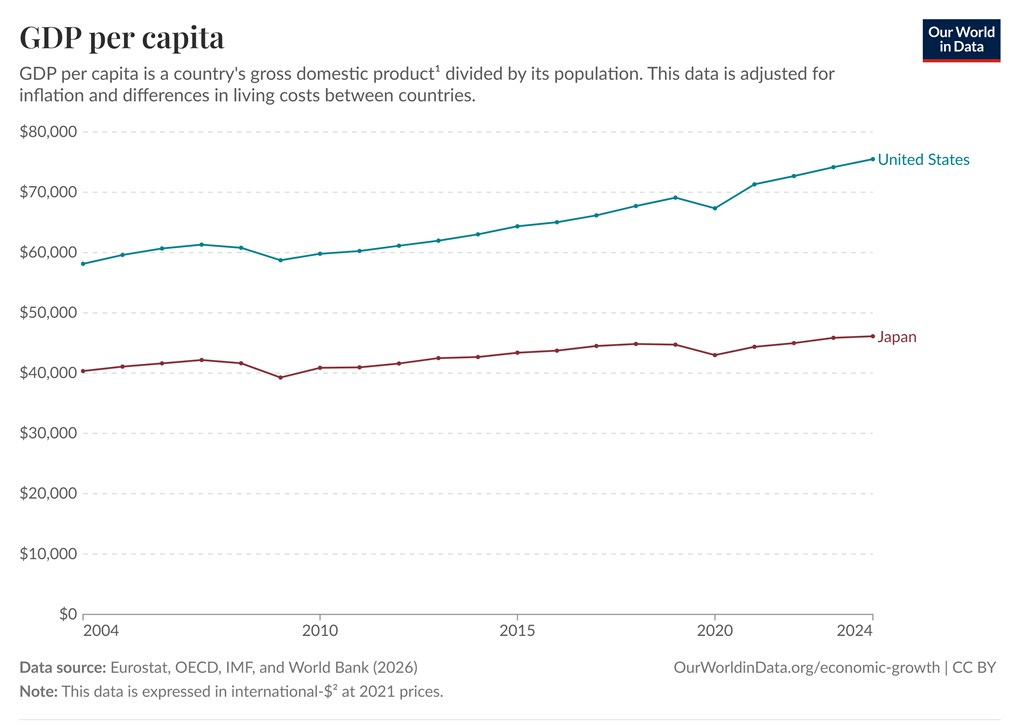
One difference is that my standards for what counts as a comfortable standard of living have crept up, due to America’s own more rapid rate of growth since the mid-2010s — and possibly from my own income growth over that same time period. Twenty years ago, for example, the cheap quality of Japanese furniture didn’t seem that different from the more comfy but dilapidated American version; now, Americans (and my social circle) tend to have nicer and newer furniture, while Japanese furniture basically hasn’t changed.
Another factor is the depreciation cycle. In the early 2000s, Japan was just coming off of a decade-long construction boom — some of it engineered by the government in an attempt to fill the hole in aggregate demand left by the country’s “lost decade”. A lot of building facades and train stations that looked shiny and perfect in 2004 now look a little weathered and dilapidated, despite Japan’s tendency to spend a lot on maintenance and upkeep. This doesn’t mean those buildings and infrastructure function any less well than they did when they were new, but the slow depreciation creates the subtle illusion of a shabbier country. (This will, of course, be an even more pronounced phenomenon in China in the 2030s.)
A third factor is the weak yen. When I lived in Japan for the first time, a dollar was worth only about 100 to 120 yen; now it’s 160. Foreigners can really live like kings here now, thanks to the exchange rate. That makes the locals feel poorer in comparison.
Yet another subtle change is that fewer young Japanese people live with their parents than they did two decades ago. The “parasite singles” of 2004 were able to live nice lifestyles while working only a low-paying or part-time job, or even not working at all, because their parents’ high incomes and stored-up savings were footing the bill. Now, with that wealth having largely run out, and with the high-earning Boomer generation having retired, you don’t see as many young people able to afford international vacations, designer handbags, and so on. (Luxury brands have proliferated, but this is more due to population aging and the tourism boom.)
There are other factors creating the illusion of Japanese poverty, which deserve their own separate sections. These include aging, the expansion of paid employment, and the effects of social media.
Everyone is 50 years old
When I lived in Japan 20 years ago, it felt like most people around me were my own age, or maybe a little older. Now, when I go to Japan, most people around me still feel…my own age, or maybe a little older.
This is also partly an illusion; I’m less likely to go to places frequented by young people, like dance clubs. But Japanese cities are dense, and everyone walks and uses public transit. I still go to the most crowded neighborhoods, including places with plenty of bars, clubs, cafes, clothing shops, cheap restaurants, and so on. There are simply far fewer young people in the streets and in the shops.
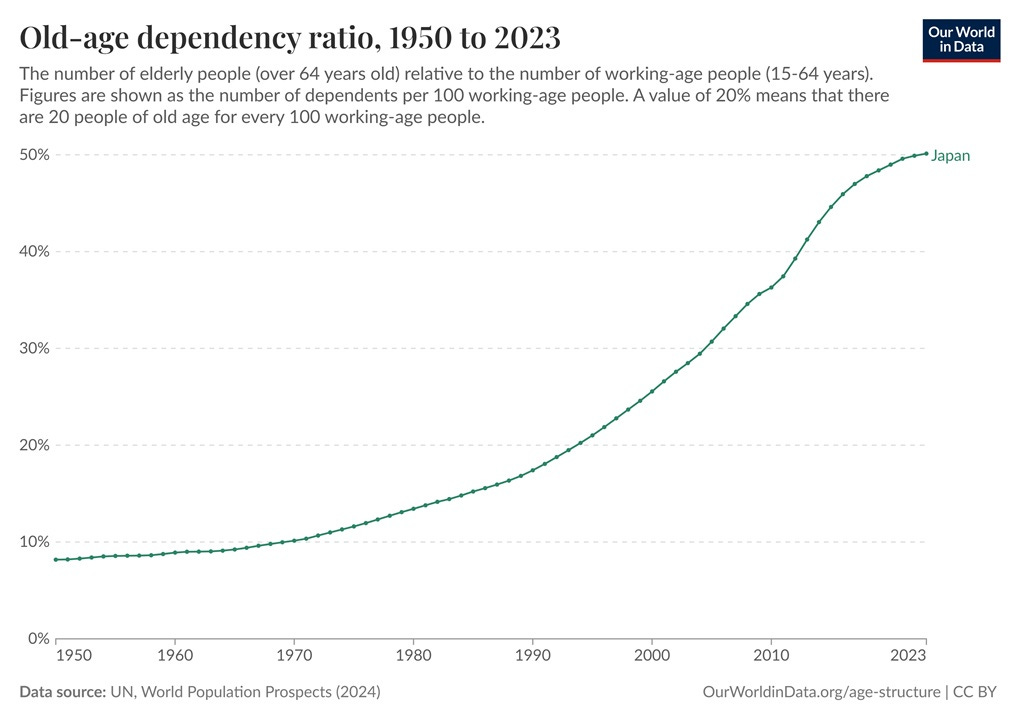
Part of this, too, may be an illusion, driven by behavioral change — the kids may be at home on their phones watching TikTok or tweeting, while older people still go out and experience the physical world. But the statistics don’t lie. When I lived in Japan for the first time, the country’s median age was around 42; now it’s almost 50. Back in the mid-2000s, there were more than three working-age Japanese people for every person past the age of 65; now, there are fewer than two.
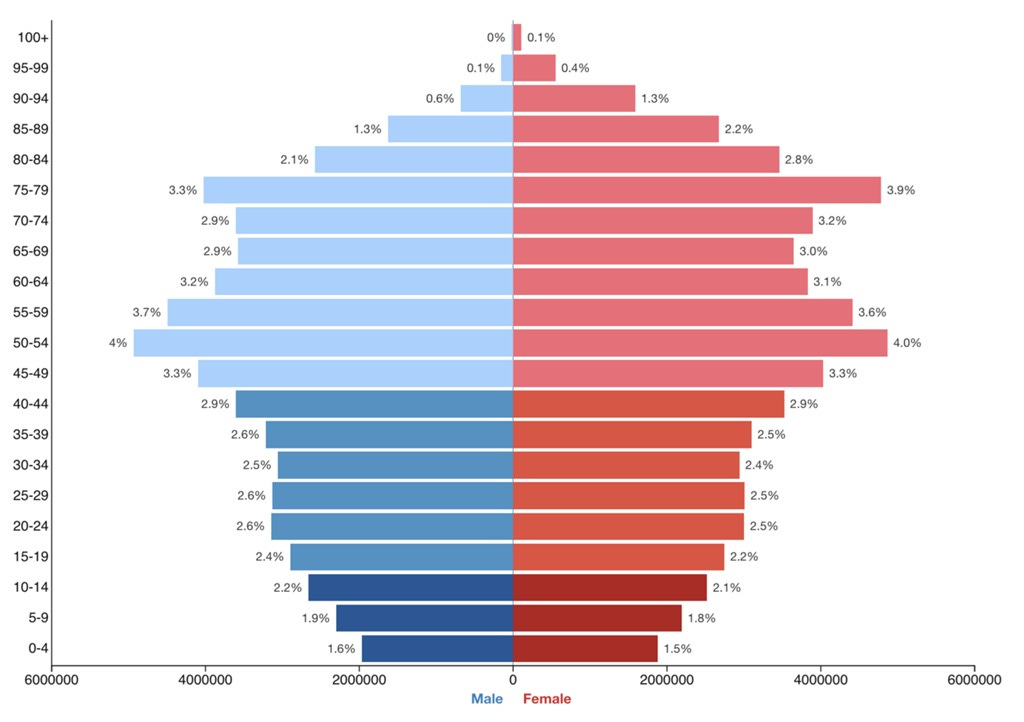
The country’s population pyramid shows this pretty clearly. The generation slightly older than me — now in their early and mid 50s — was actually the most populous, while the generation in their 20s right now is maybe only 60% as large:
The slow disappearance of young people from public spaces has given the country a more tired, less energetic feeling. Whole neighborhoods of Tokyo and Osaka in the mid-2000s felt like what William Gibson once called “the children’s crusade” — a mass of youth imposing their aesthetics and attitudes on society by sheer force of energy and numbers. That’s all gone now.
Aging has also meant less prominence for youth culture in the built environment — anime, fashionable clothing, pop music, and cheap trendy eateries are all less common motifs in Japan than they were decades ago. Meanwhile, nice restaurants and luxury brands — things older people consume — are steadily taking over urban spaces.

