


How did the screen you’re looking at right now get invented? There was a whole pipeline of innovation that started in the early 20th century. First, about a hundred years ago, a few weird European geniuses invented quantum mechanics, which lets us understand semiconductors. Then in the mid 20th century some Americans at Bell Labs invented the semiconductor. Some Japanese and American scientists at various corporate labs learned how to turn those into LEDs, LCDs, and thin-film transistors, which we use to make screens. Meanwhile, American chemists at Corning invented Gorilla Glass, a strong and flexible form of glass. Software engineers, mostly in America, created software that allowed screens to respond to touch in a predictable way. A host of other engineers and scientists — mostly in Japan, Taiwan, Korea, and the U.S. — did a bunch of incremental hardware improvements to make those screens brighter, higher-resolution, stronger, more responsive to touch, and so on. And voila — we get the screen you’re reading this post on.
This story is very simplified and condensed, but it illustrates how innovation is a pipeline. We have names for pieces of this pipeline — “basic research”, “applied research”, “invention”, “innovation”, “commercialization”, and so on — but these are approximate, and it’s often hard to tell where one of these ends and another begins. What we do know about this pipeline is:
It tends to go from general ideas (quantum mechanics) to specific products (a modern phone or laptop screen).
The initial ideas rarely if ever can be sold for money, but at some point in the chain you start being able to sell things.
That switch from non-monetizable to monetizable typically means that the early parts of the chain are handled by inventors, universities, government labs, and occasionally a very big corporate lab, while the later parts of the chain are handled mostly by corporate labs and other corporate engineers.
Very rarely does a whole chain of innovation happen within a single country; usually there are multiple handoffs from country to country as the innovation goes from initial ideas to final products.
Here’s what I think is a pretty good diagram from Barry Naughton, which separates the pipeline into three parts:
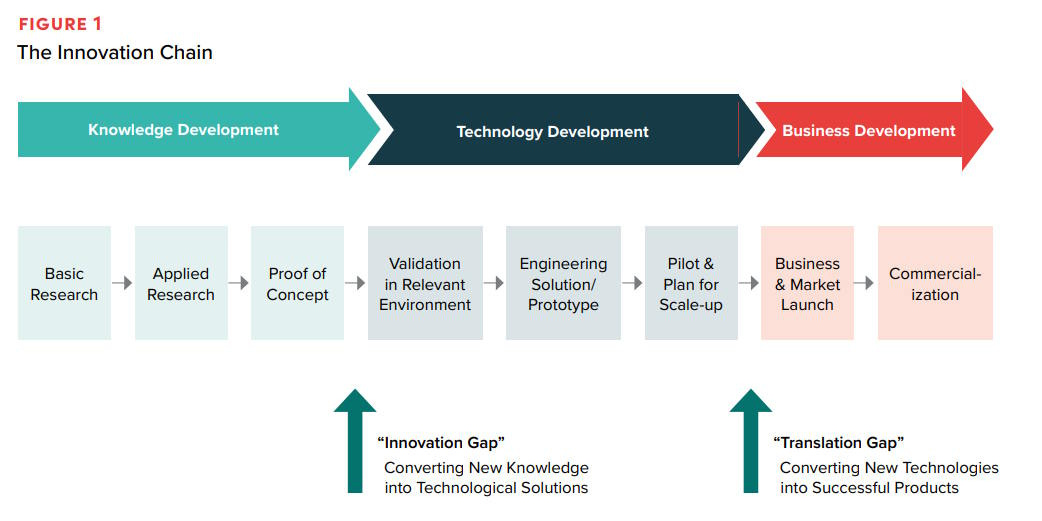
Over the years, the pipeline has changed a lot. In the old days, a lot of the middle stages — the part where theory gets turned into some basic prototype invention — were done by lone inventors like Thomas Edison or Nikola Tesla. Later, corporate labs took over this function, bringing together a bunch of different scientists and lots of research funding. Recently, corporate labs do less basic research (though they’re still very important in some areas like AI and pharma), and venture-funded startups have moved in to fill some of that gap.
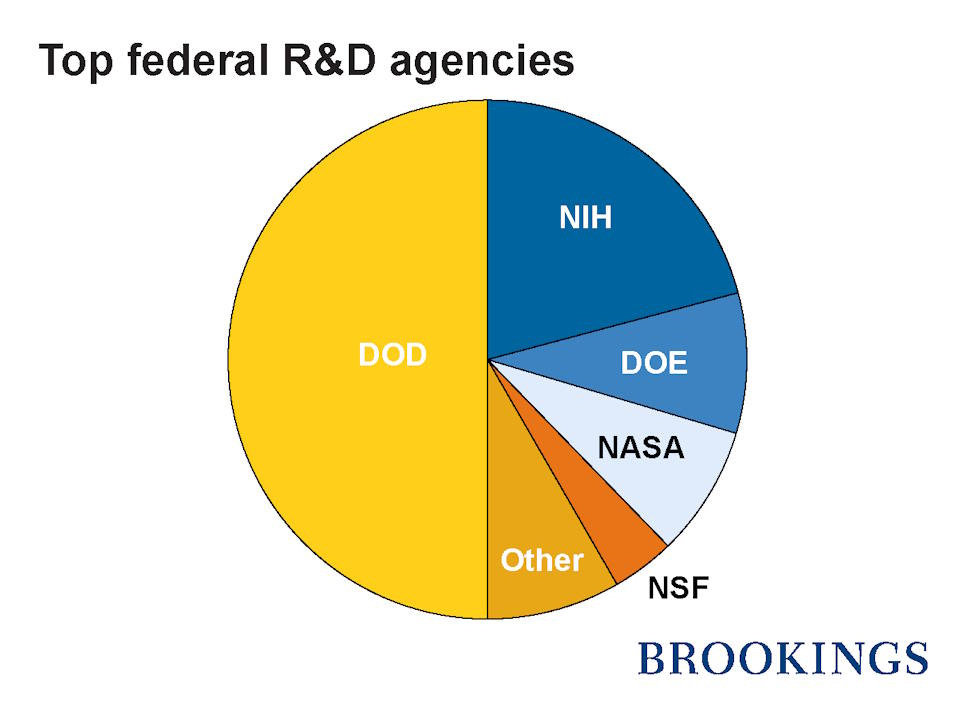
The early parts of the pipeline changed too — university labs scaled up and became better funded, government labs got added, and a few very big corporate labs like Bell Labs even did some basic science of their own. The key innovation here was Big Science — in World War 2, America began using government to fund the early stages of the innovation pipeline with truly massive amounts of money. Everyone knows about the NIH and the NSF, but the really huge player here is the Department of Defense:
Japan, meanwhile, worked on improving the later parts of the chain. I recommend the book We Were Burning for a good intro to the ways that Japanese corporate labs utilized their companies’ engineering-intensive manufacturing divisions to make a continuous stream of small improvements to the final products, as well as finding ways to scale up and reduce costs (kaizen).
And finally, the links between the pieces of the pipeline — the way that technology gets handed off from one institution to another at different stages of the chain — changed as well. America passed the Bayh-Dole Act in 1980, making it a lot easier for university labs to commercialize their work — which thus made it easy and often lucrative for corporations to fund research at universities. (This had its roots in earlier practices by U.S. and German universities.)
Meanwhile, in parallel, the U.S. pioneered a couple of other models. There was the DARPA model, where an independent program manager funded by the government coordinates researchers from across government, companies, and universities in order to produce a specific technology that then gets handed off to both companies and the military. And there are occasional “Manhattan projects”, where the government coordinates a bunch of actors to create a specific technological breakthrough, like building nuclear weapons, landing on the moon, or sequencing the human genome.
So we’ve seen a number of big changes in the innovation pipeline over the years. And different countries have done innovation differently, adding crucial pieces and making key changes as their innovation ecosystems developed The UK pioneered the patent-protected “lone inventor” model (with some forerunners of modern venture capital). Germany created corporate labs and the research university. America invented Big Science, modern VC, and DARPA, while also scaling up modern university-private collaboration and undertaking a few Manhattan-type projects. And Japan added continuous improvement and continuous innovation at the end of the chain.
That story more or less brings us up from the 1700s to the late 2010s. That’s when China enters the innovation story in a big way.
China’s innovation boom
Up through the mid-2010s, China had a pretty typical innovation system — the government would fund basic research, companies would have labs that would create products, and so on. China wasn’t really at the technological frontier yet, though, so this system didn’t really matter that much for Chinese technology — most of the advances came from overseas, via licensing, joint ventures, reverse engineering, or espionage. If you’ve ever heard people talk about how China “steals” all its tech, they’re talking about this era — and “steal” means a whole bunch of different things.
In the 2010s, China’s growth slowed down. There were a lot of reasons for that, but one reason was that they were approaching the limits of how much technology they could transfer from overseas. They had to start inventing things on their own. So they did.
You’ve probably read a lot about Chinese innovation in the last few years. Most things you read will fall into one or more of three basic categories:
“Look how much money China is spending on research”
“Look how many academic papers China is publishing”
“Look which high-tech industries China is dominating”
Here is a good recent Financial Times article that combines the first and the third of these, here is an Economist article from last year about the second, and here is a recent Economist story about the third.
All of these are certainly worth looking at. For example, China really is spending a whole lot more money on research:
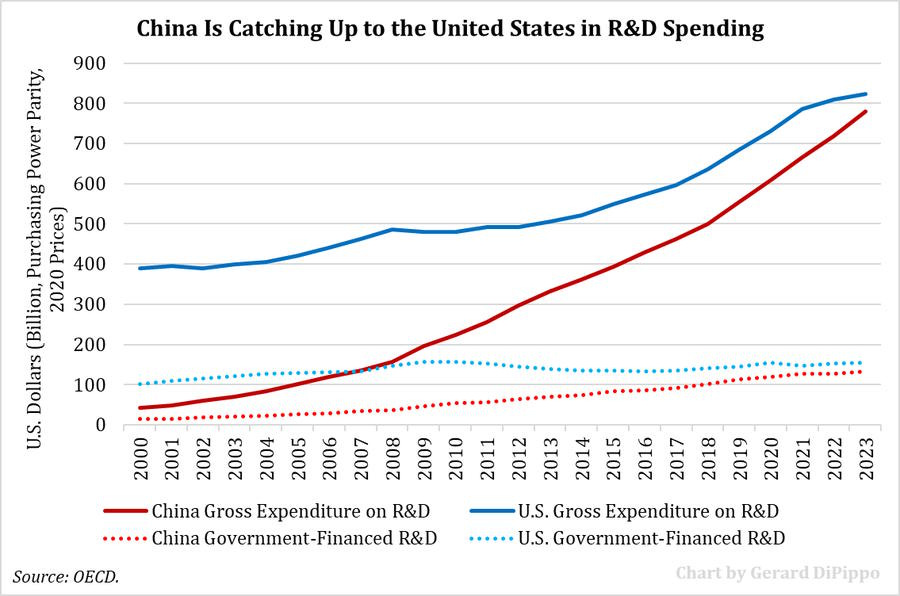
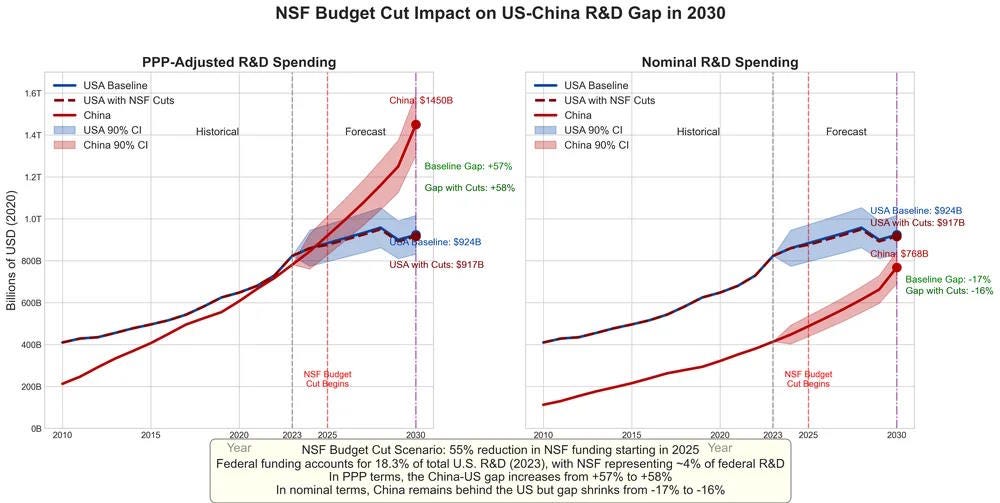
And since salaries and materials and equipment are all cheaper in China, in PPP terms they’re actually spending a bit more on research than America now. And the gap is set to widen, with or without planned U.S. budget cuts:
As for scientific output, despite inflating their citation counts a lot with citation rings and other tricks, China now leads the world in high-quality STEM papers, especially in materials science, chemistry, engineering, and computer science:

And as for high-tech manufacturing, China is dominating there as well, except in a few narrow sectors where U.S. export controls have managed to keep key pieces of technology out of Chinese hands.
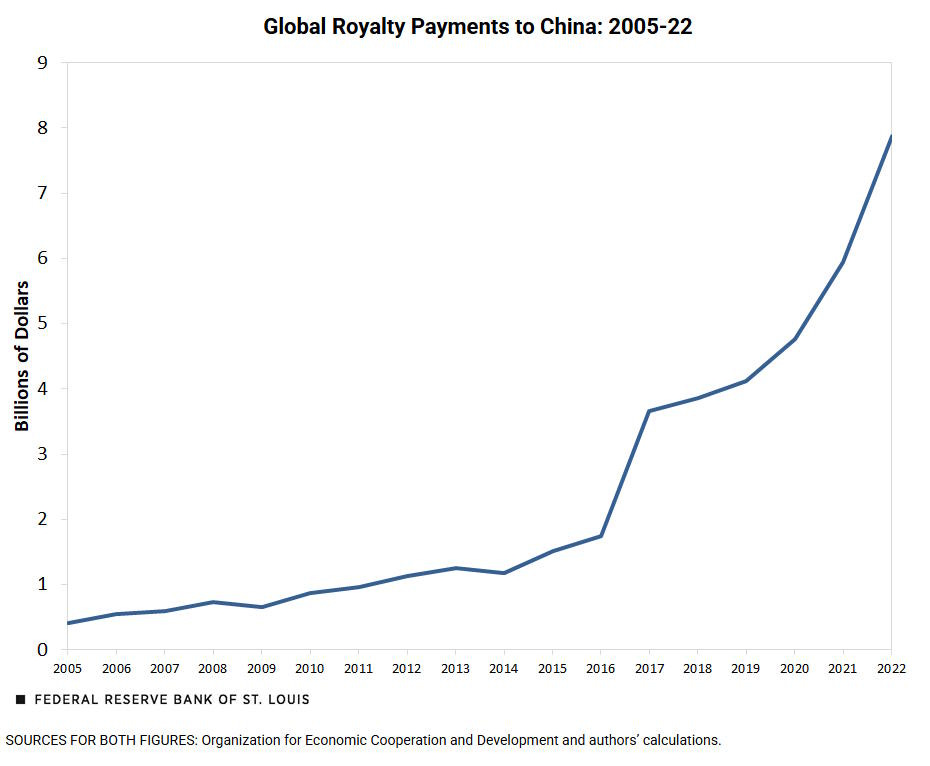
One other piece of evidence that China’s innovation is producing real results comes from the royalties that the world pays to Chinese companies to license their technologies. This amount has skyrocketed since China rolled out its new innovation system in the late 2010s, showing that China is producing lots of technology that the world is willing to pay for:
But although you’ll read a lot in the news about how much China is innovating, you almost never read a good explanation of how they’re doing it. Most people don’t seem to think about how research actually functions; people talk as if it’s just a black box where money goes in and cutting-edge high-tech products come out the other side. But it’s not a black box; the way that a country translates money into products is very important. It affects how productively the money will get used, who spends the money, how much can be deployed, what kinds of products and technologies that the system will create, and who will benefit from those products.
In fact, we know a lot about China’s innovation system — enough to know that in the last decade, they’ve created something new and powerful and interesting. If you want some readings, I strongly recommend:
MERICS’s 2023 report, “Controlling the Innovation Chain” and its 2024 follow-up
Barry Naughton’s condensed writeup of the MERICS report, describing why the shift happened and what it means
IGCC’s 2023 report, “Reorganization of China’s Science and Technology System”
Jamestown’s brief summary of the key actors in the system
If you want a deeper dive, CSET has some good reports on the Chinese Academy of Sciences and the “State Key Lab” funding ecosystem.
Anyway, reading all this, it’s clear that like all the industrial nations before it, China has made big changes to the way innovation gets done. I’ll talk about what these changes are, and what they imply for the future of technology (and the economy), but first I think it’s useful to think a bit about the purpose of China’s innovation system.
What is the goal of Chinese innovation?
Why do any science or create any technology? There could be several reasons:
Advance the boundaries of human knowledge, satisfy personal curiosity, and gain intellectual prestige
Get rich
Make a country more prosperous
Solve an environmental or health problem
Win a war or make your country powerful
In any country, there will be various actors working toward each of these goals. Academics generally want to discover cool stuff and get prestige; entrepreneurs and financiers typically want to get rich; policymakers generally want to enrich the populace and strengthen the nation. The innovation pipeline relies on these goals all lining up. The scientists who discovered quantum mechanics did it because it was cool and interesting, and maybe because they wanted to look smart; they didn’t really know whether it would ever be used to create a smartphone screen, and they certainly didn’t expect to get rich off of anything like that. It just sort of happened that eventually, all of these motives and goals lined up to take us from Niels Bohr to Steve Jobs over the course of a century.
China’s leaders created their new innovation system with the idea that maybe this could happen a lot faster if the whole thing were done with a single goal in mind. That goal, as Barry Naughton writes, is to strengthen the Chinese nation — to make it both militarily strong and economically self-sufficient, in order to be able to either win a war against the U.S. and its allies, or to overawe them so that they accept Chinese primacy without fighting a war at all. Naughton writes:
Beijing’s policy shift to re-engineer the innovation chain…marked a realignment of innovation strategy, with much greater weight given to security. Similarly, the goal of “science and technology self-reliance” was written into the 14th Five-Year Plan in 2020[.]
And MERICS writes:
Integrating the innovation chain is increasingly motivated by the pursuit of technological self-reliance (i.e., security, breaking so-called foreign tech strangleholds) rather than economic growth drivers (i.e., development, becoming a first mover in strategic emerging industries).
This basically fits with what I wrote about the purpose of the modern Chinese economy in a post last month:
[Xi’s China] feels like a nation built for the glory and greatness of its leaders and owners, rather than for the happiness of its regular people…Under Deng Xiaoping, Jiang Zemin, and Hu Jintao…the deal [was] prosperity for political quiescence. Now, under Xi Jinping, the deal has been altered. China’s people are basically being told “Let them eat national greatness.”
That doesn’t mean China wants to prevent Chinese people from becoming more prosperous.1 It’s just that this is a secondary goal — a “nice to have” instead of a “must have”.
That single overriding goal of security/power/greatness allows China’s government to vertically integrate the entire innovation chain. Essentially, what China has done is to ditch the standard innovation model, where government, academics, corporations, and financiers all work independently toward their own goals, and to replace it with a model where the government coordinates their interaction toward a single overarching goal from beginning to end.
Basically, the government now tries to take innovation “from bean to bar”, as the chocolate shops say. It tries to identify a technological goal — say, becoming nationally self-sufficient in robotics — and then work backwards to figure out what breakthroughs it needs in order to reach that goal. Then it tries to fund the basic and applied research to create those breakthroughs, transfer the breakthroughs to the appropriate companies, help the companies create new products, and then help the companies commercialize and scale those products.
This obviously requires a huge amount of coordination between all the relevant actors, which is why China calls this a “whole-of-nation” approach. It’s only possible because of the incredibly high state capacity of the Chinese state, the unquestioned authority of the CCP, and the intrusion of the party-state into every sector of the economy. But it’s also only possible because of the unity of purpose that pervades the new innovation system.
How China’s “whole-of-nation” system is new and different
I haven’t participated in the Chinese research system, but I understand the U.S. and Japanese systems fairly well. So reading about these, I can immediately pick out four major elements of China’s system that seem new and different. These are:
The Chinese Academy of Sciences (CAS)
A system of industrial and development “zones”
The Central Science and Technology Commission (CSTC) and other steering organizations
Innovation consortia
First, CAS. I’ve read a bunch about what CAS is, and it’s still hard to explain. It’s basically if you combined all of America’s national labs, MIT and Caltech, the National Academy of Sciences, and the Office of Science and Technology Policy all into one organization. It has a huge network of national labs, two elite universities, a gigantic association of scientists throughout China, and top advisors in the Chinese government. On top of that, it has a holding company that takes equity stakes in major Chinese manufacturers.
I don’t know of any other country with one organization that combines this many functions. The fact that CAS combines all of these functions allows it to do a lot to vertically integrate the Chinese R&D system. CAS can suggest a research project to the government via its advisory function, then call on its academics and national labs to do the basic research, then furnish researchers for the innovation consortia that turn the basic research into an invention, and then use its holding company to help (or persuade) companies to adopt, commercialize, and scale up that invention. Obviously this doesn't happen all the time, but it's something that can happen.
On top of that, CAS seems like it has the potential to enable much more idea-sharing across China’s entire research ecosystem. In America, a researcher who wants to switch from Caltech to Lawrence Berkeley National Labs, or even to get a joint appointment, has to go through an elaborate application process. But it seems like CAS’ structure could theoretically allow Chinese scientists to flit back and forth between universities, national labs, and corporations. That could potentially enable a bunch of cross-pollination and collaboration that America’s more institutionally siloed system prevents.
The other big new piece of the research system is the industrial development “zones”. For decades, we’ve understood the importance of industrial clustering effects for knowledge industries — just look at how Silicon Valley powers the global software industry. Engineers move from company to company, carrying their know-how with them and cross-pollinating their ideas. We can think of this as a final part of the innovation pipeline, downstream even from the efforts of single companies; even after one company commercializes its innovations, clusters spread those innovations to the entire ecosystem.
China’s industrial development “zones” are basically intentional attempts to create industrial clusters. The government either identifies an existing industrial cluster and tries to get more companies in the industry to move there, or tries to assemble a bunch of companies to create a cluster from scratch. It then sends a bunch of researchers from academia and national labs to the clusters, with the purpose of helping the companies out. Sometimes those researchers come bearing insights from research projects at universities and national labs; other times, they actually do research at the labs of some of the companies, and then help transfer the results to the other companies in the cluster.2
This is essentially something new. Mark Muro of Brookings has suggested doing something slightly similar in the U.S., and the Endless Frontier Act would have done something a little like this if it had been passed. But China has actually institutionalized clustering as part of their innovation system. It’s essentially adding a downstream step in the institutional chain, the way Japan once added the downstream step of continuous innovation within single companies.
Those seem like the new pieces of the pipeline that China has invented. But China has also forged new links between the pieces of the pipeline — new ways to steer and coordinate the whole process. First of all, at the top, they have the steering organizations — the State Council, the Ministry of Science and Technology (MOST), and the new Central Science and Technology Commission. IGCC has a good explainer of those organizations.
Basically, these organizations do central planning. They get input from CAS and other scientists, as well as corporations, and they decide on a type of product or capability they think China needs — gas turbines, or sodium-ion batteries, or rare earth ion extraction methods, or whatever. Then they try to coordinate the resources to create the whole innovation pipeline necessary to end up with that product.
The other new link is the “innovation consortium.” This is sort of like a DARPA project — it’s an ad-hoc collaboration between whichever researchers the government and its expert advisors think will be able to produce a certain technology. Here’s Barry Naughton’s description of how these work:
The innovation consortium is the most important organizational initiative of the current [research] program…All consortia are organized with a strong lead actor—typically a state-owned enterprise or research institute—and a specified engineering or product target from the central or local government. While membership is diverse, it always includes a research institute or lab and a company or end-user representative to unite the two ends of the innovation chain. Members sign contracts which specify goals, criteria, and rewards. Unique incentives for each type of actor are set in order to further the consortium’s mission…
There are two main types of innovation consortia: those which are predominantly research-driven and those which are predominantly economics-driven…A research-driven consortium is generally led by a research institute or a national lab…The enterprises feed practical information and market insights to the research institutes to assist those efforts…
Economics-driven consortia…[have] pursued diverse targets ranging from high-power semiconductor lasers to monoclonal antibodies and wearable technologies. The city government sponsors the organization of the consortium and usually entrusts its operation to the leading local enterprise in that area. The city’s motives mix economics and [national] security.
These sound a bit like DARPA projects, except instead of an independent project manager, you have an organization leading the way. In both cases, you have an ad-hoc assemblage of public and private researchers trying to plug a specific “hole” in the economy — in DARPA’s case, to create something the military could use, and in China’s case, to reduce reliance on a specific foreign technology. Basically, China’s innovation system is a little like trying to do “DARPA for everything”, except it also coordinates the upstream basic research and the downstream commercialization as well.
So in a very short space of time, China has created or repurposed a bunch of institutions3 that allow it — at least in theory, and sometimes in practice — to vertically integrate its entire innovation pipeline, from science to invention to commercialization to scaling and diffusion. Basically, the way it’s supposed to work is something like this:
China’s government and party officials, advised by top scientists, identify a product or a process they think China needs.
The top brass designates one or more organizations — research labs, government ministries, companies, etc. to lead the project.
If necessary, the research organization organizes basic research efforts to discover new science to enable the creation of the thing the government wants.
The organization then gathers researchers from academia, national labs, corporate labs, and so on to create an innovation consortium. The consortium turns the (new or existing) science into an actual product or process.
The researchers from the companies in the consortium then show their companies — usually located in an industrial development zone — how to use the thing they invented, turning the invention into a product or process.
The company then scales up production, often with additional help from local governments and subsidies from the central government. The technology diffuses to other companies in the same industrial cluster, enabling the whole industry to take advantage of it.
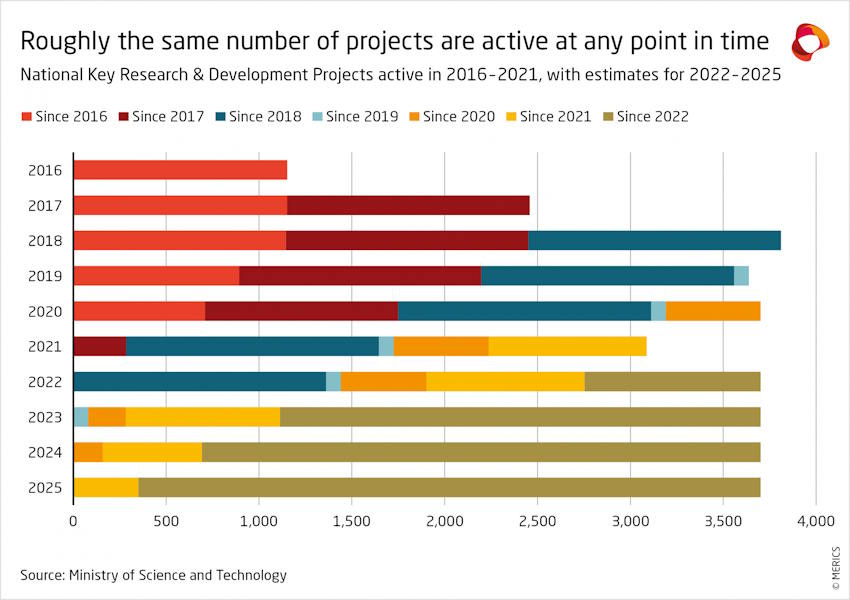
That’s the idealized version, of course. In reality, as Naughton and others note, there are often turf wars, duplication of effort, muddled goals, and projects that are more hype than reality. It’s not yet clear how efficient this system will end up being. America’s institutional creations — Big Science, DARPA, VC, and all the rest — are time-tested by now, but China’s are new and unproven. It’s actually pretty astonishing how recent this all is; China really only got this effort underway in 2016 or 2017:
Besides the question of how smoothly and efficiently the whole system will function, there’s the question of what this system will be able to accomplish in the broader sense.
China will change the nature of global innovation
It’s tempting to ask whether China’s new innovation system will be good or bad for global innovation. But as I mentioned before, that’s a matter of opinion — there are many things that research and innovation can accomplish, and it depends on which of these you value more.
One thing I think is clear is that if China’s new innovation system broadly succeeds — that is, if vertically integrating the research pipeline turns out to be effective in producing a lot of products and processes that prove useful to Chinese corporations — then the rest of the world will come under increased competitive pressure. This is already happening — China’s EVs are outcompeting the best that the rest of the world has to offer.
That will push other countries to follow suit — to at least partially emulate the mission-driven, application-oriented approach and top-down vertical integration of the Chinese research ecosystem. If they don’t, their companies could die and their armies could be defeated on the battlefield. So I expect the less pragmatic purposes of science and innovation — curiosity, humanitarianism, intellectual prestige, etc. — to get the shaft compared to the 20th century.
I also think this will result in innovation becoming somewhat more incremental. This is already the case in China:

Big breakthrough discoveries often happen because of curiosity. Niels Bohr and Erwin Schrödinger invented quantum mechanics because they hungered to understand the Universe, not because they wanted to make OLED screens or precision weaponry. In fact, they didn’t even know quantum mechanics could be used for those things. If you focus your research effort on questions whose applications you can envision, your horizons will naturally shrink.
In effect, this amounts to the quasi-militarization of the scientific enterprise as a whole. China’s leaders view every market as a way of building “comprehensive national power”, rather than as a way to enrich humankind. And because China is now so huge and well-resourced, and because it has reached the cutting edge of the technological frontier, other countries will be forced to view markets the same way or risk being outcompeted entirely.
China’s leaders’ vision will push their own country’s innovation even more toward incremental efforts. As Naughton and others repeatedly stress, China’s goal for innovation is almost always to shore up strategic vulnerabilities — to have China make every type of physical good in existence, so that it can’t be constrained by sanctions, export controls, or blockades.
But this means focusing innovation on import substitution instead of creating new markets from scratch. China’s leaders want it to be the “make-everything country”, but what that actually means is “make everything that has already been invented.” The Soviets put a man in space to demonstrate the greatness of communism; China wants to use its world-beating research prowess to keep making T-shirts. That’s pretty boring.
(In fact, China’s strategy of stealing breakthrough discoveries and inventions was probably already pushing us toward incremental innovation. Blueprints and experimental results and algorithms can be easily transferred from country to country; in an age when espionage is commonplace and intellectual property isn’t respected, the technologies that have durable moats are the ones that depend on distributed tacit knowledge, like grinding glass, optimizing combustion engines, or operating EUV machines. In other words, if big ideas always get stolen, it makes sense to focus more on the accumulation of a bunch of little tricks of the trade.)
But on the plus side — at least, from my point of view — is the possibility that China has found a way to mobilize more of society’s resources toward progress. Vertical integration of the innovation pipeline has never really been tried before, except for a few highly targeted efforts in wartime. Society probably misses out on a lot of productive innovation due to the fact that scientists, corporations, and the government all want different things out of the whole operation. If China’s vertical integration can align goals and incentives toward pumping out a high volume of new discoveries and technologies, that may be a boon to humanity, even if the discoveries tend to be more incremental in nature.
China’s innovation system is certainly a thing of awe. In a way, it’s the next step in the evolution of science from an individual enterprise to a vast collective effort. Perhaps that sort of approach is exactly what the world needs for an age when the low-hanging fruit of science has been mostly picked. Perhaps the age of brilliant iconoclasts and lone inventors is over, and what we need now in order to sustain progress is the kind of whole-of-society mobilization that China is figuring out how to do.
Update: Commenters are leaving some really great comments here. For example, MagellanNH says:
It seems like despite the system being largely nationally coordinated with a lot of central planning, there’s still a huge element of competition between regions and individual start-ups that helps keep the system more dynamic.
Yep, there is definitely plenty of competition built into this system, along a number of axes. There’s regional competition to see who can be the industrial “zones”, as well as which zones can play host to each special project. There’s competition between labs to see who can be part of each project, and who can take the lead. And there’s even competition between different agencies with overlapping mandates, to see who can come up with a better project that eventually makes it into the commercial sphere. This isn’t Gosplan, where some central authority tells you exactly what to do. It’s more like competition within a very huge vertically integrated company with a lot of divisions competing for resources and prestige.
Meanwhile, Max asks some great questions:
(1) in light of involution, how can private Chinese firms appropriate their investments in R&D? (2) in light of consortia sharing, isn’t substantial free-riding likely, and if not, are there different legal or cultural constraints at work that prevent free-riding? and (3) what role does competition play, if any, at the R&D stage, and, if present, is it competition among firms, bureaucracies or regions, or all of the above?
I’d say the answer to all of these questions is “I don’t know, and probably nobody outside the system really knows, and in fact people within the system probably don’t even know because the system is very new and still evolving fast.”
Remember that this whole thing only really got started about eight years ago. There might be a lot of iteration, as China’s leaders learn what works and what doesn’t. Remember that the first version of Made in China 2025 was basically a flop, but they made some adjustments and tried again with overall better success. Belt and Road didn’t turn out very well either, but they’ve made adjustments and they’re trying again. Whether the adjustments work, how fast they get made, in whose interests they get made, and whether these challenges are even solvable in the first place all seem like open questions.
My very tentative gut-reaction answers to Max’s questions above are:
About companies getting the benefit of R&D in terms of profit — they can’t, really. Or only a little bit. The upside of diffusing innovations is that everyone gets to take advantage of them. The downside is that the profits to be made are lower. China is experiencing involution as a result of over-subsidizing too many companies to make too many similar products. That could eventually be true with innovation too. Corporate profitability certainly doesn’t seem to be high on the priority list of the people designing these systems.
I’m really not sure about free riding. Effort is probably observable within a consortium, but who observes it, and what they’re empowered to do about it, seem like open questions. My instinct is that this is probably one of the kinks that is still being worked out.
The competition question I talked about a bit above, and I think the answer is that there’s tons of internal competition built into the system, but how effective that will be is still an open question. Japan had tons of internal competition within its 20th-century industrial policy system — competition between MITI and the Ministry of Finance, competition of ministers within MITI, competition between companies that MITI coordinated and supported, and competition between divisions within those companies. How helpful or harmful any of that competition was is still an open question, although there are probably reams and reams of old MITI documents from the 70s offering various people’s opinions.
The government does sometimes want to stop individual entrepreneurs from getting too rich, as it showed in 2021 during the tech crackdown. As for advancing the frontiers of human knowledge, that’s an interesting question; big disruptive breakthroughs seem like something the leadership is a bit scared by, since they throw a wrench into the projections and calculations of future national greatness. But the Chinese leadership doesn’t seem to think they can prevent big breakthroughs from happening once in a while, and so their goal will be to simply dominate those breakthroughs as fast as possible after they happen. You can see this approach with generative AI.
That’s the ideal, anyway; in practice, it probably doesn’t work nearly this smoothly in most cases, and some of the clusters are probably just for show.
Not CAS, though. CAS is old.
Monetizing basic research has always been a fools errand. For example going back to1992, research into the cockroach microbiome was still in its early stages. "A key study published that year focused on the contribution of anaerobic protozoa and methanogens to the hindgut metabolism of the American cockroach (Periplaneta americana)." Of course many in Congress would have made fun of this early microbiome research. Thirty years later, built on the shoulders of cockroaches (and other lesser species), human microbiome research is well underway but has yet to lead to significant paradigm shifts in human healthcare. Per your quantum example, there was a substantial lag between quantum physics and smart phones.
An enormous effort needs to go into basic research to build to the point that monetization/societal benefit is achieved (of course along the way a bunch of scientists had fun figuring things out). US government investment needs to keep contributing to this base on which product development can be built. Essentially decide to commit to x% of budget on research and just keep plugging away across a variety of disciplines. No one can know what will pay off, but statistically research will pay off.
Even once the development opportunity is created, the big money goes to the group that solves the "last" problem, not to the first mover. So in my view the most productive ecosystems need to have small risk takers (not invested in the status quo) as well as established players who can buy out and the complete the development of innovative products. Hard to think that any central government (or large corporation) will be sufficient in and of itself to provide a steady stream of innovation. Neither the Chinese or large corporations will fail for lack of trying.
Excellent overview; three quick follow-up questions/comments: (1) in light of involution, how can private Chinese firms appropriate their investments in R&D? (2) in light of consortia sharing, isn't substantial free-riding likely, and if not, are there different legal or cultural constraints at work that prevent free-riding? and (3) what role does competition play, if any, at the R&D stage, and, if present, is it competition among firms, bureaucracies or regions, or all of the above? Certainly the framework for evaluating innovation and incentives (from Schumpeter to Arrow to our recent Nobel prize winners) tends to focus on competition among firms. China's approach suggests either that the economic modeling is incomplete or that their approach will have problems progressing to next-generation products. We shall see.