

Back when I started blogging in 2011, I saw my main function as technocratic — I would discuss policy ideas with other intellectual econ types, and wise policymakers at the Fed, in Congress, or in the Obama administration might put those ideas into practice. Since 2016, however, technocracy has felt less and less important, and policymaking has felt more ideological. In the second Trump term, concern for costs, benefits, and the public good seems to have entirely gone out the window — policy is now driven either by the whims of an aging egomaniac and his personality cult or the echo chamber of the online right. Tariffs and immigration raids make no sense as economic policy; they are intended as part of a nativist, isolationist ideological project. The Democratic alternative is less bad, but is still increasingly ideological, centered around the idea that corporate profits are inherently bad.
This changes the nature of my job, and in fact makes it much harder. Whereas in the past I could just recommend policies, now I have to make arguments about what kind of country we should want to have in the first place. In order to get anyone to listen to my advice, I have to be a bit less technocratic and a bit more ideological. And I have to do that at a time when the main ideologies being offered to the American public are becoming more extreme.
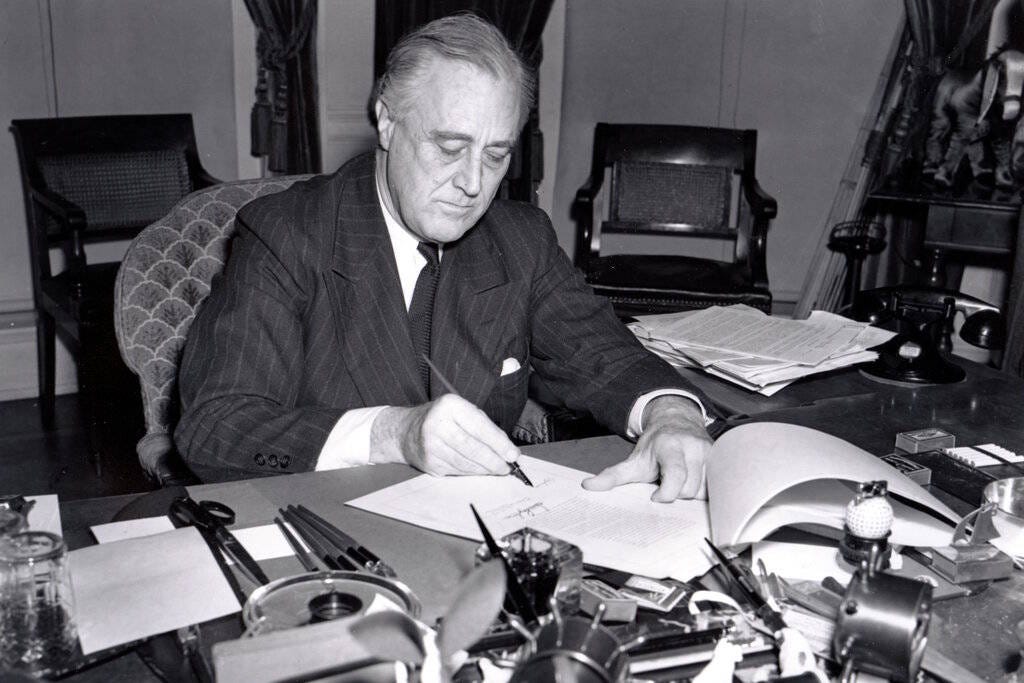
And yet this is the job now, so I should stop complaining and just do it. Because I do have a pretty clear picture of what kind of country I think America should be. I believe that in the 20th century, under the leadership of Franklin D. Roosevelt, the United States devised the single best governing ideology that any country has ever created: liberal nationalism.
I’ll explain what I think that means, but first I want to take a detour and point out a recent debate between two prominent commentators on the political right. One is the pseudonymous “Roman Helmet Guy”, an anti-immigration right-wing nationalist. The other is Balaji Srinivasan, my college friend, who represents a libertarian perspective and who now lives in Singapore. Balaji tried to keep the debate civil, while Roman Helmet Guy (henceforth “RHG”) was vituperative, vulgar, and accusatory. But both made interesting and important points about identity and national allegiance, and the debate ended up illustrating some points I want to make about liberal nationalism. So let me present an abridged form of the debate.
RHG started the debate by accusing Balaji of being ungrateful to America:

Balaji responded by casting doubt on the degree to which an individual’s success is attributable to the country where he succeeded, and by arguing that the global online community embodies America’s founding ideals better than America itself:
The degree to which one's success is attributable to a country's platform is hard to separate out. Obama said to conservatives: "you didn't build that, someone else made that happen." That is certainly one view, that 100% of success was due to the country platform, and zero to the individual…
[E]ven if the US government fails, even if the polarization proves too much, even if the $175T in debt takes down a once-amazing country, the Internet will be there…[I]t reflects the best of American values — free trade, free markets, free speech, free exchange of ideas — and I believe we can rebuild from it, just as Europe rebuilt from Christianity after Rome.
RHG retorted1 that Americans like Balaji ought to be loyal to the people of America, not to its ideals or its institutions:
I am not loyal to a set of values. I am loyal to the American people. You were born here. You were raised here. Educated here, made rich here. You should be loyal to the American people too. The PEOPLE. Not a set of values, not an economic system…
You fled the country and now go on podcasts talking about how tech people can ‘avoid the collapse of America.’ To you, my country and my people are just something for your class to exploit for wealth and then move on. If my people vanished from this earth, your only thought would be “How does this affect my ROI?”…My people gave you everything, yet you have no gratitude. No loyalty.
Balaji pointed out that many of the people who built America were immigrants, and that building America didn’t mean that they betrayed their country of origin. He then argued that in the modern, polarized America, it’s impossible to be loyal to the entire people; you have to choose whether to be loyal only to the red half or the blue half:
[I]f someone tries being loyal to “the American people”, does that mean being loyal to the 75 million Kamala voters, the Blue Americans? Because if you’re loyal to them, you are unfortunately no longer loyal to the Red Americans…Just like there is no Korea, only North Korea and South Korea, there is unfortunately no America any more, only Blue America and Red America.
He also accuses RHG of promoting an unequal, racialized version of national identity, in which Indians and other minorities are required to be subordinate to WASP Americans:
[W]hat test do you propose to determine whether someone is a true American, aside from their current paperwork?…[L]oyalty means symmetry. I am loyal to you if you are loyal to me. But the way you're talking about loyalty translates to servitude. I've been polite, and engaged you in good faith, but we are strangers. Yet you are demanding gratitude and even deference (!) from me, implicitly on racial grounds…
Why would anyone be loyal to a MAGA faction that arbitrarily designates countless millions to be Grade B, C, and D [Americans]? You can't just redefine the social contract overnight…with some tweets, into a…blood-and-soil America that the WASPs themselves shut down...and then get extremely mad when others don't buy into it.
RHG, in his defense, declares that he is loyal to all Americans, regardless of race or politics:
The only thing the American people demanded from you was that you employ the capital that you accumulated in our country to strengthen America and her people. The capital you accumulated under the benevolent protection of millions of American soldiers and policemen who do pick up a gun every day and put their lives on the line to defend our people…
As to which Americans you should have been loyal to: All of them. America is not an ideology. Even the most ideologically deluded idiots are still Americans. And I am happy to embrace all American citizens as my brothers and sisters, regardless of background…The truth that you’ll never understand…is that no nation of Balaji Srinivasans will ever be strong. Because you would all flee the moment things got tough, just as you fled America.
Both of the debaters make important points here. Balaji is, of course, right that it’s perfectly fine to emigrate from your country of birth, especially if that country collapses or becomes ruled by a nightmare regime. Being a refugee is not a form of ingratitude, and it’s silly to hold people to a moral standard in which anyone who moves to a different country is a traitor.
(That said, I think Balaji is being excessively panicky when he paints America as being in a state of civil war. The danger to his person and his fortune from remaining in America would have been minimal. And it’s absurd to assert that you can only be loyal to one half of the American populace or the other; Red Americans and Blue Americans are simply not in a civil war.)
RHG also goes way too far when he dismisses the idea of loyalty to American ideals. A nation’s people are important, yes, but its values and institutions are also important. Should loyalty to the Russian people have made every Soviet citizen loyal to Joseph Stalin? Should loyalty to the German people have made every citizen loyal to Hitler? No, of course not. Countries aren’t just sets of people, they’re also systems for organizing those people — the United States of America was born in 1776, not when Jamestown was founded. It’s perfectly acceptable to love your people but to reject the regime under which they live.
But at the same time, RHG makes some important points of his own. He’s absolutely right that a country in which everyone packed up and moved at the first sign of trouble would be an ineffective country. Social change requires voice, not just exit; making change requires that someone stay and fight the system, and if people keep running away they eventually run out of places to escape to.
Similarly, a country needs to be able to tax its rich people and companies in order to fund public goods (defense, courts, infrastructure, science) and to provide a social safety net. If rich people and capital are perfectly mobile, raising taxes becomes impossible, and countries have to choose between underfunding public services and running exploding deficits. In a very real sense, rich people give back to the people of their nation by staying and paying taxes.
And contra Balaji, rich people do owe a lot to the system that allowed them to get rich. Entrepreneurs immigrate to America for a reason; it would have been very hard for Elon Musk to build PayPal, Tesla, or SpaceX in South Africa. And although America is an especially good place to get rich, any functioning state is better for upward mobility than a state of anarchy. Try seeing how rich you can get in Somalia!
Much of what makes America a good place to get rich is its institutions — good courts and property rights, public safety, government support for research, and so on. But RHG is right that much of it is due to the actions of the American people — the workers who fix the roads that rich people drive on and build the offices they work in, the law-abiding regular people who behave themselves instead of overloading the justice system with crime, the taxpayers who pay for the courts and the roads and the research.
Balaji made his first millions by founding the genomics company Counsyl, which benefitted enormously from taxpayer-funded genomics research. That money came out of the pockets of regular Americans. It was channeled through American institutions, yes, but regular Americans made sacrifices for the science that allowed Balaji to get rich. It’s not possible to put a dollar amount on the debt that Balaji owes to regular Americans, but I do think some expressions of gratitude would be in order, even if delivered from Singapore.
At the same time, this raises some problems for RHG’s flavor of nationalism. Who exactly are the “people” of America that RHG is demanding that Balaji be loyal to? RHG claims that he views all Americans as his “brothers and sisters”, regardless of their politics or their background. But who counts as an American? Is it citizenship alone? Does someone who takes the oath of citizenship immediately become Roman Helmet Guy’s brother or sister? And if so, why is RHG so doggedly opposed to new immigrants, when that just means adding to his family? And if RHG has some other criterion for true American-ness besides citizenship, what is it?
This is the problem at the heart of right-wing nationalism, and there’s just no way to resolve it. If you accept citizenship as the definition of Real American-ness, then you have to admit that immigration creates Real Americans, when immigrants naturalize and/or have kids in the U.S. But if you reject citizenship, you have to rely on some more limiting, restrictive, and ultimately divisive test — race, or number of generations in the country, or whatever.
Every time rightists try to put forward a new concept like “Heritage American”, it falls flat, because the dividing lines are so arbitrary and contested. Do you only include WASPs, and kick out the Catholics? That’s kind of a non-starter, electorally. Do you include Catholics but kick out Jews? Do you bring in Jews but kick out people of Chinese and Indian and Mexican descent? What about Black Americans? Any attempt to designate a core “American people” by ethnicity, religion, or race is a non-starter electorally, so rightists typically either stick to vague hand-waving or spout deeply unpopular views from behind pseudonyms on social media.
Americans, meanwhile, overwhelmingly reject race, religion, and ethnicity as criteria for true American-ness. Most Americans of both parties are civic nationalists, of the type that make Roman Helmet Guy’s blood boil — they believe that the most important things for being a real American are citizenship, belief in the Constitution and the Declaration of Independence, obeying the law, and voting in elections:
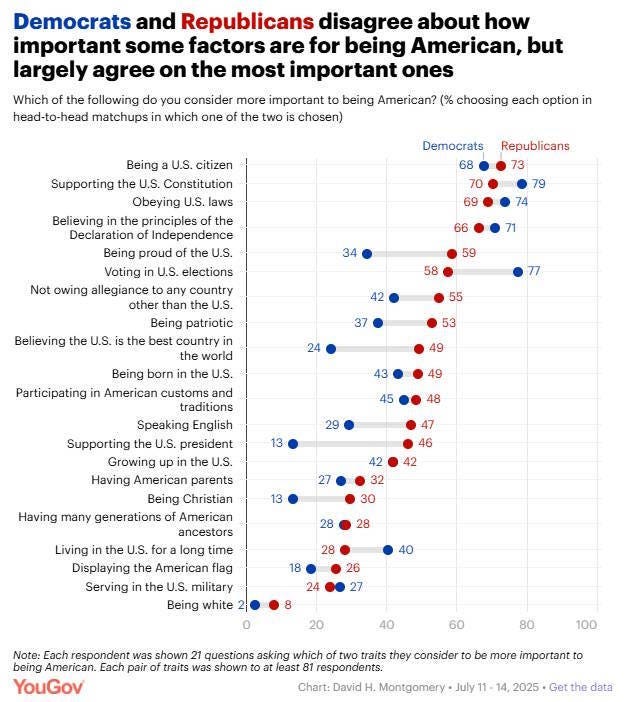
Americans themselves have little use for the kind of restrictive nationalism that rightists like Roman Helmet Guy are trying to sell them. (In fact, support for skilled immigration — the type of immigration that brought Balaji’s parents and millions of other Indians to the U.S. — is extremely high among both Republicans and Democrats.)
But this doesn’t mean that Americans would do better with rootless globalism, of the kind Balaji has embraced. The internet has created many “vertical communities” of like-minded people who chat with each other online, but those are no substitute for traditional communities of people who live near each other in physical space. Roads, schools, police, national defense, and plenty of other public goods and services can only be provided at the spatial, local level.
And in countries where people don’t feel a sense of kinship with their neighbors, public good provision becomes very hard. It’s hard to build a road if you think a lot of the benefit will go toward groups of people you don’t like. It’s harder to get people to allow the construction of new housing in their back yards when they think that people they don’t like will live there. Ethnic bloc politics is poison for democracies. A social safety net is hard to provide if you think the welfare benefits will go to groups of people you distrust or despise. And so on.
Homogeneous countries don’t have to worry as much about this problem, but a diverse country like America needs to work harder to forge people of disparate backgrounds into a single unified whole. Just saying “America has no culture except for multiculturalism” doesn’t cut it, because if Americans have nothing to bind them together in a sense of shared destiny and shared interests, the country will literally fall apart.
In the 20th century, America had an ideology that was committed to forging a single national identity from a dizzying array of backgrounds. That ideology was liberal nationalism, as promoted by the administration of Franklin D. Roosevelt, and by his ideological successors (including Republicans like Dwight Eisenhower).
FDR might seem an unlikely candidate for the paragon of liberal nationalism, given that he tossed around 80,000 Japanese Americans in concentration camps during World War 2 and compromised with segregationists. But those actions have to be viewed in the broader context — in an era in which racism and xenophobia were at their peak in the U.S., and growing all over the world, FDR strove mightily to turn the country in a new, more pluralistic direction.
FDR ended forced assimilation policies for Native Americans, and gave them greater autonomy on tribal lands. He maintained a group of Black advisors, created plenty of programs to help Black people economically, created cultural programs to publicize Black achievement, and preserved the testimonials of former slaves. He created campaigns promoting interfaith understanding and cooperation, helping to reduce America’s traditional anti-Catholic prejudice as well as antisemitism. His Federal Writers Project employed writers to document America’s cultural diversity.
FDR also strongly promoted the notion of America as a nation of immigrants — an idea that still deeply holds sway over the American psyche, despite rightists’ attempts to get rid of it. Here’s a radio program that the Roosevelt Administration created to promote this idea:
And everywhere, the Roosevelt administration pushed back against the sort of restrictive right-wing nationalism that was common in the early 20th century. The Department of War made a film in 1943 (released in 1947) called “Don’t Be a Sucker”, in which it advocated for an ideology of national unity and derided the kind of demagogues who tried to divide the country along ethnic and religious lines:
FDR and the liberal nationalists were not modern multicultural progressives. They strongly believed in national unity. This obviously meant patriotism, respect for American institutions, and a shared sense of national purpose during World War 2, but it also meant a lot more. FDR and the New Dealers — and especially the Office of War Information — advanced the notion that America had a unifying culture, set of democratic ideals, sense of history, and way of life that transcended Americans’ different backgrounds. The history of the New Deal is littered with examples of attempts to forge American-ness into a sort of shared civic religion.
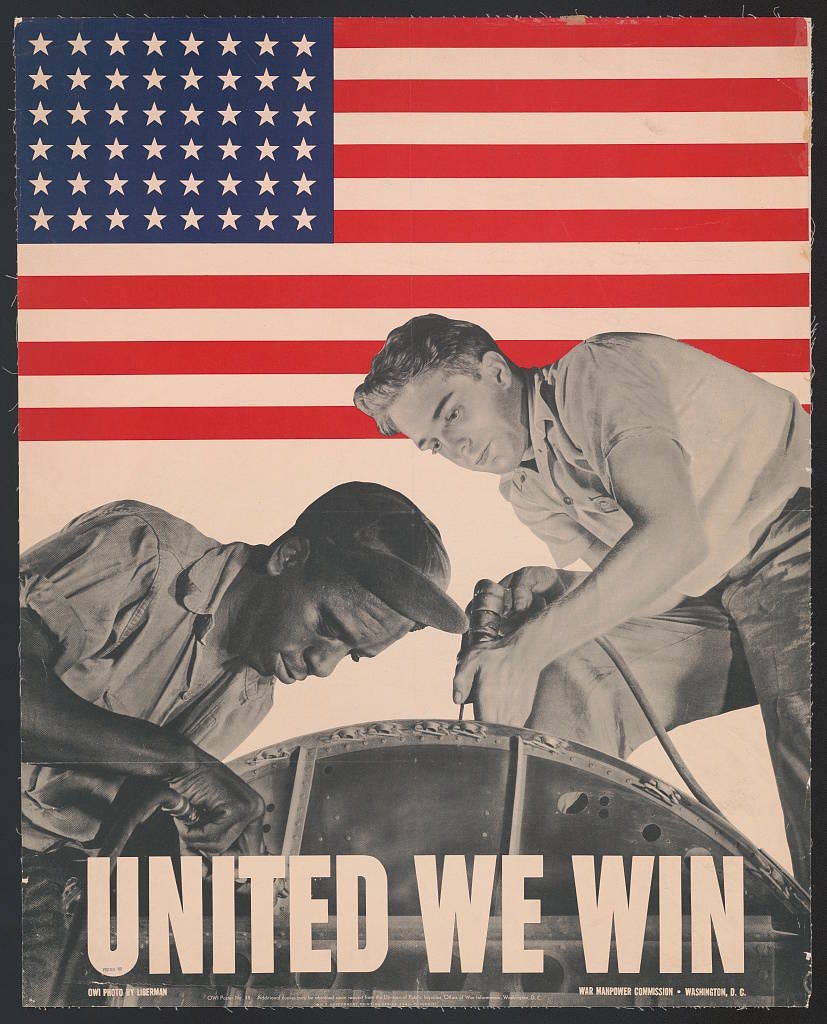
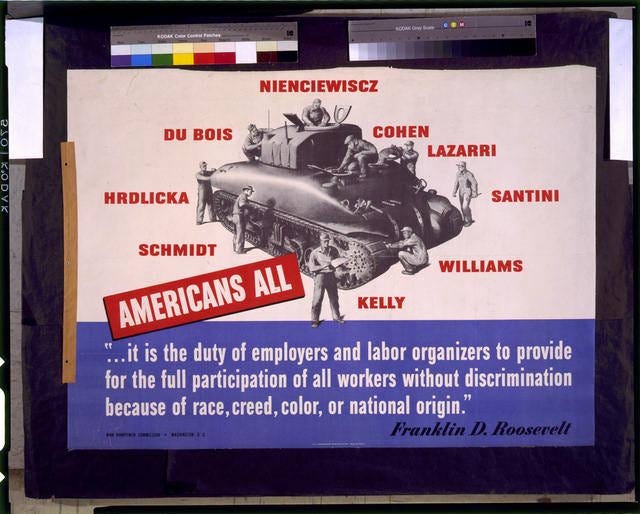
The legacy of this liberal nationalism lives on strongly in the beliefs and values of the American people, as evidenced by the responses to the poll above about American-ness. But the civic religion that sustained American unity through the triumphant 20th century has been abandoned by the political activist classes — the modern left and right. It’s difficult to imagine today’s leftists crowing about the idea that people of various backgrounds are “Americans All”. And it’s nearly impossible to imagine today’s rightists admiring a poster like the one above but with the names Patel, Zhang, Hernandez, and Khan.
The reason American policy is insane right now is because the country is being torn apart. And it’s being torn apart by a political activist class that has abandoned the unifying ideology of 20th century America — the ideology that defeated both fascism and communism, forged a kaleidoscope of ethnicities into a single nation, and sustained U.S. prosperity and economic dominance for 70 years.
Both the rightist and leftist projects in America are doomed to fail. There’s only one ideology that can save this country, and it’s the one that worked for us before. Bring it back.
RHG also, rather ridiculously, accused Balaji of “treason” for badmouthing America from foreign shores. We need more education about what treason means.
Excellent overall article
As a minor ironic side thought, a guy using the name Roman Helmet Guy arguing for exclusionary blood-and-soilish nationalism (if not directly and not in such words but dancing up to it) is bizarrely wrong-headed on symbolism given the success of the Roman empire as compared to other classical ones was its integrationism - one could unlike other classical states 'become a Roman' (and climb up post first gen) - right up to Emperor see the Libyan Severans... (and equally Rome's quite promiscuous openess to coopting bits and pieces of cultures within the Roman sphere, religious, kit, etc)
That's something of a touch back to Noah's closing - to return to our integrationist unifying ideology.
This is one of those posts that really states the obvious for anyone not in the constantly online activist shrieking wars. My wife is an immigrant, her whole family are immigrants, all of my friends are immigrants and even though they are all quite lefty coded progressives if I say something like “you know the great thing about America is that anyone can come here and bring their culture and their talents to the country and become a part of the whole community” they think it’s the most uncontroversial thing in the world. This is an ideology that I think is so deeply embedded in our culture that it seems odd to have to defend it. It’s certainly a perspective that I grew up with in a conservative Christian church going household. It’s always been the bedrock of my perspective on American culture and one of the things I am most proud about our civilization.