

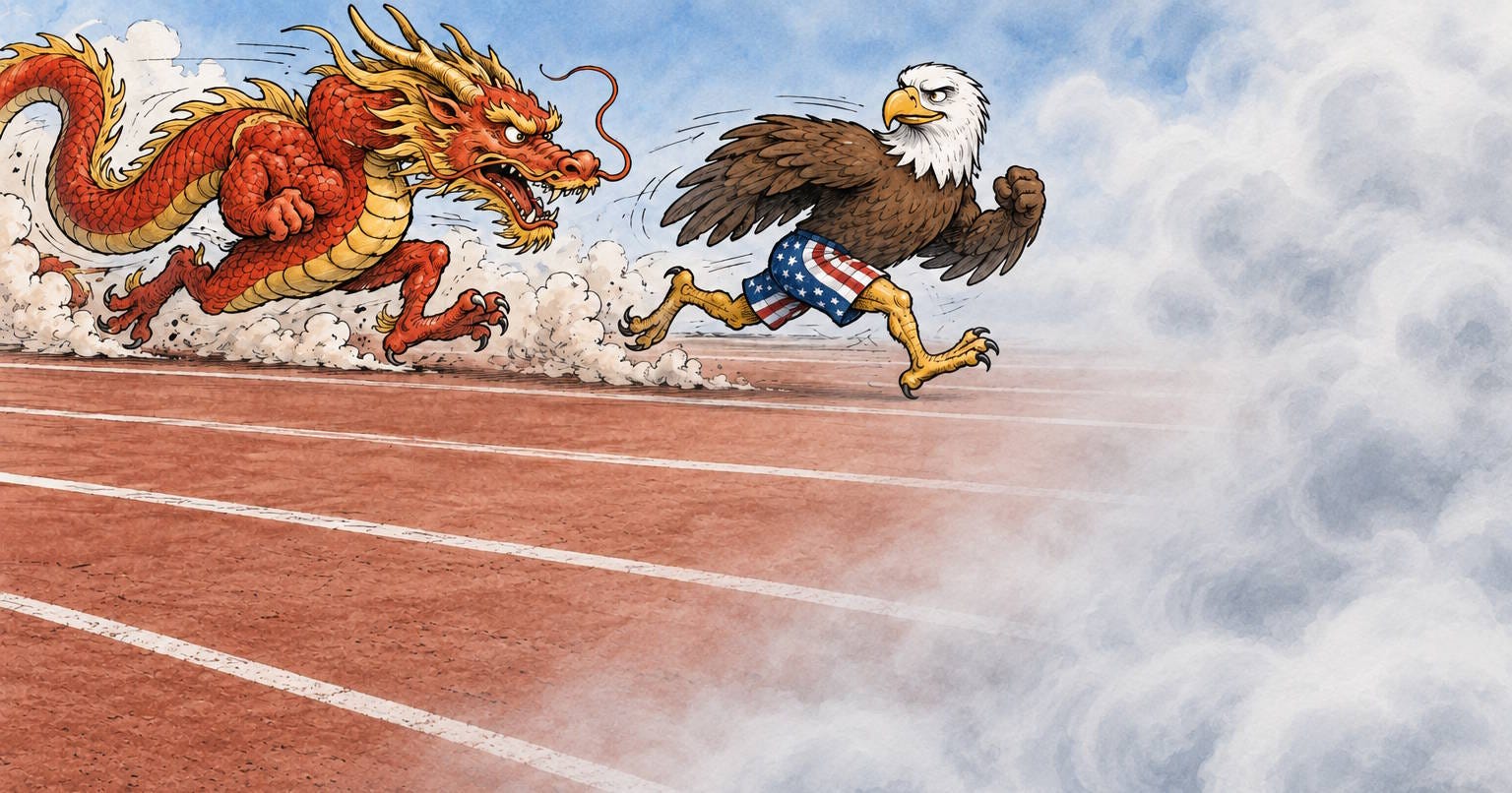
Most of the debate around AI, at least in the U.S., is not about the international aspect. The local political debate is all about data center construction; the national economic debate is mostly about fear of job loss, with a side discussion about a potential bubble; and the technological discussion, at least in public, is mostly about AI safety and risk. U.S.-China competition gets mentioned in certain circles, but it’s probably safe to say that it’s not Americans’ chief topic of concern.
But it still matters! For one thing, there’s the military aspect to think about. Cyberwarfare so far hasn’t been decisive in military conflicts, but AI’s incredible cybersecurity prowess could change that. If AI ends up strengthening defense more than offense — say, by finding all of the available exploits and patching them before an attacker can get to them — then cyberwarfare will become less important. But if those who possess the best AI models are able to successfully hack anyone using a less capable model to defend, it could lead to a decisive shift in the balance of power.
AI hacking doesn’t have mutually assured destruction, like nuclear warfare does. Imagine if China were to gain a big lead in AI models that gave it the power to easily hack into American banks and brokerage accounts and erase people’s wealth. It would cause absolute chaos in American society, but how could the U.S. retaliate? Launch nukes? Nor could the U.S. hack China in return, since China’s more capable AI would also be used to defend.
If either country opens up a large, sustained lead in AI capabilities, it might upend the balance of power between the two.
Not all AI issues are zero-sum, of course. If the U.S. and China both continue pushing forward with AI research at maximum speed, it may quickly cause safety issues. The recent AI agent swarm attack on Hugging Face shows that AI has reached the level where it can pose a significant hazard to human companies and organizations — and perhaps soon to human society itself. Bioterror risk is certainly the most terrifying, but there are plenty of other ways that highly capable AI could cause chaos.
The U.S. and China have a shared incentive to implement strict safeguards against these catastrophic risks, and perhaps even to regulate the pace of AI development. But given the Chinese Communist Party’s power-seeking nature, it seems much more likely that China would agree to cooperate on AI safety if U.S. capabilities were comfortably ahead. So even if the goal is cooperation, the U.S. should be thinking about how to keep its technological edge.
Fortunately, the U.S. is still beating China in the AI race. Our companies have better models, more compute, and far more revenue. But there are ways that the Trump administration, despite claiming to be the AI industry’s best friend, could squander America’s lead — especially by pushing Chinese AI talent out of the country.
U.S. models are still better than Chinese models
There have been several moments when it seemed as if China’s frontier models were catching up to America’s in capabilities. The most dramatic was the “DeepSeek Moment” in early 2025, which put Chinese AI on the map. More recently, the release of Moonshot’s Kimi K3 this July and Z.ai’s GLM-5.3 a few weeks ago seemed to indicate that Chinese models were nipping at the Americans’ heels.1 Z.ai especially made waves when it beat Anthropic’s famous Mythos model on one measure of cyber-hacking capabilities:
Chinese AI startup Z.ai said on Friday its open-source GLM-5.3 model had neared Anthropic’s restricted Mythos 5 in identifying software vulnerabilities…Z.ai said GLM-5.3 scored 84.5% on CyberGym, a test of whether a model can review code, identify security flaws and confirm that they are real. That was slightly higher than the 83.8% it reported for Mythos 5. The results have not been independently verified.
Note that this is just one measure of cybersecurity prowess, and that Mythos was still comfortably ahead on other measures:
GLM-5.3 lagged behind Mythos 5 in converting discovered flaws into working attacks — a standard part of defensive security research. Z.ai said its model scored 54.4% on the ExploitBench test of this capability, versus 78.0% for Mythos 5…In a separate timed test, Z.ai said GLM-5.3 completed 105 attack-development tasks in two hours and 130 in six hours. Mythos 5 completed 181 and 247 tasks, respectively.
But still, if Chinese AI could get within striking distance of America’s best, it was a big deal.
What this discourse rarely mentioned, though, is that Mythos is not America’s best. It was simply the best that’s been released. Mythos Preview came out in April, four months before GLM-5.3. And the original Mythos actually finished training three months earlier, in January, and was released internally in February.2 Anthropic delayed its release due to cybersecurity concerns. Z.ai, being a fast follower, probably had far fewer such concerns. In fact, Anthropic has stated that it has internal models that are better than Mythos.
