

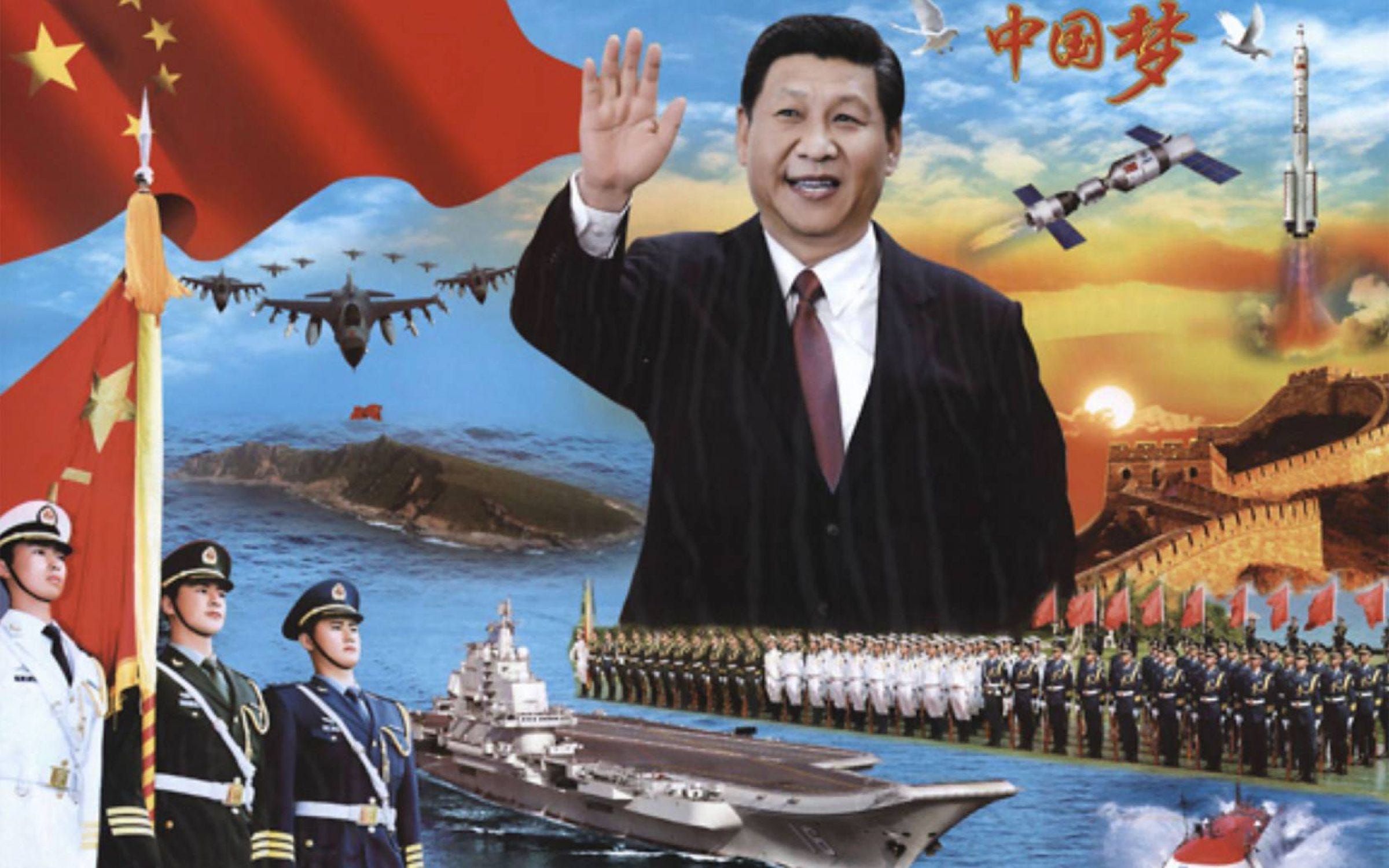
I am not a China expert, nor would I ever pretend to be one. But last year I do think I managed to catch something important that a lot of people seem to have missed: Xi Jinping is not as competent of a helmsman as he’s made out to be.

The reason I think a lot of people missed this is that Xi has proven incredibly adept at taking control of the Chinese Communist Party. His dramatic takedown of rival Bo Xilai, his anti-corruption campaign that expunged various rivals and skeptics, his purge of the police, and his creation of the country’s first cult of personality since Mao — all of these created the image of a man of bold vision and iron will who would be able to transform the world as ruthlessly as he had transformed the power structure around him. This week, of course, Xi is pulling off his greatest power-grab yet — a third term in office, which, along with his other centralizations, will in effect make him dictator-for-life.
An unspoken ancillary assumption in this story of Xi the Mighty, however, was that China could basically accomplish anything the CCP told it to. After all, the country had just finished three decades of some of the most rapid growth the world has ever seen, stunning observers with feats of production — towering megacities, high-speed trains, production capacity that rivaled the whole developed world put together. As long as the Party acted with one purpose, then China would act with one purpose, and if that purpose was Xi’s, well, that made Xi himself nigh-omnipotent.
But this assumption, if it was ever true, was always highly contingent. In the 90s and 00s the CCP created a distributed bureaucratic oligarchy where industrial policy was farmed out to the provinces, governing competence was rewarded within the party, succession happened by consensus, and the supreme leader was merely first among equals. Deng Xiaoping, who set up this system and hand-picked the successors who would see it to completion, was certainly a key historical figure. But the strength of the system relied on the dispersed, distributed talents of tens of millions of party members.
By reorganizing the CCP as an extension of his person, Xi puts all that in jeopardy. Rewarding loyalty over competence degrades the quality of top personnel. Eliminating competing factions robs decisions of needed criticism and consensus. And centralizing power in the hands of one man mean that that man’s mistakes become national failures.
Already, the mistakes have begun piling up. Growth, especially all-important productivity growth, slowed a lot even before Covid and has now basically halted. The crash is due largely to Xi Jinping’s personal choices — his stubborn insistence on Zero Covid (which also has a dimension of social control), his willingness to let the vast real estate sector crash, and his crackdown on tech companies and other entrepreneurs. Overseas, Xi’s signature Belt and Road project has left a trail of uneconomical infrastructure, debt, and bad feelings around the world. His aggressive “wolf warrior” diplomacy, combined with his crackdown on Hong Kong and his use of concentration camps and totalitarian surveillance in Xinjiang, has soured much of the world on the prospect of Chinese leadership. And his promise of a “no limits” partnership with Russia blew up in his face when Putin bungled the invasion of Ukraine. Even Xi’s nationalized industrial policy — the Made in China 2025 initiative and the more recent push for semiconductor dominance — has not done much to accelerate growth, and has prompted the U.S. and other countries to switch from engagement to outright economic warfare.
In his speech to the CCP’s 20th Party Congress, Xi attempted to spin these failures as successes. Here’s a good thread by Bill Birtles that hits the highlights:

In each case — Zero Covid, aggressive diplomacy, tech crackdowns, the crushing of Hong Kong — a failure of outcome is presented as a triumph of will. As long as a unified China stood strong and acted tough, success has been achieved, despite any negative economic and diplomatic consequences.
Beyond obvious screw-ups, Xi has simply changed the character of Chinese society. Acquaintances who lived in China during the fast-growth Hu Jintao years, or even during the early years of Xi’s rule, recall a China full of hope and energy — one that seemed like it was opening up economically and culturally, even if it not politically. Private tech businesses like Tencent and Alibaba offered the promise of fortune and creativity to a budding entrepreneur class. Chinese society was learning to have fun and enjoy the leisure of newfound wealth, whether in dance clubs in Shanghai or at home playing video games and watching TV idols. People could make art, practice law, do cutting-edge science with international colleagues. The CCP had started to seem like a faraway ruler, rather than the terrifying immediate presence it had been during the Cultural Revolution, or again during the Tiananmen massacre. This was the new China that advocates of engagement trumpeted in books like Middle Class Shanghai.
That China is gone now. Chinese people realize this, and I think Americans are just starting to realize it. Xi Jinping crushed that China — not with tanks, but with tech-industry crackdowns, with restrictions on TV idols and video games, with campaigns against Western, Japanese, and Korean influence, with crackdowns on the VPN services that Chinese people had used to access the global internet, with steadily increasing levels of mass surveillance and social credit systems, with increased communist party presence at every level of life, and now with Zero Covid.
Some are saying that Xi’s ascendance represents a return to China’s old imperial system, or a reprise of Mao. But I see something a bit different — a nostalgic Baby Boomer kicking against modernity and yearning for a semi-imagined past greatness. This reminds me a lot of Donald Trump — and like Xi, Trump is a guy who’s proven adept at bullying a political party to obey and worship him. In fact, my ability to see through Xi’s veneer of competence was really just pattern-matching — I recognized a certain type of strutting, nostalgic, domineering old guy.
The big difference, of course, is that the GOP isn’t a pervasive bureaucratic oligarchy that has given itself quasi-absolute power over business and society. A Trump-type figure in China thus commands much more power than in America.
And this, I think, is why China’s political and governance structure — an authoritarian one-party oligarchy — is far more inherently flawed than it appeared during the Deng and post-Deng years. That sort of system is great at mobilizing national resources, and China always had more resources than most. But it’s inherently unstable — even if it manages to escape turning into a personalistic dictatorship for a few decades, the centralization of power, the intolerance of civil society and opposition movements, and the selection of leaders by a small coterie of insiders all invite a takeover by one bully who’s really good at internal politicking. You can write all the succession rules you want, but without a society of widely distributed alternative centers of power, those rules will be worth no more than the paper they’re printed on.
So now here we are. For perhaps another decade, or even longer, China and the CCP find themselves stuck with a leader who looked like a Great Man of History but whom they are belatedly realizing is not all he was cracked up to be. They could have gotten rid of him had they collectively realized this sooner, but now no one dares act against him.
It’s almost as if democracy has something to recommend it after all.
Fifty years ago, at the height of the cultural revolution, I nearly got a PhD. in classical Chinese history and literature. I read more original Confucian texts than most Chinese today, though not nearly as much as a candidate for the traditional Chinese civil service.
At that time, I concluded to myself that Confucian society, which promotes individuals as members of their families in concentric circles of influence and protection, had tremendous potential as a capitalist power. This structure encouraged economic risk-taking and creativity while protecting its members from the worst effects of setbacks. Chinese entrepreneurs have powerful support systems pushing them on. I saw this in the lives of pre-Han Confucians and in the great traditional Chinese novels. I see this as a driver behind China's tremendous success before its subjugation to the west during the decline of the Qing dynasty. Read Needham's Science and Civilization in China to understand the scale of that success.
The last few decades have confirmed my early conclusions.
Will I continue to be right? I'm not at all sure. Xi may be now promoting the worst part of the Chinese legacy: sycophancy and family-based corruption. Noah's suggestion that Xi is a mediocre guy who has taken advantage of his position as a prince of the elite sounds familiar to a reader of Chinese novels.
Networked computer communication provides more Chinese with a view of what is happening in the world outside their family compound or village than ever before. Their view reaches the U.S. and Europe even as Xi tries to suppress it. They see more possibilities than ever before. Correction may come faster than anyone expects.
Well written. Would recommend reading Fukuyama's "Bad Emperor" problem. https://www.the-american-interest.com/2012/05/28/chinas-bad-emperor-problem/?_ga=2.261411204.803161483.1666020309-1793206309.1666020309