

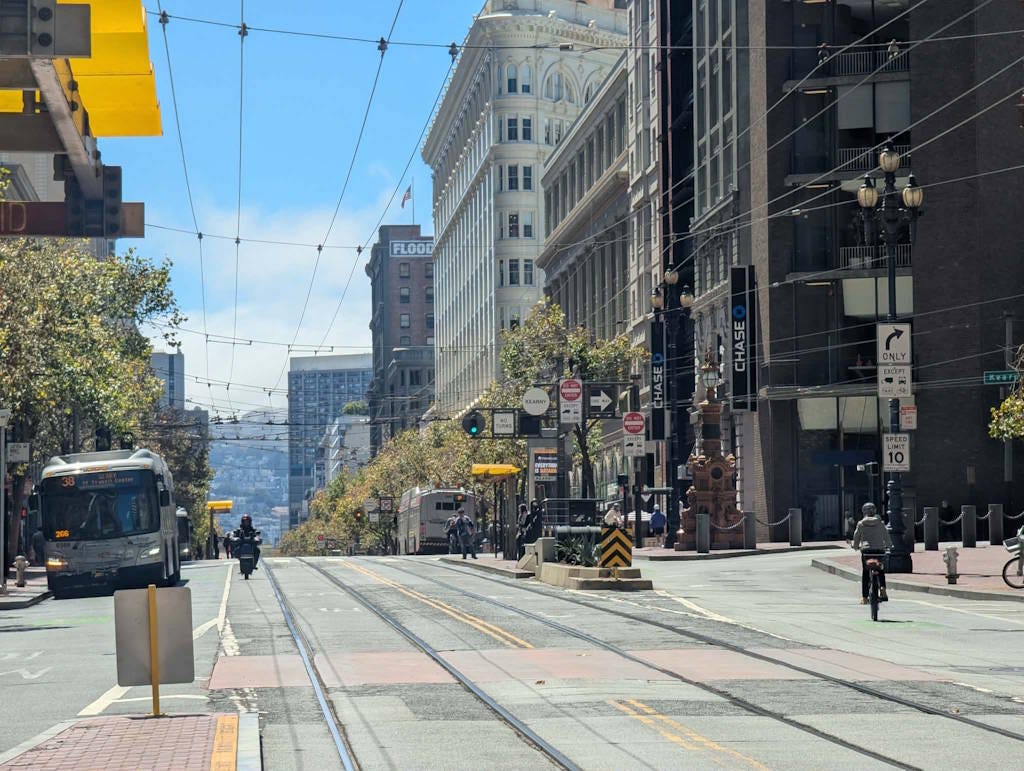
I still remember the first time I set foot on Market Street. I was a freshman in college, and big cities were still a very new thing to me. It felt like I was swimming through an ocean of foot traffic; the towering shops and hotels seemed like they were built by giants.
That Market Street is gone now. In its place is a giant empty field of asphalt in the center of San Francisco — a desolate gray waste baking in the sun, empty except for the occasional bus and a tiny smattering of bicycles.
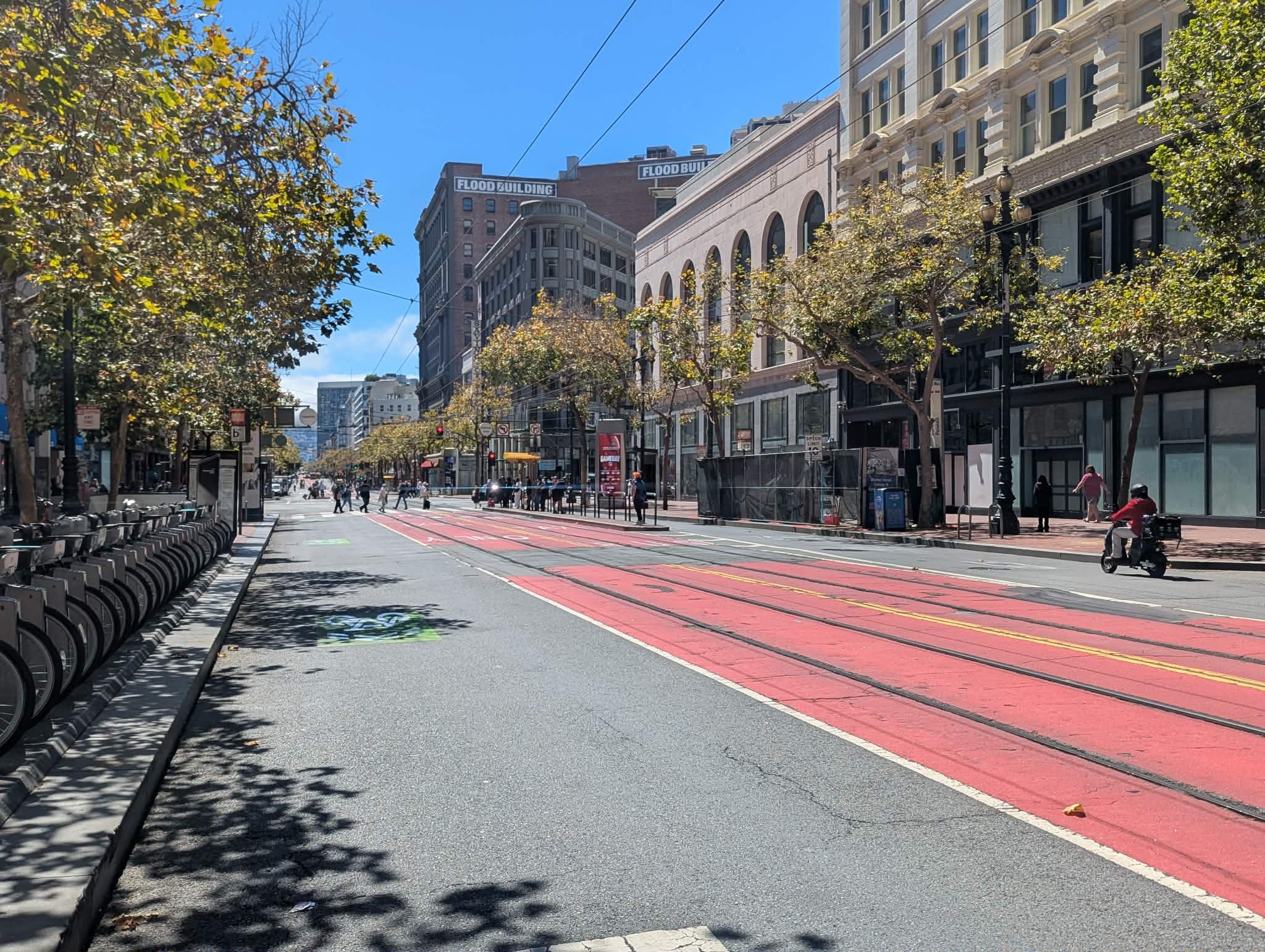
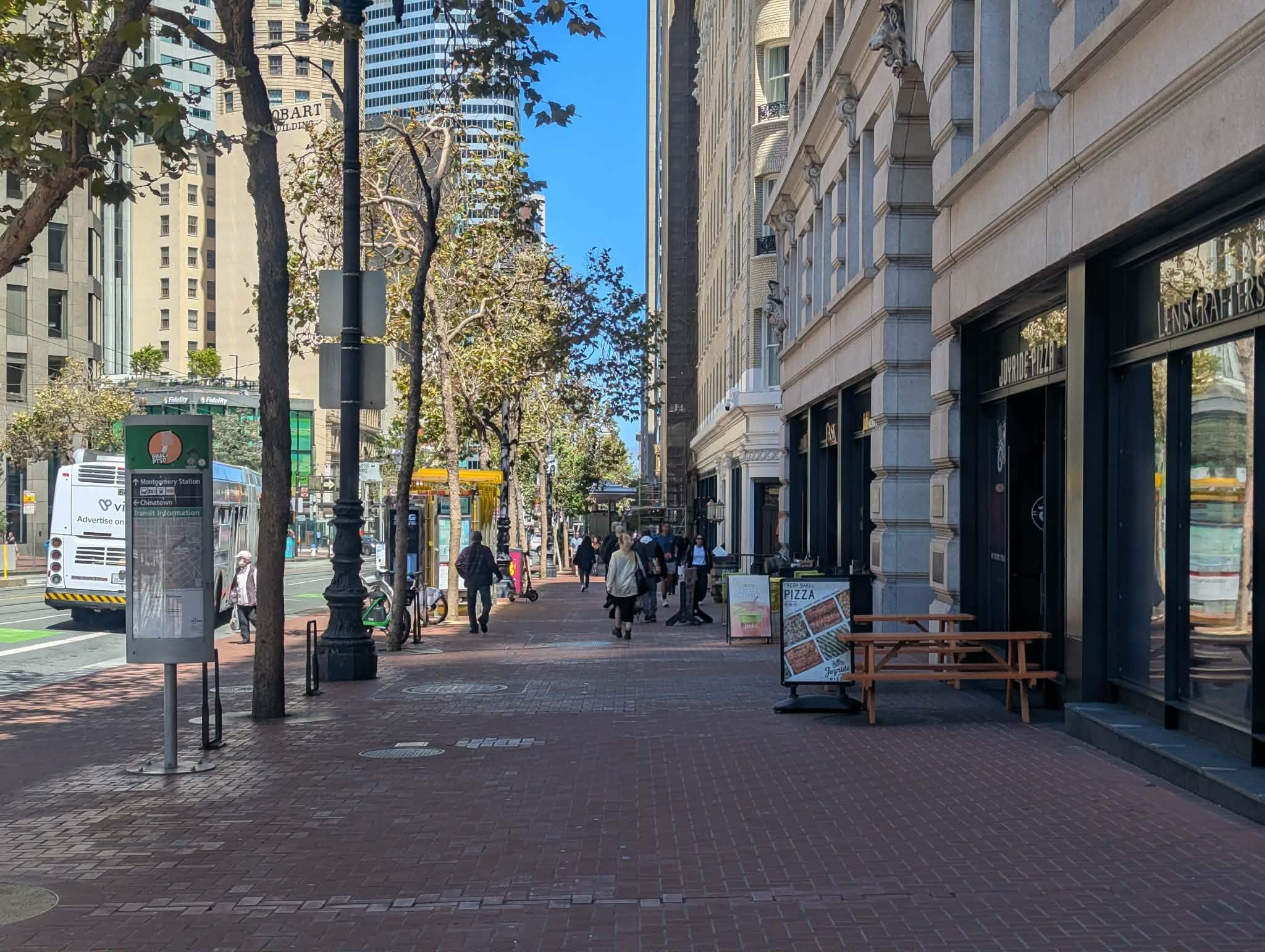
On either side of this yawning wasteland are giant sidewalks with only a few pedestrians, boarded-up stores, and the occasional small, sad retail chain. At midday on a Monday, what was once the bustling commercial heart of San Francisco feels abandoned.
What happened? In fact, Market Street was destroyed by several things:
The city’s decision to close the street to cars (but not buses), enacted in 2019
The crime wave of the early 2020s
The pandemic, and the shift to remote work
The second and third of these, together, are known as the “Doom Loop”. It’s been talked about a lot, so let’s just cover it briefly.
The pandemic, and the economic and social changes it brought, came out of the blue. But San Francisco was particularly vulnerable to the shock. As in many American cities, 20th century urban planning and zoning rules concentrated office buildings in the downtown area and put housing farther out. This meant that once people stopped going downtown for work, the neighborhood was just a lot more empty, because almost no one lives there. This is in contrast to big cities in Europe and Asia, where downtown neighborhoods are typically mixed-use. (SF also had a stronger shift to remote work, because of the heavy presence of the tech industry.)
The crime wave was another shock. Although SF escaped the destructive rioting that hit other West Coast cities like Seattle, Portland, and Los Angeles in 2020, it had plenty of looting in downtown areas — especially around Union Square and the San Francisco Centre mall on Market Street. Even after the pandemic ended, San Francisco suffered especially hard from the statewide wave of “smash-and-grab” store thefts. It got so bad that American Eagle actually sued the San Francisco Centre for being negligent toward crime, reporting over 100 serious incidents of violence and harassment in its downtown store.
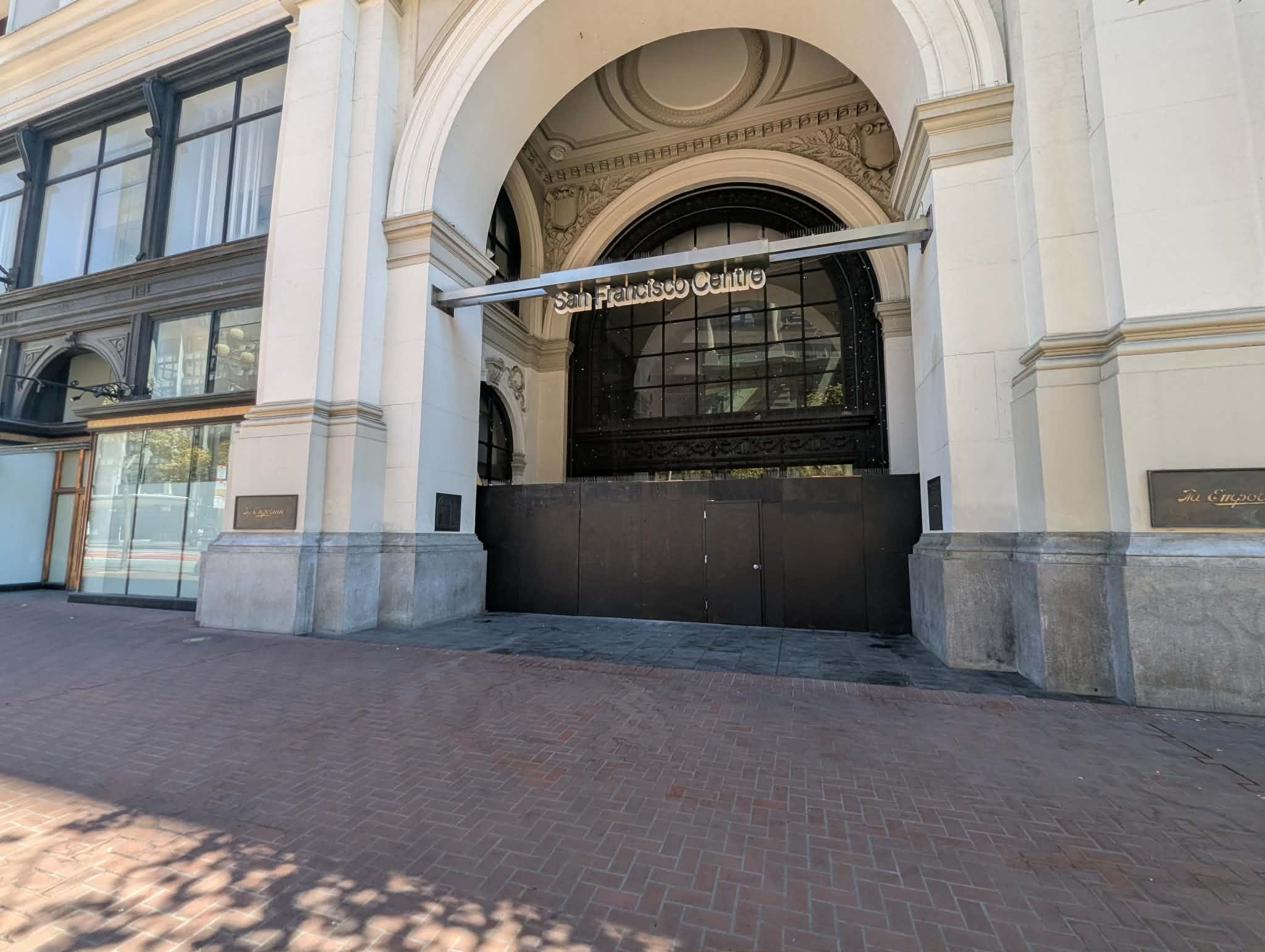
Crime and emptiness fed on each other. Less foot traffic meant fewer “eyes on the street” to discourage property crime. Property crime and reduced foot traffic forced stores to close. Fewer stores meant less foot traffic, and so on. The collapse of downtown culminated in January 2026 with the closure of the San Francisco Centre, the iconic mall that had formed the commercial heart of Market Street, but which had been gutted by the Doom Loop. It now stands as a looming, empty, boarded-up structure dominating the area around the Powell Street train station:
The intersection of Powell Street and Market Street, once bustling and alive with tourists, shoppers, and street vendors, is now virtually empty, except for a forlorn line of people waiting to get on the iconic streetcar:
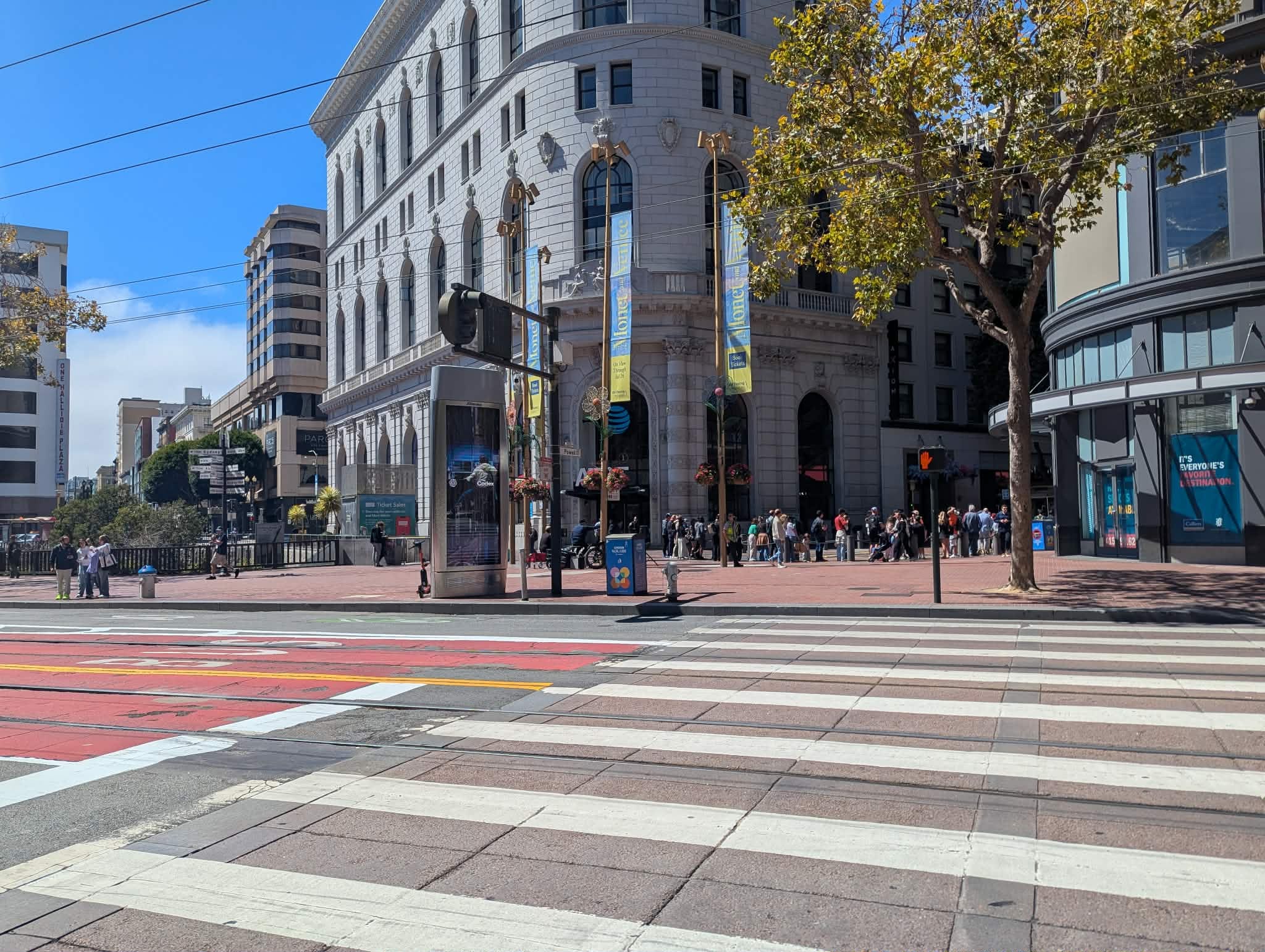
But recent years have seen the first glints of recovery from the Doom Loop. For one thing, crime has begun to fall. 2025 alone saw a 27% decrease in property crime, including a 29% decrease in burglaries, a 22% decrease in larceny (including retail theft), and a 24% decrease in robbery. 2026 has seen further drops. The reasons for this are interesting, but I’ll go into them another time. Suffice it to say that this has made downtown SF feel much safer and more orderly. The stereotype of SF as being overrun by drug addicts and dangerous vagrants still holds true of a few areas of the city, but from Powell Street to the bay, the city no longer feels like a post-apocalyptic movie.
Meanwhile, the business district is showing a few sluggish signs of life. The AI boom is causing a (modest) rebound in the demand for office space. Some office buildings are being converted to housing, raising hopes that SF’s downtown can finally become a mixed-use neighborhood. A concerted effort to revive Union Square after the devastation of 2020 is beginning to bear fruit. And both companies and the SF city government are mandating return-to-office policies.
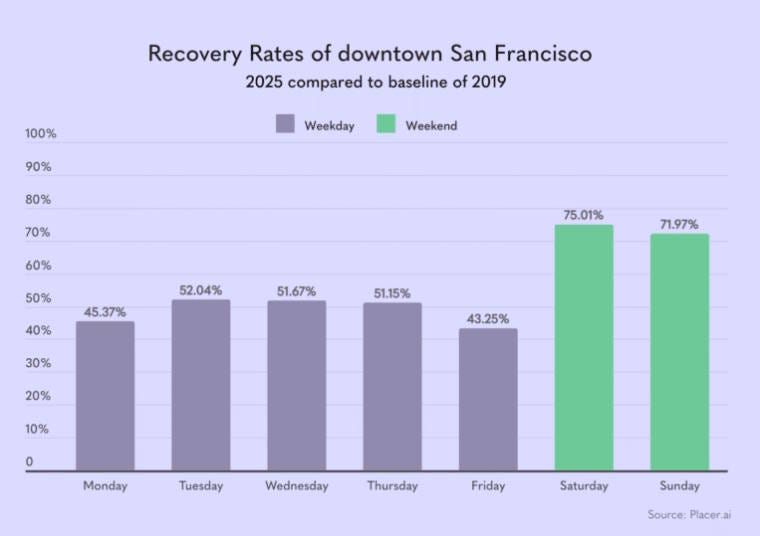
And yet Market Street remains a dead zone. Weekday foot traffic is still down by half compared to 2019:
The wounds inflicted by the Doom Loop will take lots more time and effort to heal. Retail businesses have to be encouraged to open. Defunct buildings have to be torn down and rebuilt. Crime has to be reduced even further, and so on. This will all take years.
But there’s one other factor contributing to the death of San Francisco’s most important street, and it began before the pandemic: The ban on cars.
In recent years, a number of cities around the world have experimented with car-free zones and traffic reduction policies in their downtown areas. The most famous of these is Paris, with its Limited Traffic Zone, its expansion of pedestrian malls, and its road closures during Sundays and holidays. Shortly before the pandemic, San Francisco decided to enact a plan its leaders thought was in the same spirit: closing downtown Market Street to all car traffic:
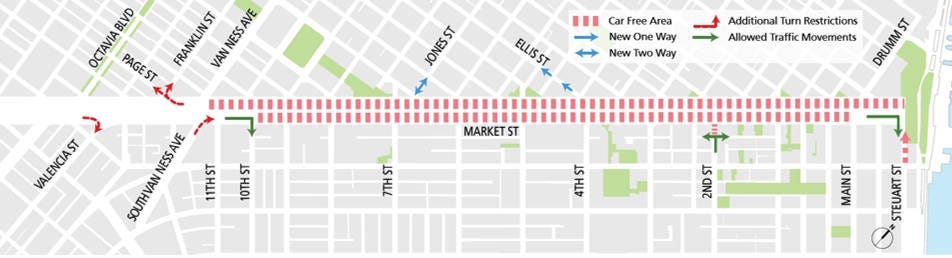
But although Market Street was closed to cars, it wasn’t closed to buses, delivery trucks, and licensed taxis. This was in keeping with the general “transit good, cars bad” thinking of modern progressive urbanism. But a bus will kill a pedestrian just as easily as a car will, which is why Market Street remains empty of pedestrian traffic. This mathematically guaranteed that Market Street would become a more empty place: Cars were subtracted, but pedestrians weren’t added.
The direct cost of this policy is pretty obvious. When people can’t park in a parking garage on Market, and when Uber and Lyft can’t pick people up and drop people off on the street, it makes businesses on the street less attractive to visit. Sure, people could bike or take the train, but not everyone wants to do that; instead, they’ll just go to restaurants or stores in other areas. In addition, restaurants on Market Street now can’t deliver food, cutting them off from an important source of revenue. That probably helps explain why Market has suffered more from the Doom Loop than other areas.
But what did SF gain by deleting cars from Market Street and adding nothing at all in their place? Cars create a little bit of pollution (though modern cars are very clean), so that was removed. Pedestrians who run off the sidewalk and into the street are somewhat less in danger of being killed (though still in danger). These are meager benefits indeed.
What about bike traffic? Presumably, reduced danger of being hit by a car would allow more cyclists to ride down Market Street. But in fact, bike traffic on the street is considerably lower than it was pre-pandemic:
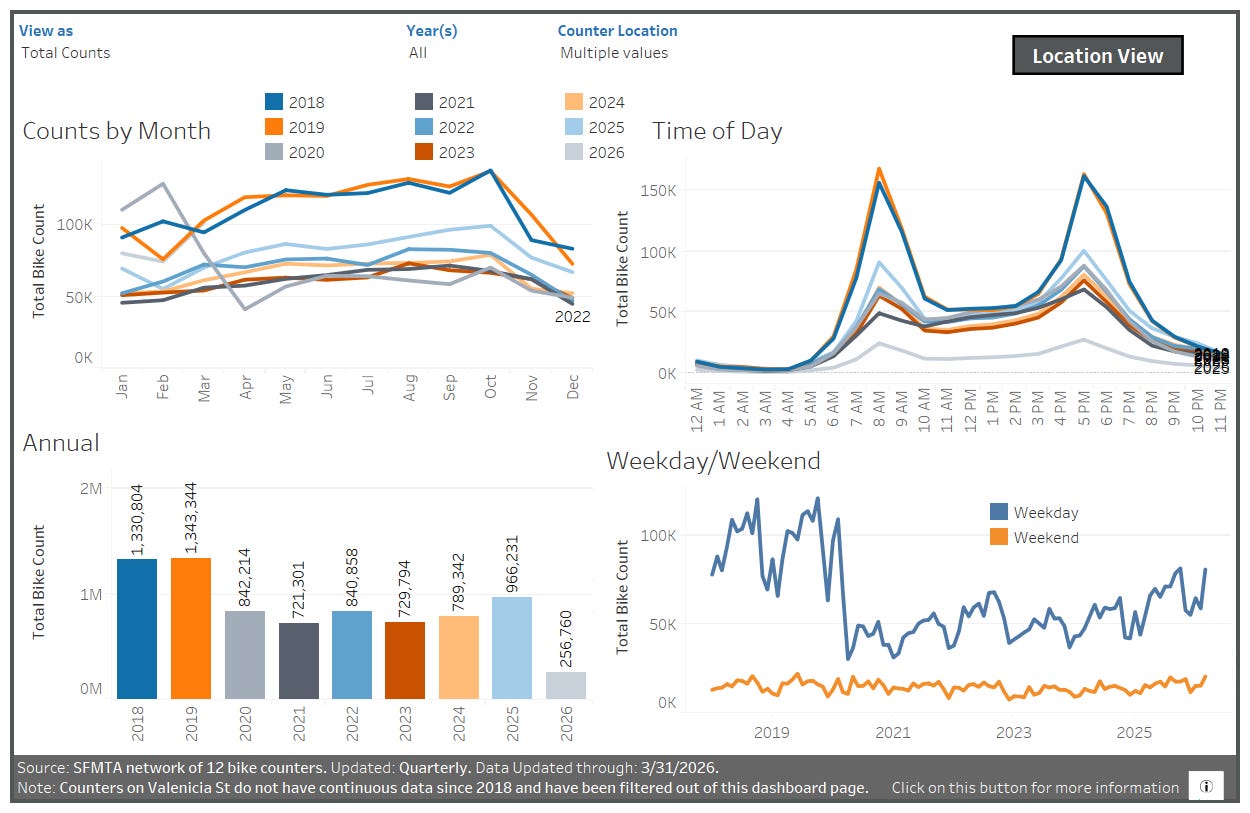
A lot of that is the Doom Loop — there are simply fewer stores for cyclists to visit on Market Street, so there’s less reason for them to go there. But much of downtown hasn’t collapsed the way Market Street has, and presumably cyclists could use the street as a way to get to places like the Embarcadero, Chinatown, etc. They’re not doing it. Cyclists are a relatively rare sight on Market these days.
One reason might be that although the city planned to make the car-free stretch of Market more bike-friendly, it never really followed up on those plans. So it’s still pretty dangerous to ride a bike or scooter down the street — you can get caught in the train tracks, and you can get hit by a bus or truck.


In fact, this sloppy implementation is a general pattern with the Market Street closure. Josh Koehn had a great article in 2023 about how the plan degenerated from its initial form:
A $600 million capital project called Better Market Street promised to create a futuristic boulevard that would safely buffer bicycles and scooters on elevated sidewalk lanes, separating the little wheels from rapid bus lines, vintage streetcars and pedestrians…The new vision for Market Street, advocates said, would create a safer, more vibrant multimodal avenue…More than a decade of planning went into alterations of Market Street…
But funds for anything beyond modest improvements along a three-block stretch of Market Street between Fifth and Eighth streets…have evaporated…The cost of Better Market Street, which soared above a billion dollars before being reined in to a still-staggering $604 million, is almost double the amount spent on the tormented Van Ness Avenue redesign…
City officials enraged safe streets advocates when they announced in late 2020 that the elevated bike lanes on sidewalks would be scrapped.
SF’s lack of state capacity had a lot to do with this; constant cost overruns inevitably require ambitious projects to be scaled back. The pandemic also obviously got in the way. But part of what killed the vision for Market Street is simply that the vision itself was never very good.
If you look at Paris, it’s immediately clear how that city’s car-limitation measures were designed to create spaces for pedestrians. In certain areas like the banks of the Seine, Paris didn’t just ban cars; it also banned buses and trucks, so that people could walk safely. Paris also reserved much larger areas for pedestrians on certain days.
But Market Street has no more pedestrian areas than it did in 2019. You can still only walk on the sidewalk. If the entire street were reserved for foot traffic during certain times — like SF does with Valencia Street, for example — then these periodic temporary pedestrianizations could become an event that regularly draws lots of people to the area. This could include farmers’ markets, street concerts, and other fun events. Those would give people a reason to walk around Market Street even before new businesses opened.
Alternatively, if SF permanently closed off some portion of the street to buses and trucks, that stretch of road could become a pedestrian public square, similar to the center of Times Square:
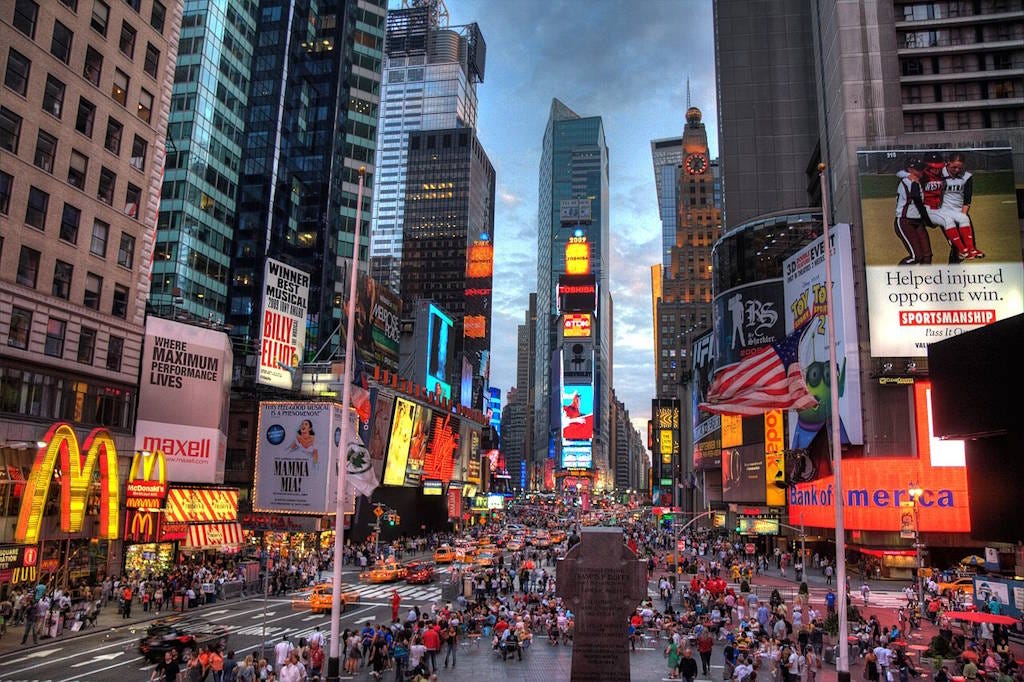

Instead of thinking about how to create spaces that people would actually want to walk around in, the SF government — and the many activist groups and nonprofits that influence its policy — appear to have adhered to the simple rule of “bikes and buses good, cars bad”.
This is a way of thinking centered around modes of transit rather than public space. It implicitly conceives of areas like Market Street as thoroughfares to take people from one place to another, rather than as actual destinations. Market Street’s car closure is all about forcing people to go down Market Street in a different way, rather than about encouraging people to go to Market Street.
There’s something inescapably and depressingly suburban about this way of thinking. In the suburbs, life is lived point-to-point — you go from house to strip-mall to restaurant to office without thinking much about the places you traverse in between. In a suburb, the mode of transportation — how you get from Point A to Point B — is the important question.
Americans are a suburban people; even many of our urban areas look like suburbs in other countries. So perhaps it’s inevitable that the urbanists who closed Market Street off to car traffic would think entirely about modes of transportation and ignore the vibrant city center whose destruction they exacerbated. Instead of Jane Jacobs, they ended up just being the Robert Moses of buses.
Again, careful attention to car limitations in cities like Paris, where people are used to occupying urban places instead of simply whizzing through them, would have proven enlightening. Paris’s Limited Traffic Zone doesn’t ban cars in downtown areas; it merely bans cars from transiting through those areas. People who stay within the area can still drive. The point is to make downtown spaces into places people occupy rather than places people simply go through. What San Francisco did to Market Street was, in many ways, the exact opposite.
In lieu of turning Market Street into a pedestrian paradise, SF’s best move is probably just to allow private cars again. It’s not the optimal way to create more foot traffic to nourish retail businesses, but it’s the quickest and easiest. In fact, Mayor Daniel Lurie has made moves in this direction, allowing certain Uber, Lyft, and Waymo cars to operate on the street. But they might as well simply go all the way. Best to simply bury the era when Market Street was a large empty scar commemorating the decline of San Francisco; if San Francisco can’t be Paris, at least it can return to what it used to be.
As a Parisian, I'm dismayed to see the positive coverage of the city's policies. Costly, never-ending works make walking (I'm primarily a pedestrian) a nerve-wracking adventure, forcing us to navigate narrow corridors while so-called embellishments go on and on. Cyclists and e-scooter riders whizz down the sidewalks and ignore traffic rules. Meanwhile, stores and eateries are shuttering everywhere. Take a walk down the Avenue Général Leclerc (the General drove down it to liberate Paris in August 1944) and the famous Boulevard Saint-Michel, and lose count of the number of places that have shut down since I came to live in the area in 2005. Excuses are made for this: the growth of suburban shopping malls, COVID, among others.
But the City makes only the feeblest efforts to fine scofflaws and revive business, preferring instead to boast of "vegetalization" (now dying in the successive heatwaves) and the reductions in car traffic, while failing to address the knock-on effects of emptier roads.
To an extent isn’t this the “Housing Theory of Everything” strikes again. To me the real key component of what closing off Market Street didn’t work as intended is your point about the lack of mixed use development. If there were actual residents living these areas then a lot of these stores would have remained open and the ones that didn’t survive would attract new businesses better suited to serve local residents.
I’m reading this thinking San Francisco Centre should absolutely become multi family housing. I know, I know very difficult to do and very costly. But you know with the exception of maybe Manhattan South if 125th street there may not be a place in America where super expensive construction costs are still worth it given the extreme high demand for housing and land costs.
Also, this is the part I’m not sure of. Shouldn’t SB79 be very conducive to apartment conversions in this stretch precisely because of the variety of bus stops on Market Street. In theory shouldn’t the law pre-empt the usual white haired residents showing up to protest changing “historic” San Francisco Centre and the shadows people will bring that will block tomato gardens?