

Would you like to see an example of a badly conceived policy? Here you go:


The bill to require discounts for self-checkout will probably not pass. But what’s notable is that if this bill did pass, it would have exactly the opposite of the effect its creators want. The stated justification is that customers are doing unpaid labor by scanning and bagging their own groceries, and that this discount would compensate them for that effort. But the bill is part of a more general effort to disincentivize automation in the retail industry, in order to protect working-class jobs:
Rhode Island was the first state in the U.S. to enact statewide self-checkout restrictions with its Restrictions on Self-Service Checkout Stations Act, which takes effect January 1, 2027. The act requires grocery stores to have at least one human-operated checkout station for every three self-service stations during peak hours…Similar legislation has either been introduced, enacted or considered in additional states including California, Massachusetts, Connecticut, Washington, and Ohio.
The standard objection to this bill, I suppose, would be that self-checkout already gives shoppers a discount, because it allows stores to save money on hiring human labor, and that these savings get passed on to consumers in the form of lower prices. That argument is correct as far as it goes, but it means the debate ends up as one of technocracy versus populism — protecting the livelihoods of a few cashiers versus giving a huge number of consumers very slightly lower prices. There’s no simple or easy conclusion to that debate.
But in the case of New York’s proposed self-checkout discount, the problem is that the bill would actually make grocery stores fire human cashiers in favor of more self-checkout.
To understand why this is true, first imagine an incredibly extreme version of the policy. Imagine that instead of 10%, you made a law forcing grocery stores to give a 90% discount for self-checkout. This is exactly the same as forcing stores to charge 10x for using a human cashier. Who would pay 10x for groceries, just to use a human cashier? Basically no one. So everyone would go use the self-checkout machines, and stores would have no need for human cashiers at all.
But wait, you may be thinking. How could any store afford to give a 90% discount on groceries? The same way they give discounts for seniors and students at movie theaters. You just raise the sticker price, so that the price people actually pay after the discount is the same as before. So instead of keeping human-cashier prices the same and cutting prices for self-checkout, what stores would actually do if you made them give 10% discounts for self-checkout is to raise prices across the board — not by 10%, but by enough so that overall revenue is just about the same as it was before.
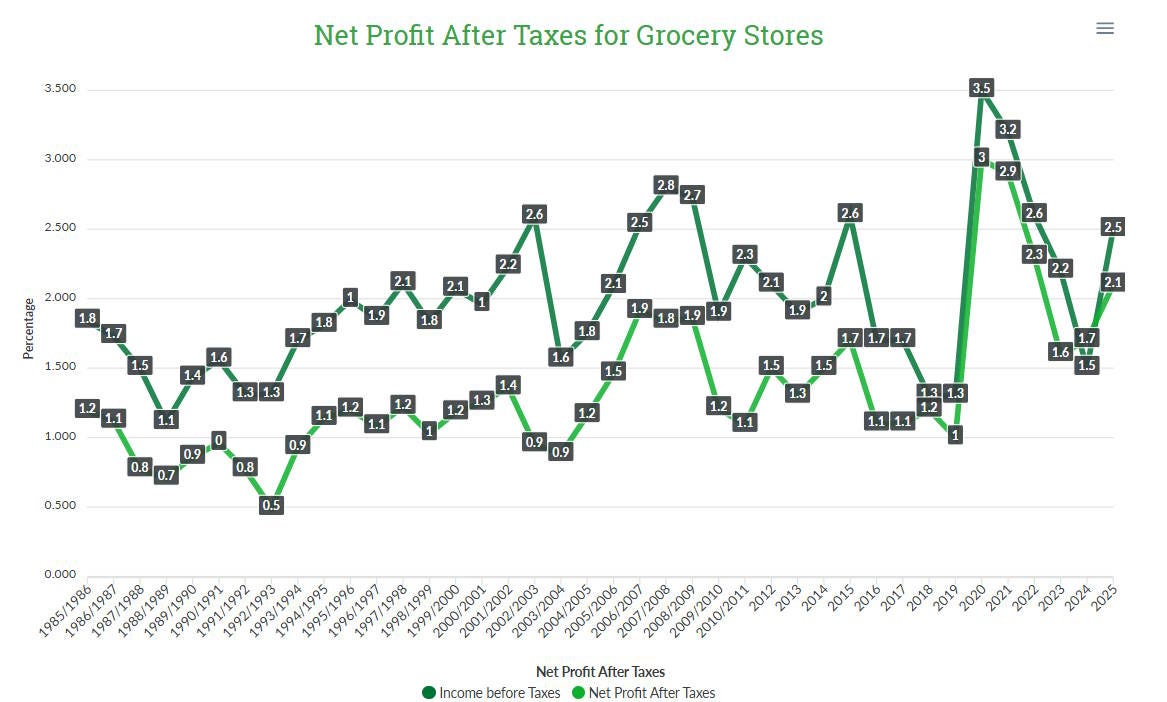
How do we know this is what will happen? Because the grocery store industry is very competitive. Profit margins are almost always between 1.5% and 2.8%, which is very low compared to the average industry:
It’s not just profit margins that demonstrate this — there are tons of grocery stores, and new ones enter the market all the time. This means that if grocery stores tried to respond to the New York bill by getting rid of self-checkout and using only human cashiers — in order to charge higher prices and make higher profits — other stores would undercut them by offering self-checkout with big discounts. People would flock to those other stores, and the stores that tried to overcharge would lose business until they, too, put in the self-checkout machines.
This is kind of like if you told grocery stores to charge 10% more for Skippy peanut butter than for Jif peanut butter. Obviously stores would want to stock more Skippy, because they’d earn more money on each sale. But obviously consumers would want to buy more Jif, because it was cheaper. At the end of the day, the consumers would win, because consumers tend to win out when an industry is highly competitive. Some people would still buy Skippy, because some people just really like Skippy more, but overall, forcing one brand of peanut butter to cost more than another brand means you’ll have less of it on the shelves.
By the exact same reasoning, forcing stores to charge more for purchases scanned by human cashiers will end up getting a lot of cashiers fired and replaced with self-checkout machines.
As policies go, this example isn’t particularly hard to explain, or to understand. If you ask any economist, or any good AI, they’ll give basically the same answer, in different words. It would be a good question on an undergrad microeconomics exam. But when I tried to explain this on X, some people had a lot of trouble understanding:


The idea of a 10% discount on self-checkout as a way to incentivize human employment is pure “slopulism” — stuff that seems like populism, but wouldn’t achieve the results that people want from the policy.1 It’s snake oil that sells well based on people’s inability to see the consequences of what they’re being sold.
Slopulism is an inevitable outgrowth of populism. Once people decide that technocrats, elites, experts, and gatekeepers aren’t worth listening to, they become vulnerable to all sorts of policy scams. In general, these scams fall into two categories:
Accidental scams, where the people making the policy just don’t understand what they’re doing
Ideological scams, where ideologues sell the public on an ideologically-driven policy by pretending it offers benefits that it doesn’t really offer
The second of these is more dangerous than the first. Slopulism that arises out of pure ignorance is very hard to correct, and social media — which elevates the dumbest and loudest at the expense of the most well-informed — probably makes it harder. But in the end, patience, education, and reason can overcome accidental slopulism — and AI may help a lot.
But when slopulist ideas are being promoted by smart people with ulterior motives, it can be a lot harder to wake the populace up. At that point, there’s the danger that slopulism becomes a bipartisan equilibrium, with each party’s ideologues executing a coup against the reasonable moderates by appealing to slopulist instincts.
