


I have a fun announcement today, which is that I have a new side gig. I’ll be joining the Japanese VC firm Coral Capital as a Venture Partner! That’s less prestigious than it sounds — basically I’ll just be doing a few blog posts and helping to introduce them to folks in the U.S. But it’s still cool, and the Coral team is really great. The reason I’m doing this, of course, is to encourage more American investment into Japan, in order to revitalize that country’s economy. That was the subject of my book, The Weeb Economy (alternate title: Weebs Will Save Japan), which Coral helped to promote. I also want to contribute to Japan’s ability to defend themselves from an increasingly threatening regional environment; Coral is involved with defense tech as well.
Anyway, here are some excerpts from Coral’s announcement:
Today we’re thrilled to announce that Noah Smith is joining Coral Capital as a Venture Partner…Noah is one of Japan’s greatest champions on the world stage…He lived in Japan for years, speaks the language, and has spent two decades studying its economy. Last year he published Weebs Will Save Japan (Nikkei BP), a book on how Japan’s cultural gravity and industrial strengths can power its next era of growth. His next book, now in progress, covers Japan’s defense tech sector and national security. He has argued forcefully that Japan should attract more foreign capital and talent, that Japan can be America’s arsenal, and that Japan’s manufacturing prowess is one of the most underpriced assets in the global economy.
Long before we started working together, Noah was already making the case we’ve built our firm around…
The world’s focus is shifting from bits back to atoms. Reindustrialization, defense, energy, robotics, and physical AI are the defining investment themes of the next decade, and they play directly to Japan’s strengths. In these industries, language and culture barriers matter far less than monozukuri, the process power and manufacturing know-how Japan has compounded over decades. And as the world de-risks from Chinese supply chains, Japan has a once-in-a-generation opportunity to deepen its ties with the United States and fill the manufacturing voids being left behind…
Japan is America’s most important ally. It is the largest foreign direct investor in the United States, and Japanese companies support more American manufacturing jobs than any other foreign investor. Japan hosts more US service members than any other country in the world. The US-Japan corridor is the most consequential economic relationship in the world right now, and we intend to be the firm that bridges it.
This is the thesis we laid out in JAPAN IS BACK, and it’s why we’ve partnered with companies leveraging Japan’s strengths to compete globally. Anduril is not just selling to Japan but building in Japan, with plans to invest billions in manufacturing capacity here. Kyoto Fusioneering, TeraWatt Technology, Ookuma Diamond Device, GITAI, and many more are taking Japanese hard tech to the world…The lost decades are over. It’s time the whole world knew.
So anyway, you’ll be hearing a little more about that in the coming weeks and months!
OK, on to the roundup. First we have a very fun podcast appearance, in which I discuss a wide variety of topics with former streamers Lukas and Saila on their podcast, Plausibly Deniable:
And here’s a Spotify link if you prefer.
OK, on to this week’s interesting stories!
1. The humanities are dying
Back in 2022 I wrote a post arguing that the boom in humanities and social science education had created “elite overproduction” — too many educated people expecting high-status jobs, and not enough academic, journalistic, legal, political, and nonprofit jobs to satisfy their dreams. I argued that this was one reason for the social unrest of the 2010s, as legions of frustrated smart people spent their energy and extra time attacking the American system they felt had jilted them — and applying ideas they had learned in academia to modern American politics via social media.
But whether or not that argument was right, I don’t think overproduction of humanities scholars is going to be a big problem going forward. From a new study called “The Humanities in Crisis” by Ober et al., here’s a chart of the number of humanities dissertations in the U.S.:
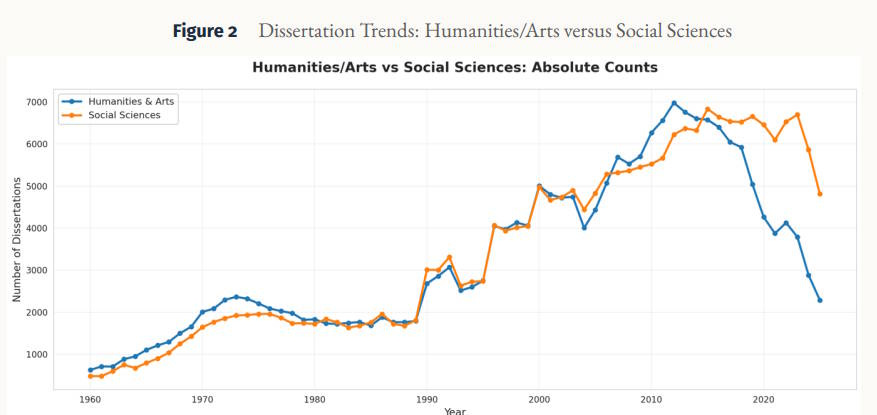
Interestingly, the humanities decline has been going on for over a decade, while the decline in the social sciences is post-pandemic.
Why this is happening is not clear yet. Most people talk about the humanities being colonized by wokeness and driving reasonable people away from the field (Ober et al. discuss this theory at length). I personally suspect that the difficulty of getting a job as a humanities PhD is probably a bigger factor. Fewer undergrads are majoring in the humanities because they think it isn’t a good route to getting a job; this means less demand for humanities profs, and thus for humanities grad students.
But whatever it is, the humanities are clearly dying in American academia.
2. Krugman’s data center crowd-out story is fishy
I love Paul Krugman, and he’s usually right about things, but I do think he’s had a bit of a blind spot when it comes to AI. In a recent post, he argued that the data center boom is crowding out other types of investment:
Massive spending on data centers is crowding out investment in everything else in the economy…Surges in private spending, like the current immense AI boom…drive up interest rates. And that is where we are now: the surge in AI spending is driving up interest rates and crowding out all other investment. Indeed, in my October 4 primer I argued that the AI boom is the main cause of soaring long-term interest rates…
In other words, all that money going into construction of datacenters and purchasing foreign produced semiconductors comes at the expense of investment in everything else…[C]onstruction of datacenters appears to be diverting funds and resources from the construction of housing, office buildings, and factories — more or less everything that isn’t AI-related.
But as Alex Tabarrok notes, the first chart Krugman uses to tell his story — courtesy of Steve Rattner — actually tells the opposite tale:
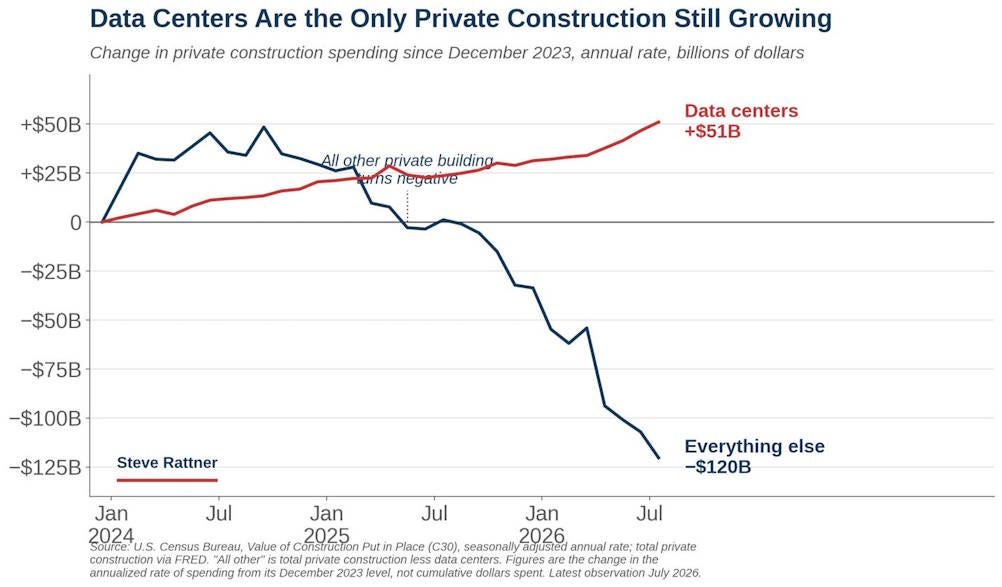
First of all, how is $51 billion of data center spending supposed to crowd out $120 billion of other spending? If supply curves slope up and demand curves slope down like they’re supposed to, a positive shock to the demand for data centers should only partially crowd out other spending.
Of course it’s possible that non-data-center investment is being crowded out not just by current data center spending, but by forward-looking expectations of even more data center spending in the future. That’s perfectly reasonable — interest rates might have risen in response to those forward-looking expectations, choking off non-data-center investment immediately.
But as Tabarrok also points out, the timing for that story is very odd. Rattner’s chart shows non-data-center construction falling off a cliff sometime in mid-2025. But the big rise in real interest rates happened three years earlier in 2022-23:
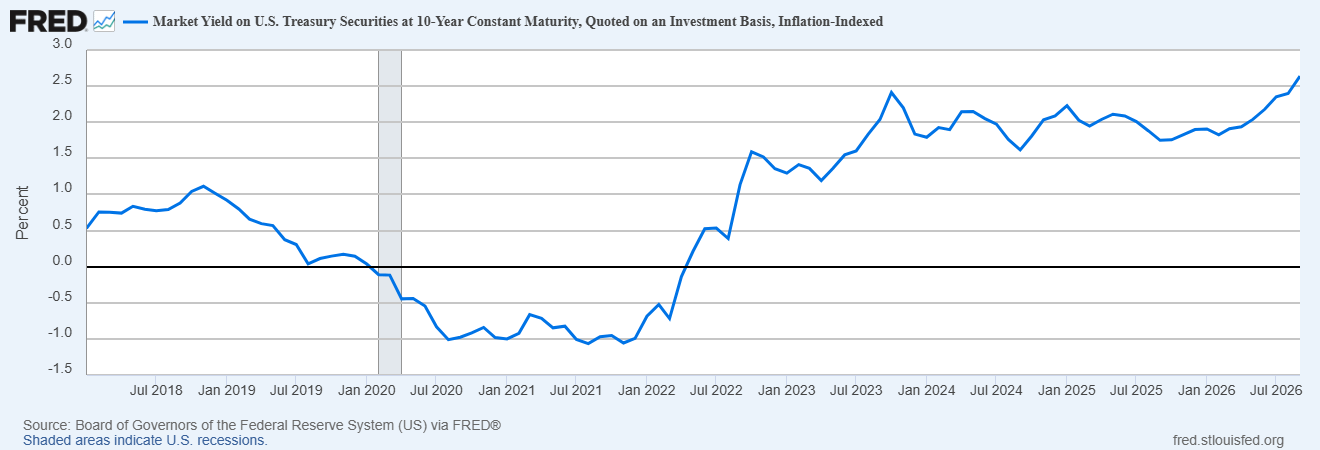
Why would it take three years for rising rates to start crowding out non-data-center construction? It’s not clear.
So for Krugman to be right, the sequence of events has to have gone like this:
Real rates rise in anticipation of AI boom (1/2022 - 10/2023)
GPT-3.5 and GPT-4 make everyone realize AI is a big deal (12/2022-3/2023)
Non-data-center construction falls years later (8/2025)
That could be true, I suppose — any macroeconomic story will generally hold up if you throw in enough assumptions about long and variable lags — but it seems pretty fishy! In any case, just posting charts of “data center go up, other stuff go down” is not sufficient to prove that significant crowd-out is occurring.
3. China’s local governments are in big trouble
Because of the history of how Europe developed strong governments, we tend to associate state capacity with high taxes. But that’s not always the case. Despite its fearsome state capacity, the People’s Republic of China has always been a low-tax country. A lot of the responsibility for paying for public goods — and, until recently, for industrial policy — was farmed out to local governments. But instead of collecting taxes — much of which they would have to remit to the central government — those local governments often chose to sell real estate to pay for their operations.
That strategy is now hitting a wall. The country’s property sales are crashing:
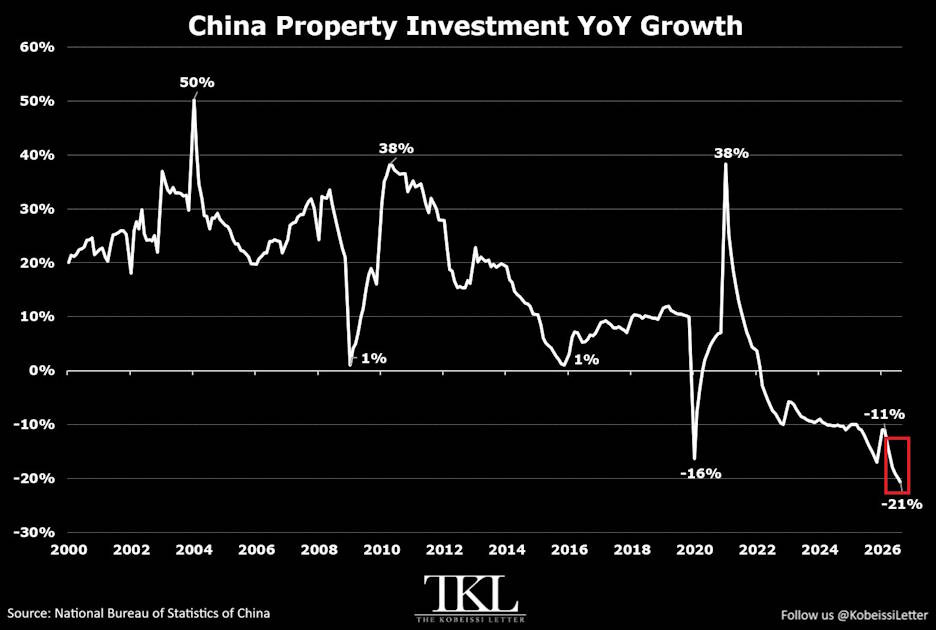
So China’s local governments are no longer taking in nearly as much money as they used to. As a result, they’re going deeply into debt. Shih and Elkobi have a new paper showing the extent of the problem. They write:
[W]e show that fiscal autonomy has been heavily eroded in the vast majority of localities in China since 2018. The bond data show that by the end of 2025, average monthly debt servicing had surpassed 50 per cent of monthly budgetary and extrabudgetary income for all but seven Chinese provincial units.
The problem is the collapse in property sales (“EBF”):
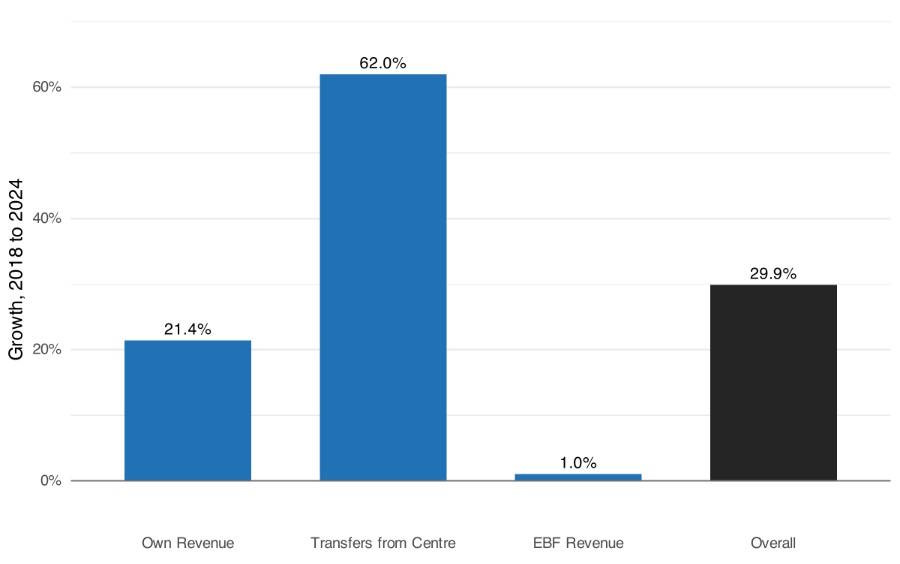
The central government will pick up the bill, but it’s heavily indebted as well, so it will pay the local governments’ bills only reluctantly.
The upshot here is twofold. First, the relative provincial autonomy that drove China’s dynamism during the 1990s, 2000s, and early 2010s may now be over; everything looks likely to be increasingly centralized. And second, China’s local governments are going to be too burdened by debt to do much of anything for a few years. China’s local governments were one of its strongest engines of growth during the long boom, but that era looks like it’s over now.
4. Is AI the vindication of financial capitalism?
The speed of AI progress has been truly dizzying. A lot of this has come in the form of cost declines — each AI task keeps getting much much cheaper every year. Epoch AI has a good chart showing this:
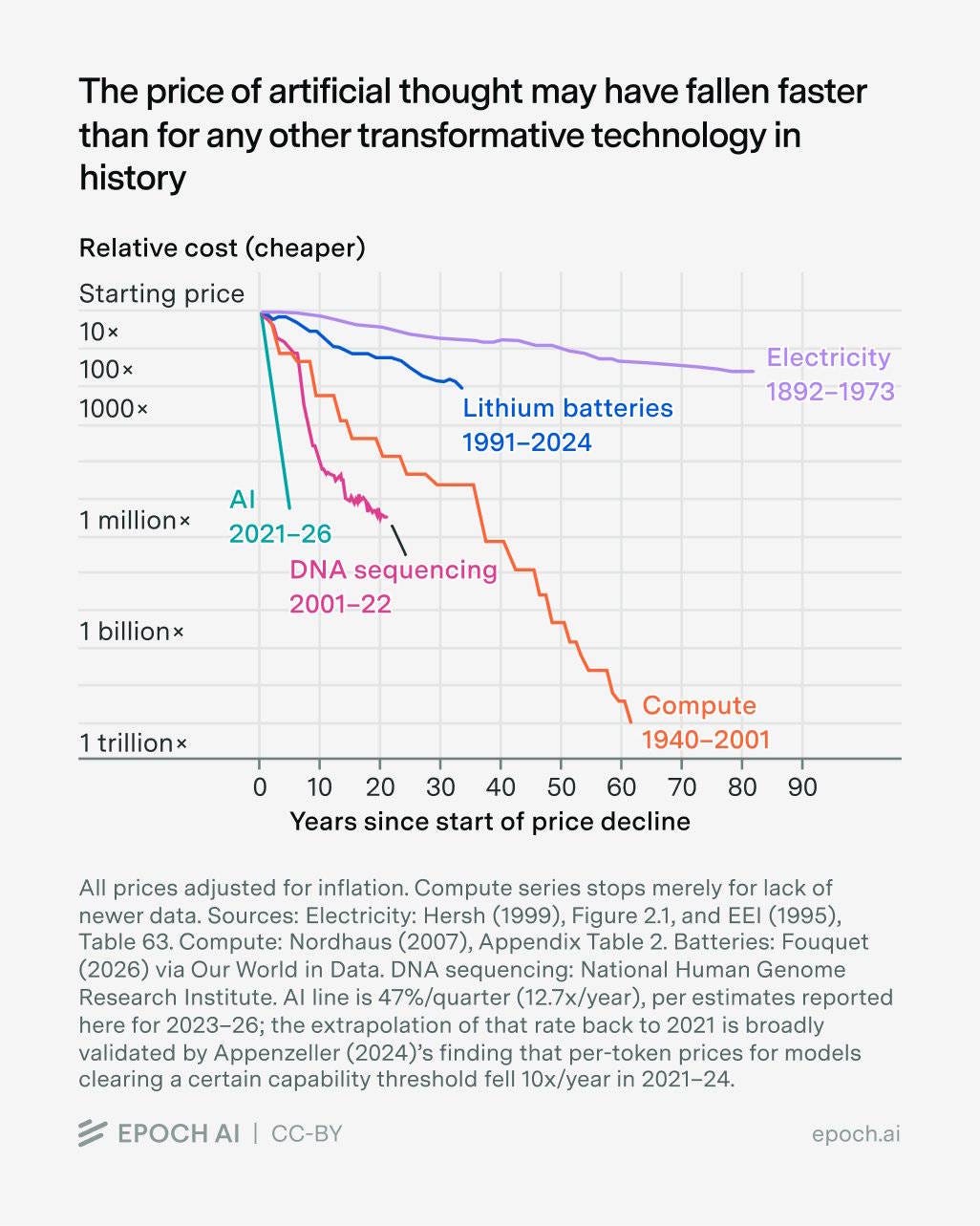
But Karthik Tadepalli estimates that if we look at AI’s cost decrease as a function of how much we’ve spent on AI research, it doesn’t stand out as much:
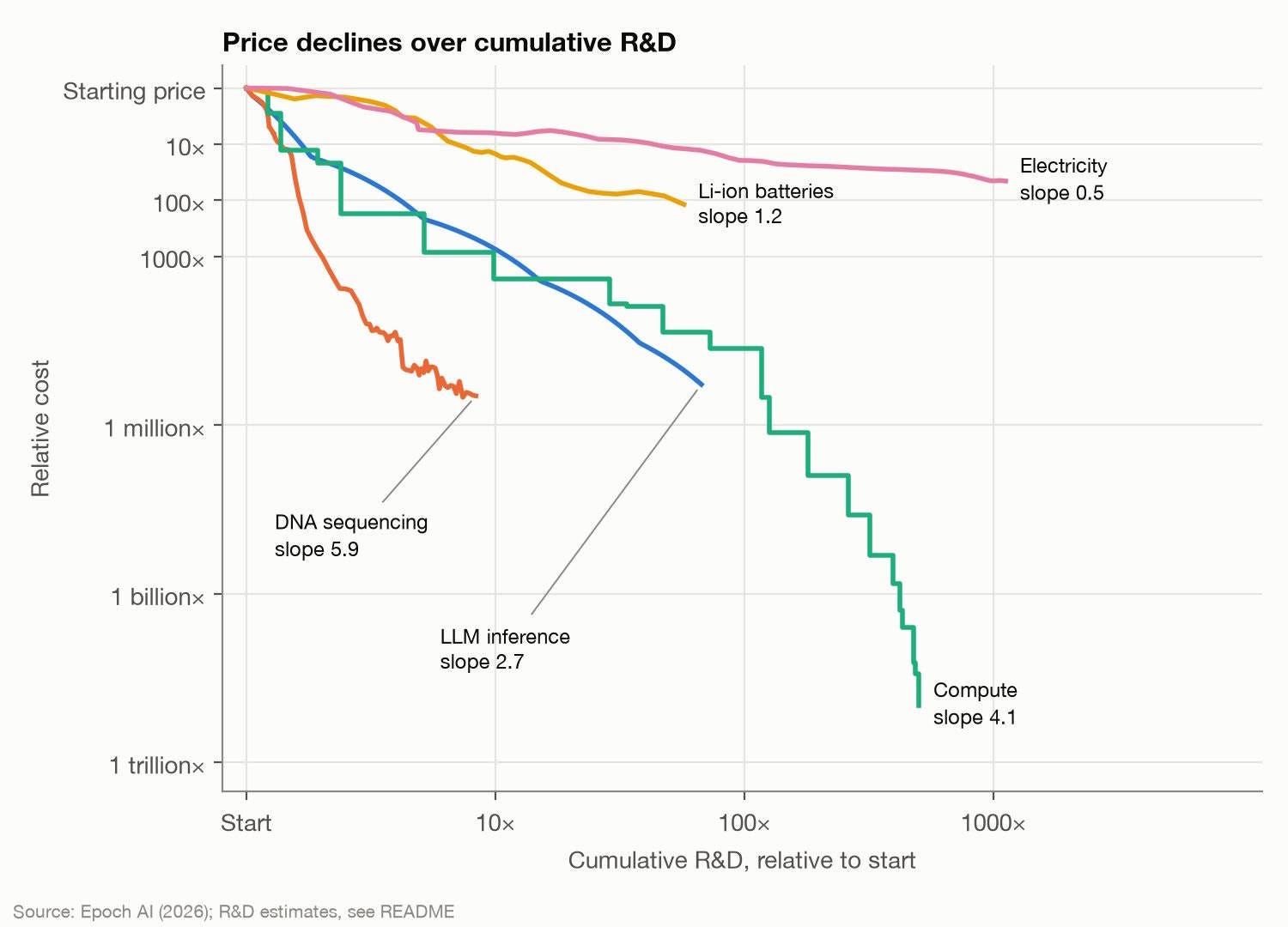
In other words, a big reason AI is getting so cheap, so fast, is that we’ve been pouring unprecedented amounts of cash into making it better. In fact, we’ve been basically spending all the cash that we saved over the previous decade and a half of hoarding cash.
James Gilliland wonders if this was the plan all along:
It pains me to say this, but if we actually “get AGI,” the resulting boom in industrial capacity from robotics and massive society-wide wealth creation will look like a total vindication of neoliberalism…The discourse about financialization and offshoring being a generational mistake may be replaced by a very different historical interpretation: that the late 20th and early 21st centuries were an enormous capital-accumulation phase, freeing up civilization-scale pools of liquid capital that could ultimately be deployed to accelerate and bring about the most consequential technological phase-change in human history…In that telling, what looked like deindustrialization and betrayal from inside the period (I grew up in the Rust Belt, I know) becomes the prelude to reindustrialization on an almost unimaginable scale.
For decades, it looked like financial capitalism was broken — no one was thinking for the long term, everyone just cared about quarterly numbers and shareholder buybacks, equity couldn’t fund massive investments, everyone just wanted to maximize short-term profits and outsource anything capital-intensive to China, and so on.
Then AI came along, and suddenly it looks like we were actually saving up for something useful. We weren’t, of course — no one knew AI was as big of an opportunity as it’s proving to be. But maybe financial capitalism worked. Maybe companies like Google just looked at the available investment opportunities before AI and said “Nah” — just like Corporate Finance 101 says they were supposed to do.
And then finally a good investment opportunity came along, and they poured in every dollar they had — and it worked.
5. A cool Japanese trick for building more housing and infrastructure
Going to Japan can be a radicalizing experience for Westerners. The cleanliness, the lack of crime, the artistry, the attention to detail, and plenty of other things make Japan feel almost magical. But one of the most magical things is the housing. Japanese cities build enormous amounts of housing — far more than their counterparts in the U.S. Housing in Tokyo or Osaka isn’t exactly affordable — Japanese salaries are far lower than American salaries — but regular people can afford to live fairly near the city center, and Japanese rents haven’t risen for a long time.
How do they do it? A lot of analyses focus on Japan’s streamlined, efficient zoning laws. The fact that they use bureaucrats instead of courts to do environmental review speeds things up a lot as well. But an often-overlooked factor is how Japan gets local political buy-in for new housing development projects. Instead of either trying to steamroll NIMBYs or kowtowing to them — the two approaches used in the United States — Japan manages them as stakeholders in the process of local development.
Cremieux had a good blog post about this about a year ago:

One of his sources is this World Bank case study by Matsui Minoru, which explains Japan’s approach of “land readjustment”.
In the U.S., when we think of “redevelopment”, we think of a developer basically kicking existing tenants out of their homes and building something else where their homes used to be. But in Japan, it often involves building the existing tenants a new home on the same spot, which they are then entitled to rent for the same price they were paying before. Here’s an illustration:
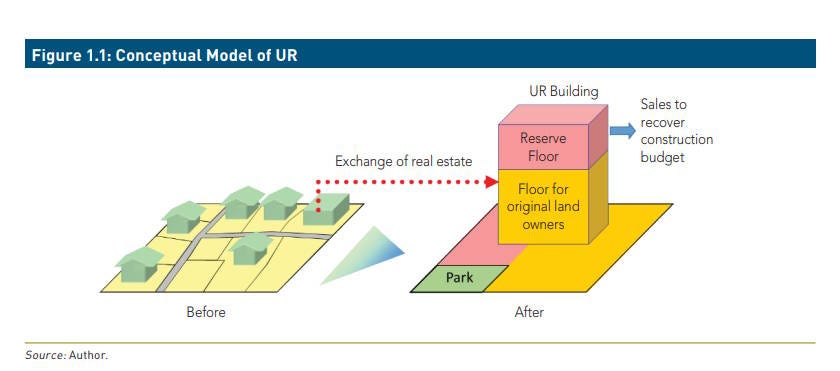
Japan actually has incredibly strong tenant protections. You’d think this would make it harder to tear down old buildings to build new housing, but thanks to land readjustment, it’s easier than in America.
Cremieux then goes on to explain how Japan uses land readjustment in lieu of America’s more forceful eminent domain laws to build high-quality infrastructure:
With land readjustment, no one is expropriated. Everyone maintains a plot and infrastructure gets built. People only compromise on size, proximity, to other plots, and so on. As a means of provisioning urban infrastructure, this is obviously going to be more acceptable to large numbers of people than is the use of eminent domain. But is it better than simply not building at all?
People who already own land might wish to keep it a certain way. Land readjustment might not be for them, and it’s likely to make them very upset because the people around them might vote to change their claims around. But enough people will agree to land readjustments in enough places that it can have radical impacts on economic geography, rewarding those who accept it with access to new infrastructure and higher densities. There will even be some people who elect to have the government or firms build infrastructure on their jointly-held parcels, letting them bid to build on their land. When the building is through, it’ll be returned to its owners in their newly-arranged plots.
People who stubbornly insist on thinking of Japan as a hierarchical, conformist, collectivist society will surely find ways to convince themselves that this is the kind of thing American individualism would never allow. But in fact, Japan’s system has far stronger protections for individual renters, while America’s system often only gets things done using the heavy hand of government.
What Japan’s land-use system really shows is the value of negotiation, compromise, and respect for individual dignity. Those are all lessons we could stand to learn.
6. Phones bad
As someone who has been shouting about the ills of smartphone-enabled social media for years now, it gratifies me to see that more people around the world — and especially in developed countries — are coming to see social media as something that’s bad for democracy:
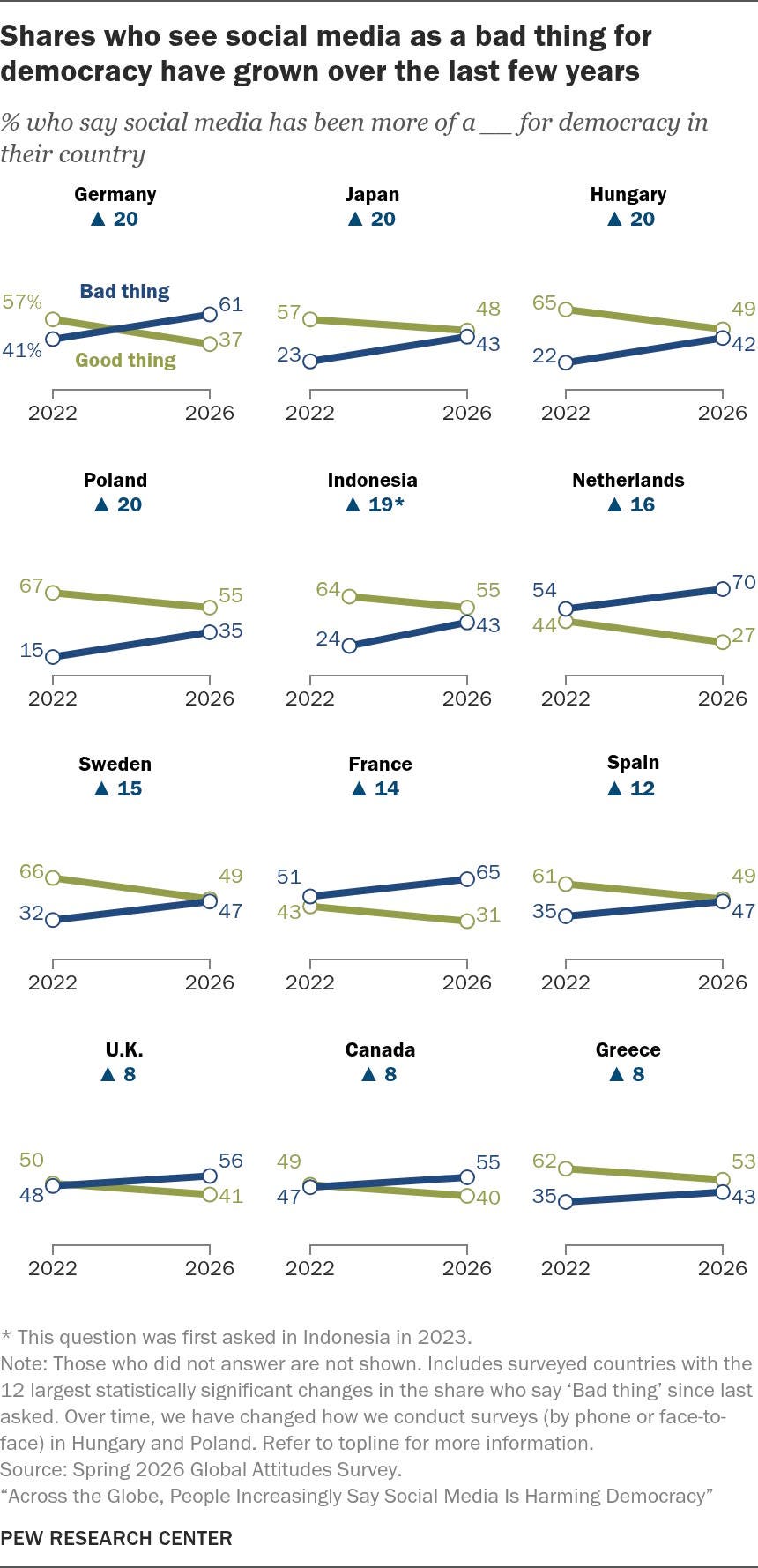
That’s in addition, of course, to other negative effects — cognitive difficulties, reduced emotional well-being, and ultra-low fertility.
What can we do about the problem? One thing we can do is to make sure people grow up without overdosing on phone-enabled social media, so that they can learn to use it when they’re older without it shaping their personalities and minds as much. Greece is leading the charge — its legislature recently passed a ban on social media for children under the age of 15.
7. China is losing market share in low-end manufacturing
Most countries’ industrial development follows a familiar pattern. They start out making simple stuff like clothes, furniture, and toys, and doing simple electronics assembly. They then shed those labor-intensive starter industries as they move up into more capital-intensive, high-tech, higher-value sectors like machine tools, autos, electronics components, and so on.
A lot of people are saying that China is going to buck this trend. The leadership has declared that even as the country moves up the value chain in traditional fashion, it wants to keep the cheap labor-intensive stuff from migrating overseas as it usually does. This is being called the “China Squeeze”, and people are writing that it threatens other countries’ path to development. If China keeps outcompeting Bangladesh, Vietnam, Mexico, etc. in the low-end industries, how are those countries supposed to industrialize?
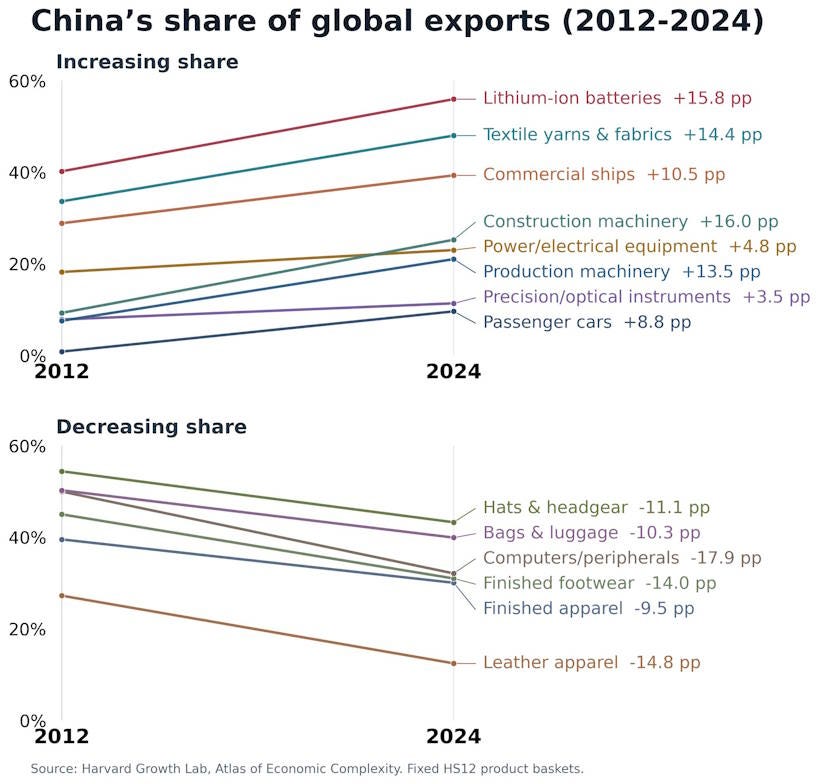
Except the China Squeeze doesn’t seem to be succeeding. Despite the leadership’s wishes, China is losing market share in lots of labor-intensive industries:
And which countries are gaining in these industries at China’s expense? Bangladesh, Vietnam, and Mexico (and some European countries):
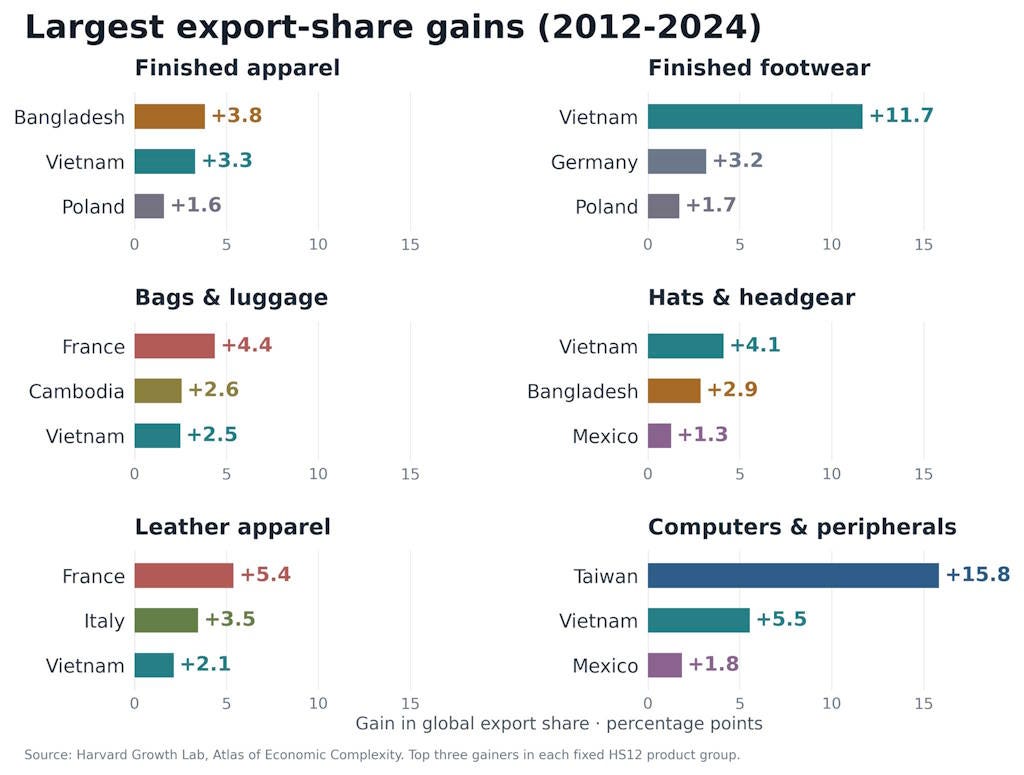
Modern pundits often just assume that the Chinese state is industrially omnipotent — that if Xi Jinping declares “This industry shall remain in China”, then indeed it shall. But the outmigration of low-value labor-intensive manufacturing industries looks like a law of nature that even the mighty CCP can slow, but not halt.
Good.
8. Rent control bad
John Burn-Murdoch did the Lord’s work when he synthesized the results of 112 studies on rent control into a single chart:
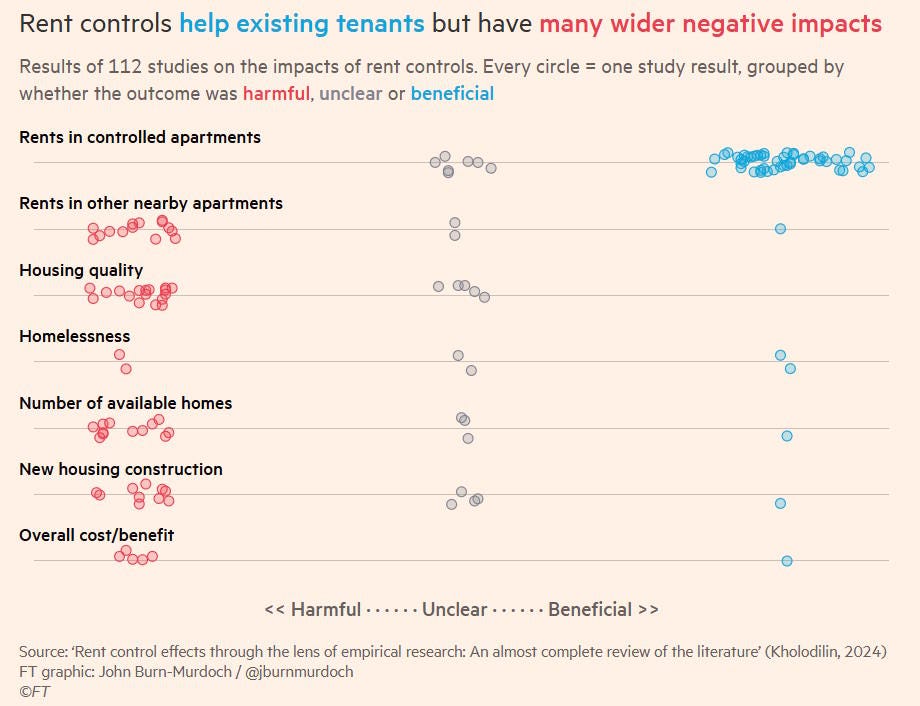
Basically, rent control helps one narrow group of people (existing tenants in the area covered by the policy) in one very specific way (restraining their rents). But it removes the incentive for developers to build new housing, which raises rents in other nearby areas and drives some people to homelessness. It also removes the incentive for landlords to upkeep their properties, resulting in decay. (And that’s not even getting into the ways that rent control policies can be gamed.)
I know lots of people love rent control, but it’s really a loser of a policy. Just build a lot more housing and hand out housing vouchers to the poor.
2. The graph you have for investment is only for the "construction" component of investment, the buildings and powerlines, which are only a small part of AI investment since it won't include the GPUs, racks, gas turbines, etc. This should be obvious because the orders of magnitude are off. US AI investment in 2026 isn't 50 billion; it's more like 500 billion. Alex Tabarrok's post quotes another graph from Krugman with his estimate of all tech vs non-tech investment, which looks much more convincing.
But ultimately any story about "crowding out" relies on what counterfactual you select. This is the gist of the disagreement between Tabarrok and Krugman, and your timing argument against. Instead of asking if there's crowding out or not, instead just ask if in another world where there weren't 500-1000 billion of AI investment in one year alone, whether interest rates would be higher or lower. That's the key question. I think the answer is non-trivial, but I tend toward higher.
Using bureaucrats instead of courts to do environmental review is not necessarily the great idea you think it is. Because local bureaucrats don't necessarily have much incentive to listen to concerns of the community, especially when they are in cahoots with the developers (as often happens in the case of large redevelopment projects particularly ones using parkland). And faster often means prioritizing developer timelines above community input. If you are interested in exploring this topic further, I would be happy to introduce you to Professor Harashina, pre-eminent scholar of environmental assessment in Japan and former head of the International Association for Impact Assessment (IAIA). He can give you an earful on all the problems he sees with how environmental assessments are conducted currently in Japan. I can also share my observations related to development projects at Jingu Gaien and other parks in Japan, where environmental assessments are mere check the box formalities, or are not even conducted at all.
I will also note in the Cremieux article you shared, where he shows two aerial before and after views, almost all the trees disappeared between the first and second photo. Don't tell me that some great environmental review was happening there...