

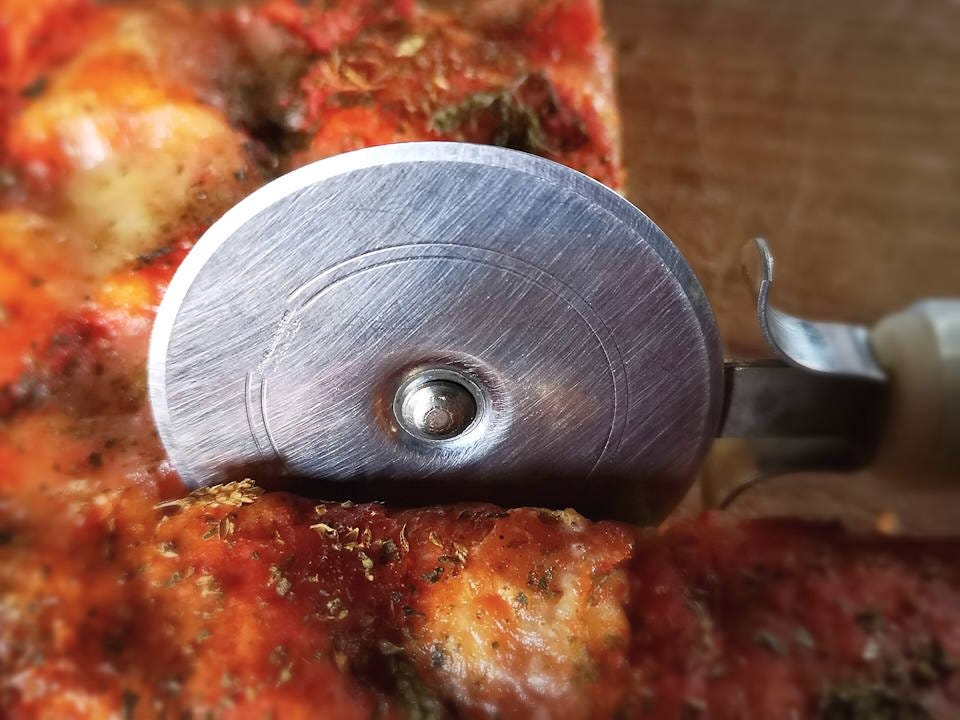
A pizza wheel — also known as a rolling pizza cutter or just a “pizza cutter” — is not a great tool for cutting pizza. I know that’s a statement that’s going to anger a lot of people when I say it, but it’s true. I’m hardly alone in saying this — Wirecutter, Eater.com, and plenty of others have noted the same drawbacks. But anyway, let’s go through the many reasons why pizza cutters are not fit for the job they’re named after.
First, it’s hard to make a very strong cut with a pizza cutter. This is because when you roll a cutting wheel forward, your hand isn’t pushing straight down — it’s pushing forward and down at the same time, meaning that only some of the force from your cut is being delivered to the pizza itself. That makes your job harder.
On top of that, the amount of force that goes into the pizza isn’t constant across the cut. As you extend your arm across the pizza while pushing the roller forward, the angle changes — when the cutter is right under your arm, most of the force goes down into the pizza, but when it’s at the far end of the pizza, most of the force is going forward instead of down. This means that you basically have to do one of three things:
Be very good at dynamically adjusting your force level as you cut
Roll the pizza wheel back and forth over the pizza several times
Push down really, really hard the whole time
The first of these is hard and takes a lot of skill. The second results in little slivers in your pizza — since it’s very hard to keep the wheel in the groove as you cut back and forth — and often causes the dreaded “cheese drag”, in which the wheel drags the cheese right off of the top of the pizza. The third method blunts the cutting wheel, and cuts deep grooves into your cutting board. And all three methods require you to expend a lot of energy.
Pizza wheels are also notoriously hard to maintain and store. Cleaning cheese off of an exposed, rotating blade is difficult, because the blade keeps spinning as you try to wipe it, and because you’re constantly in danger of slicing yourself on the edge. Storing an exposed blade makes it easier to cut yourself when you reach into the drawer. And sharpening a circular, rotating blade is extremely difficult.
Fortunately, there are better tools out there for cutting pizza. The first, which works great for thin-crust pizza, is a scissors — either a standard pair of kitchen shears, or a dedicated pair of pizza shears. The latter looks like this:
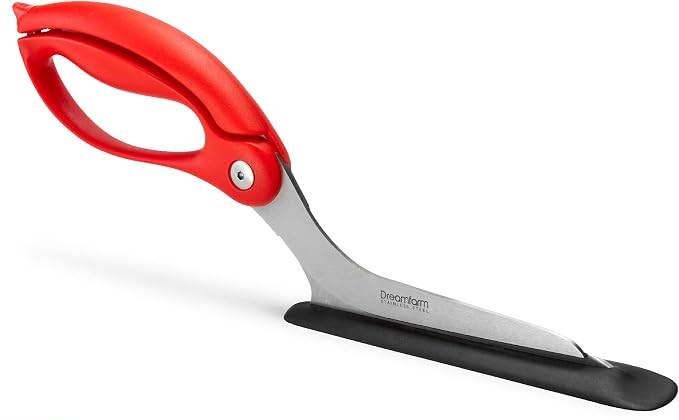
As Wirecutter notes, Italian chefs tend to just cut pizza with scissors. They also note that a standard pair of kitchen shears is very versatile, so if you use it to cut your pizza, that’s one less tool you need to keep in your kitchen.
An alternative — which works especially well if you’re making thick-crust pizza — is a rocking pizza cutter, which takes very little arm strength, is easy to clean, and gets it right every time. It looks like this:

Eater.com recommends the rocking pizza cutter. There’s also a one-handed variant. The rocking pizza cutter is a specialized tool (so it takes up storage space), and it can cut a groove into your cutting board, but it’s easy to sharpen and clean, doesn’t get stored in a drawer, and has the added advantage of actually being able to cut pizza effectively.
(A third alternative for cutting pizza, which works decently well for either thick or thin crust, is just the tried-and-true “large kitchen knife”.)
Anyway, as I said, I expect lots of people to be angry at this take, because whenever I point this out in public, people get angry. Tons of Americans use pizza wheels — I couldn’t find reliable survey data, but browsing on Amazon, talking to people, and consulting AI all suggest that pizza wheels are very common in American households. But I’m right here — the physics doesn’t lie.1
Now on to the Japanese toilet, also known as the “washlet”:
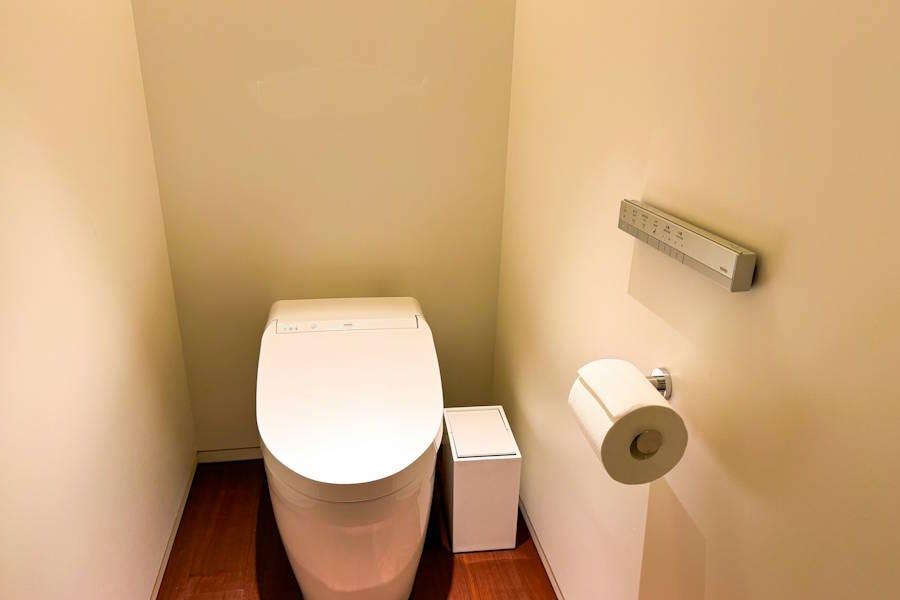
This is a purpose-built washlet, which you commonly find in Japan. But you can also buy an add-on that converts your regular toilet seat into a washlet. That looks like this:
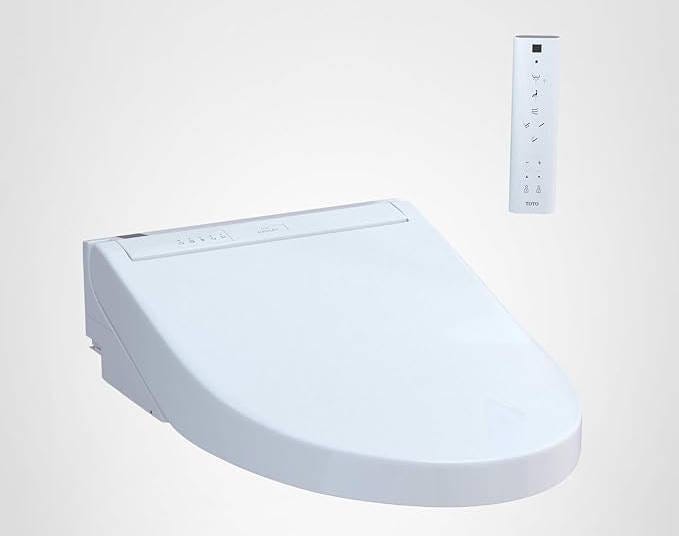
A washlet does several things that a normal toilet does not:
It has a heated seat.
It has a jet of water that washes your butt.
It also has a bidet mode.
It has a warm air jet that dries your butt.
It usually has a built-in air freshener.
The overwhelming majority of Japanese households have washlets. But they’re an incredibly rare sight in America — in general, only rich people own them.
Once you’ve used a washlet for years, it’s very hard to go back to a basic toilet. First, the heated seat is just incredibly, luxuriously comfortable. Second, the butt-washing water jet really cuts down on toilet paper use. It also gets your butt much cleaner than toilet paper alone — so much so that you start to feel like a barbarian for not using a washlet. (The warm air jet and air freshener, in contrast, are more “nice to have” features, in my experience.)
But despite near-universal agreement among product reviewers as to the superiority of the washlet, only a tiny percent of Americans have adopted them. It’s on the rise, but only slowly, and very late — the washlet was first introduced in Japan in 1980.
So there you go, Americans. Please try pizza shears or rocking pizza cutters, and please try washlets. You’ll thank me. But as you probably guessed, this is really a post about AI.
I recently had the pleasure of going to a party in Washington D.C. with a number of lawyers, art history professors, and other educated progressive professionals. This provided me with a great opportunity to get out of my west coast tech-and-econ bubble, and talk to intelligent Americans from other regions and other walks of life.
Many of these conversations turned to the topic of artificial intelligence. Not one person that I talked to was positive about the technology. The first man I talked to asked me how “the AI bubble” was going. When I told him that Anthropic was experiencing the fastest revenue growth of any large company in history, and expects to turn an operating profit next quarter, he was astonished.
To be fair, not everyone pays close attention to quarterly Anthropic numbers; as recently as late 2025 data center investment was still racing ahead of revenue and even Dario Amodei didn’t know whether his company would go bankrupt. But while observers close to the industry — and econ writers like Yours Truly — simply raised the possibility of a bubble, lots of people seemed to have assumed that a bubble was definitely in progress, and then not bothered to check up on it later.
The other folks I talked to were generally dismissive of the potential of AI, and all were concerned about negative effects. One lawyer told me that he knew some people who used it a little bit, but never used it himself. Another said that it was “about as good as a 2nd-year associate”, but worried that people’s reliance on it would erode their own cognitive abilities. Various other people asserted that AI was flooding their professions with low-quality work.2
The art historian was even more negative about AI. She argued that AI couldn’t produce real art, because it lacked human input. When I pointed out the difference between skillfully prompted AI videos and sloppily prompted ones, she did consider it, but it was the first time she had thought about it. She then argued that AI art would deceive people by presenting a distorted version of reality as if it was real. When I pointed out that people had made a similar objection to photography and film, before those were eventually recognized as legitimate and respected art forms, she considered this, but insisted that AI was somehow different.
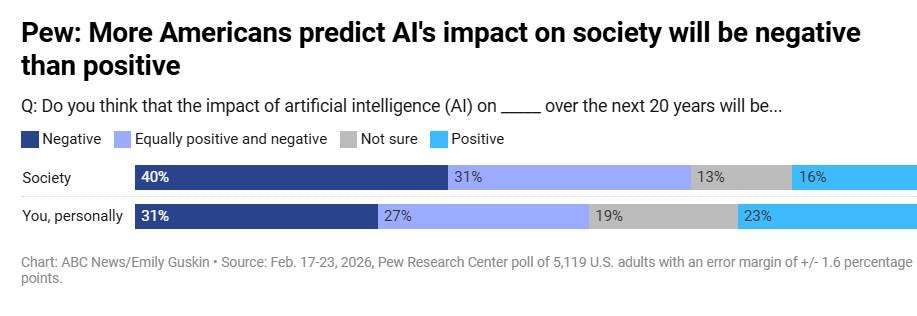
What’s interesting is that this anecdote doesn’t cleanly fit the polls. Americans in general are very afraid of AI taking their jobs, and they predict generally negative impacts on society:
But they’re using AI more and more, both at work and for personal reasons:
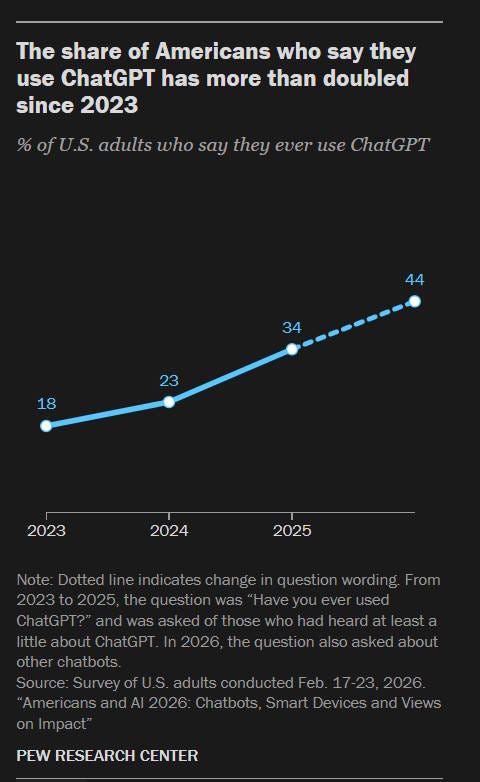
Unlike in the case of pizza cutters and washlets, Americans have correctly identified the most useful technology, and are adopting it.
But…not all Americans. Educated progressives, like the ones I hung out with in D.C., are far too dismissive of AI. Democrats consistently poll more negatively than Republicans, both on AI in general, and in terms of data center construction. On progressive-dominated forums like Bluesky, anti-AI animus is near-universal, and people who admit using the technology tend to get dogpiled. Sybren Kooistra has lamented progressives’ “unilateral disarmament” when it comes to the big technology of the future.
Dan Kagan-Kans has argued that the left is missing out on AI, precisely because so many progressives have chosen to dismiss the technology outright:


He writes:
As a movement, it appears the left has not been willing to engage seriously with AI — despite its potential to affect the lives and livelihoods of billions of people in ways that would normally make it just the kind of threat, and opportunity, left politics would concern itself with.
Instead, the left has, for a mix of reasons good and bad, convinced itself that AI is at the same time something to hate, to mock, and to ignore. “The GenAI sector’s foremost feat of marketing has been the term intelligence itself,” N+1, one of America’s foremost left publications, recently wrote. “A much more important question: What if China develops time travel or warp speed before we do?” asked Will Menaker, a host of the popular left podcast Chapo Trap House, when responding on X in December to a discussion of the possibilities of advanced AI. “Large language models do not, cannot, and will not ‘understand’ anything at all,” argued Tyler Austin Harper, the self-described “leftist, sort of Marxist-skewing” former professor, now The Atlantic staff writer, last summer…
This idea, that large-language models merely produce statistically plausible word sequences based on training data, without having any idea about what the words refer to, has become the baseline across much of the left-intellectual landscape. Thanks to it, fundamental questions about AI’s capabilities, now and in the future, are considered settled.
This dismissiveness reminds me of the cases of the pizza wheel and the washlet. There is no law of the Universe that useful technologies are adopted quickly by everyone who could make use of them.
Historically, countries that adopted gunpowder, industrial technology, computers, and other cutting-edge innovations had an edge over those that turned up their noses at them. Sometimes the consequence was a slightly lower GDP; sometimes the consequence was conquest and colonization. In most cases, economic historians believe that a fear of disrupting existing patterns of power and elite status was behind the decision to eschew new technology.
I worry about the same thing that Dan Kagan-Kans worries about. America as a whole is adopting AI rapidly. But if our educated progressive classes — our lawyers, academics, artists, and so on — turn up their noses, it could damage both their own cultural/political tribe and the country as a whole. In fact, by dismissing AI’s potential — by thinking that the most important technological revolution of the modern age can be waved away as a “bubble” or “fancy autocomplete” or IP theft or slop or whatever — they make it harder to think about the actual serious risks AI might pose.3
The coming of AI will definitely disrupt many of the relations of status and power in America. As Brad DeLong notes, educated professional types have had a long period of security, in which new innovations disrupted blue-collar work but not high-level white-collar work. That’s probably over now. But if educated progressive types don’t roll with the changes, and figure out how to use the new technology to their advantage, they could find themselves left behind by the tide of history — and the consequences will be worse than dirty butts and poorly cut pizza.
Update: As if on cue, Cory Doctorow — one of my favorite sci-fi authors, and usually a perspicacious and insightful commentator — just gave an interview with the socialist magazine Jacobin in which he demonstrates the exact same kind of airy, hand-waving dismissiveness that I encountered at the party in D.C.:
If you believe, as I do, that the toxic thing about AI is the bubble, then you have to attack the material basis of the bubble…[Companies] are pumping the AI bubble, and why they pump bubble after bubble, to tell a growth story…When they say, “We’re going to replace commercial illustrators with a pixel-guessing machine,” they’re not saying that is the source of the profits that are driving the bubble.
This kind of dismissive thinking can’t do a damn thing to slow down actual AI progress, protect people from the actual dangers of AI, or create more equitable outcomes in the AI-driven economy of the future. All it can do is make sure progressives get left behind in the tide of history.
Pizza wheels are used by many lower-end pizza restaurants, for a number of reasons. These are very high-throughput establishments, who do the pizza-cutting motion thousands of times and get very good at keeping the force constant across the cut — so constant that they can often cut the pizza in the box without cutting the box itself. Second, they have the capital and infrastructure to buy new pizza wheels instead of sharpening their old ones. Third, the speed of the pizza wheel enables extremely high throughput, often at the cost of accuracy — many restaurant pizzas arrive incompletely cut, because a wheel was used.
A software engineer at Google insisted this as well, though another Google engineer said he thought AI was generally very useful for coding.
Fortunately, Bernie Sanders has been pretty good about warning about existential risks. Hopefully more progressives will listen to Bernie on this!
"“Large language models do not, cannot, and will not ‘understand’ anything at all,” argued Tyler Austin Harper,"
Maybe others have had better luck, but I've never gotten anyone who thinks that explain to me how they think the electro-chemical computer between their ears "knows" anything. It's not even that they are ghosts in the machine people - the thought seems to never have occurred to them.
A Toto washlet in a bathroom at NRT basically saved my life after a rough flight over from the US back in 2016 and I’ve never looked back. Have them in upstairs and downstairs bathrooms of the house. I think each cost around $400. I’ve probably converted a dozen people over the years but have also felt perplexed by the slow adoption.
If you live with a partner or share a bathroom, the most overlooked benefit is the charcoal deodorizer. You just never smell each others 💩 ever again. It’s absolutely amazing. The first time sharing a hotel bathroom after having a Toto for a while will be a harsh reminder of the before times.
Biggest piece of advice if you’re looking into them is to figure out where the nearest outlet is in your bathroom because they require 24/7 electricity.