

I was writing a post about the economics of AI, but my elderly disabled pet rabbit had a bit of a health emergency, so the AI post will have to wait until tomorrow. In the meantime, I know you’d like something to read in the morning, so here’s a repost from a few years back.
The big news out of China this past week wasn’t about electric cars or semiconductors or real estate. It was about Xi Jinping purging his top general (and close friend) Zhang Youxia, along with another top general named Liu Zhenli. No one knows exactly why this happened — I speculated about a coup plot in my weekly roundup, but most analysts don’t talk about that possibility. Here are three analyses that I found pretty interesting:
Jon Czin (interviewed by Jordan Schneider) thinks Xi probably purged Zhang out of pure paranoia — Zhang was powerful and had a lot of people loyal to him, and Xi may have simply been afraid that Zhang could turn into a rival.
Youlun Nie thinks Zhang simply wasn’t doing a good job getting the Chinese military ready for an invasion of Taiwan (and that this fact had been exposed by Zhang’s rivals, who were purged earlier). Xi may have simply decided to clean house and start afresh.
K. Tristan Tang thinks Zhang simply didn’t want to get ready to invade Taiwan so quickly, and that Xi removed Zhang for resisting his orders.
In the end we can’t really know. But it opens up the possibility that Xi is entering his “lion in winter” phase. Xi isn’t an organization-builder, like Mao, Lenin, Elon Musk, etc. He’s an organization-dominator, like Stalin — a guy who rises through the ranks of a big existing power structure by being very good at patronage, backstabbing, and various other power games.
Guys like this are always incredibly paranoid, because they had to be in order to reach the top. And as they age and start to slow down, they often get even more paranoid that they’re about to be overthrown — both because they’re a weaker target, and because everyone starts fighting over the succession. At 72, Xi is already several years older than Joseph Stalin was when he descended into his terminal paranoia.
The rest of the world may thus catch a break. Xi has no term limits and no obvious successor, meaning he will probably be in power for another decade and a half unless he’s forcibly overthrown or dies prematurely of natural causes. During that time, he may be more and more focused on fighting off (real or perceived) internal challengers. This could divert his attention from attacking Taiwan, Japan, the United States, India, etc. By the time Xi is replaced in the late 2030s or 2040s, demographic decline and societal disruptions from AI may have set in, a more reasonable post-Xi leadership may decide that launching World War III is pointless.
This will not be fun for China, because internal strife at the top would tend to make policy more rudderless, and occasionally even predatory. But I bet that China’s companies, local governments, and people would be competent and clever enough to limit the damage from the top.
Anyway, this round of purges should emphasize that China doesn’t really fit the stereotypes that many Westerners apply to it. In particular, the common notion that China is a patient, far-sighted entity — as compared with the impulsive, short-sighted West — seems obviously wrong. Here’s what a Chinese writer said in 2005:
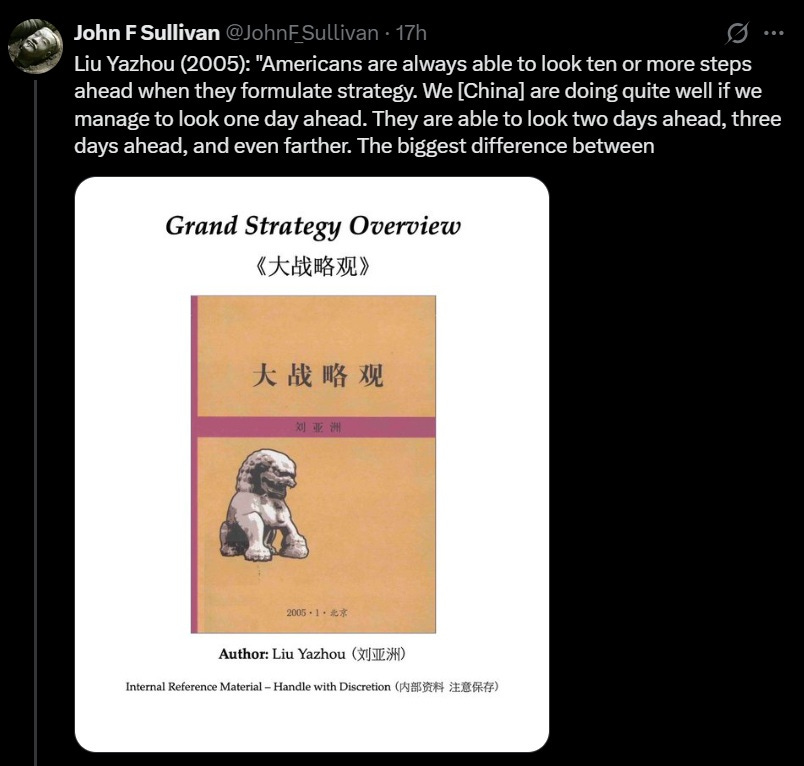
In 2022, I wrote a post about this stereotype, and argued that it was nonsense. Here is that post:
As part of my China reading series, I’m now reading Graham Allison’s Destined for War: Can America and China Escape Thucydides’ Trap?, which is about the possibility of the U.S. and China stumbling into war. Though the warning is timely and useful, Destined for War has a section about cultural differences that’s both atrocious and entirely out of place in the rest of the book. It relies on many of the same tics and stereotypes as Michael Pillsbury’s The Hundred-Year Marathon — for example, alleging that Chinese people still think in terms of metaphors from the Warring States period 2300 years ago.
One particularly silly example Allison repeats is the idea that Chinese people think about strategy in terms of the game Go (weiqi in Chinese), while Americans think in terms of chess. The metaphor, apparently, is that China thinks in terms of strategic encirclement while Americans try to checkmate the opponent. This analogy actually comes from Henry Kissinger, who helped establish a de facto alliance between the two countries during the Cold War, and wrote a whole book about China that people still quote lovingly to this day. Kissinger reiterated the metaphor in a 2011 interview on CNN, which featured the following image:

But as some of you may have noticed, the game pictured is not Go. It’s xiangqi, also known as “Chinese chess”. Xiangqi is similar to chess (the goal is to checkmate your opponent), but it’s faster-paced and more tactical, with more open space on the board. Games tend to be faster than chess games. And in China, xiangqi is much more popular than Go. So even if the idea of analyzing country’s strategic cultures based on popular board games made any sense whatsoever (which it does not), if we looked at xiangqi we might conclude that Chinese strategic culture is like America’s, but faster-paced and more aggressive.
In other words, assuming Kissinger was not just a complete doofus, he chose this metaphor based not on how accurately it describes Chinese thinking, but on how he wanted Americans to think about responding to China. And in fact, U.S. policy to balance China has been based on encirclement, much to Chinese leaders’ annoyance. Kissinger successfully got the U.S. to “play Go”.
Anyway, of all of these cliches that books like Allison’s Destined for War rely on, the one that people seem to come back to the most — and the one that most annoys me — is the idea that Chinese leaders are more careful planners and long-term thinkers than American leaders.
Part of this stereotype is just the perennial rosy view of autocracies — the idea that because they don’t have to worry about the next election, autocrats are free to craft longer-term policies. In fact this is probably wrong and may even be the reverse, since as the great political scientist Bruce Bueno de Mesquita would tell you, autocratic leaders also have to think about the folks who have the ability to give them the boot (and, often, the bullet).
But part of the idea that “China thinks long-term” probably just comes from the fact that it’s so old. Allison argues this explicitly, contrasting America’s two and a half centuries with China’s millennia of existence. Maybe only if you can think of history on that time-scale can you think of the future on a similar time-scale.
Maybe? But isn’t it a little weird for an American author to make this argument in a book that’s explicitly based on the 2400-year-old history of ancient Greece? Americans don’t think the world was created by George Washington — like Graham Allison himself, they think quite often about stuff that happened in ancient times. In Americans’ minds, the U.S. is more analogous to a single Chinese dynasty, most of which lasted for a much shorter time than the U.S., and none of which has hit the 3-century mark for 1800 years.
In any case, though, it’s far from clear that Chinese leaders engage in more long-term thinking than American leaders do. There are plenty of examples to show this.
In the late 1700s, America’s founders were creating a constitutional system that endures to this day, and is broadly considered the longest-lived constitution in the world. Many of the legal and political concepts the framers pioneered are now the basis of almost all rich modern nation-states. Shortly after that, Alexander Hamilton was creating a long-term economic plan that involved big infrastructure projects, infant-industry policies, and a central bank, with an eye to dominating manufacturing industries. It’s important to realize how revolutionary this was, as this was the very early days of the industrial revolution and no one even know how important manufacturing would eventually be! Hamilton saw it before almost anyone else did, and the policies he pioneered are in some ways the basis of China’s current industrial policy.
What was China doing at that time? The Qing Dynasty was at its height of wealth and power in the 1700s. But although it built plenty of palaces and stuff, it didn’t really modernize the canal system, whose decline ended up hurting the Chinese economy. Its failure to collect taxes effectively weakened the government considerably. The empire turned inward, ignoring most opportunities for international trade and commerce. And most damningly, the Qing failed to see the potential of industrialization and modern technology. In a fateful encounter with a British embassy in 1793, when presented with clocks, telescopes, modern weaponry, and a number of other pieces of proto-industrial Western technology, the Qianlong emperor sniffed that he had no need of Britain’s manufactures. From that time until the 21st century, China was playing technological catch-up.
Fast forward to the 20th century, when Mao reunited and stabilized China under Communist Party rule. In the 1950s and 60s, when the U.S. was building the interstate highway system and the modern university system, China was engaging in the Great Leap Forward, a bizarre experiment in hyper-distributed industrial production that failed so catastrophically that tens of millions of people ended up starving to death. Shortly afterward, China switched directions and decided to engage instead in the Cultural Revolution, whose strategy was apparently something along the lines of:
Get everyone in China to vilify and beat up on each other for a decade
???
National greatness!
If the Cultural Revolution contributed to Chinese national greatness in any way, it was only by traumatizing Chinese people so much that they sought out stability at any cost in the decades that followed.
OK, but perhaps China’s lurch from ill-conceived disaster to ill-conceived disaster during the Mao years was the function of rule by a single mentally unstable individual. Since then, China has had a lot more policy continuity, and a lot more success — a period of sustained rapid growth such as the world has never seen. Does this represent a shift toward (or back toward) long-term thinking?
Perhaps. The economic modernizations under Deng Xiaoping and Jiang Zemin were truly some of the most impressive in the world, especially the well-handled privatization of state-owned enterprises, the quasi-privatization of land ownership, and the farming out of industrial policy to local and regional governments who were free to experiment and imitate each other’s successes. I’m not sure whether this policy package required long-term thinking, but it was certainly brilliantly executed and wildly successful. For three decades, China enjoyed the rapid growth that this policy package produced. Hu Jintao’s efforts to boost economic activity in rural areas were also well-executed and probably quieted persistent rural unrest.
But during China’s spectacular rise, there were many long-term issues that the leadership simply didn’t deal with, even though it surely saw them coming a mile away.
For example, the one-child policy — which was probably unnecessary to bring fertility rates down to replacement level in the first place — went overboard and was kept for far too long. Now China’s fertility is below 1.3, lower than Japan’s. Its workforce is shrinking by millions a year, and even bigger decreases are now fully baked into the demographic cake. Seeing the fruits of its short-sightedness, the Chinese government is frantically trying to reverse course, switching to a three-child policy and clumsily trying to crack down on vasectomies and abortions.
Meanwhile, when the United States faced falling fertility in the 70s and 80s, it simply let in more immigrants. This was a highly successful strategy. Ronald Reagan, the biggest booster of immigration, even foresaw that the mostly-Democratic-voting Latinos he encouraged to enter the country might one day vote Republican.
Another example is the environment. China’s breakneck growth paid little heed to air quality, water quality, or global warming. Air quality in the capital had to reach apocalyptic levels before the government took action. Now the country is facing water shortages, and its schemes to redistribute water availability are just exacerbating the problem. Desertification from decades of land mismanagement continues to be a major challenge. Meanwhile, the U.S. has steadily improved its air and water quality since the Nixon Administration. Both countries are way too reluctant to cut carbon emissions, but at least in the U.S. emissions have been generally headed in the right direction — unlike China.
Or take science and technology. The U.S. natural gas boom, which allowed it to unlock shale gas deposits and rapidly decrease reliance on coal, was enabled by government research into hydraulic fracturing technology in the 1970s. MRNA vaccines, which are now saving hundreds of thousands of American lives even as China races to reinvent the technology, were also based on decades of patient, forward-looking government science funding. The U.S. government didn’t know these technologies would be as impactful as they were — it simply recognized the distinct possibility, and invested accordingly. China, in contrast, has pioneered some new kinds of weaponry, but in general has focused on either appropriating foreign technology or playing aggressive catch-up in known areas like semiconductors.
Industrial policy provides a fourth example. The U.S. was certainly short-sighted in allowing its industrial commons to be outsourced en masse to its main geopolitcal rival. But China allowed its economy to become dominated by real estate, reducing long-term productivity growth as it dealt with every economic shock by hurling more money at the property sector. Now Xi Jinping’s sudden course-reversal and attempts to deal with this problem by crushing real estate are causing chaos in the country’s economy. Local government finances are especially exposed; for many years China had talked about implementing a property tax to wean local governments off of land sales, but it somehow just never happened.
And though it’s hard to peer into China’s government’s opaque decision-making process (which probably helps to convince credulous Americans that wise long-term planning is going on behind the scenes), it sure looks like a place where the leadership doesn’t listen to people who don’t tell it what it wants to hear. Xi is rumored to be a micromanager who demands to be surrounded by fawning yes-men (some accounts are even more negative). And when academics or other independent voices warn about troubles brewing, the leadership seems to shut them down pretty quickly:


Thus perhaps it’s no surprise that quite often we see cases where China’s government takes aggressive, dramatic action, ignores the long-term consequences, and then rapidly reversing course once those consequences become clear. It looks less like 1000-year planning and more like 30-year oversteering. As for Xi, his industrial crackdowns and social crackdowns might ultimately come to be seen as far-sighted planning, but my guess is that instead they’ll be more of the same. Ultimately China may also come to regret the fruits of the Uyghur repression, the crushing of Hong Kong society and culture, and bellicose “wolf warrior” diplomacy.
All this doesn’t mean Chinese policymaking is bad; sometimes, as under Mao, it leads to catastrophe, and sometimes, as under Deng, Jiang, and Hu, it yields spectacular success. It simply means that this does not look like a country that is following a 1000-year plan, or even a hundred-year plan. It looks like a country that is lurching awkwardly into modernity, constrained by the political imperatives of an autocratic, unstable political system and by the haunting specters of past mistakes.
But maybe, when writers like Graham Allison and Michael Pillsbury tell us that China is this wise long-term planner, they’re not describing China so much as telling us what they want America to be more like. In recent years we’ve underinvested in infrastructure and housing and export industries, squandered much of our global leadership, prepared poorly for pandemics, stuck our heads in the sand on climate change, and in general have failed to act like the far-sighted country we were in the mid 20th century or the late 18th century. The stories we tell about other countries are often the stories we want to tell about ourselves. Just as Kissinger tricked us into playing Go, maybe Allison and Pillsbury can trick us into thinking a little more carefully about where we’d like to be in 100 years.
Great write-up. To me, democracies look chaotic but seem to learn faster. Lots of noise, disagreement, fragmentation...but at least the feedback loop is real. In closed systems like China’s political system, when everything is about appeasing one man, it may look stable or visionary from the outside, but it’s usually just brittle underneath.
Across thousand-year timelines, the real test of a political system isn’t unity or control, but whether its feedback loops are strong enough to survive bad leaders, blind spots, and ill-thought-out policies.
This hurts to read in 2026.
Especially the part about America's better science policy.
China is going to decarbonize the world, not the US.
Also, the pre Mao China wasn't as much of a basket case as the popular imagination suggests.
In the PRC, it was important to cast the ROC as irretrievably oppressive, foreign dominated, and illegitimate in order to justify the CCPs overthrow.
In the West, the narrative of "who lost China?" opened a market for scholarly work that emphasized how much the ROC was beyond saving, thus there was no point in questioning whether the US (or anyone else) could have done more.
Now, three things have changed. First, the modern PRC wants to reclaim the WW2 legacy of the ROC, which means rehabilitatiing the KMT which did 90% of the anti Japan fighting. Second, the legacy of McCarthyism is in the rear view mirror so questions about "How could US China cooperation during the war have been better?" can be asked without it devolving into accusations of "Roosevelt was Stalin's Stooge!" Finally, Chiang Kai Sheks diaries became available in ~2012, so we actually know what he was thinking about during that time.
Richard Frank, Rana Mitter, Sarah Paine, and Hans Van de ven have all written recent books that use the new information.