“Roads of crystal soared between the spires, crossed and recrossed by smooth silver shapes like beads of running mercury.” — William Gibson, “The Gernsback Continuum”
I was happy to hear the news that Three Mile Island might be restarting. Three Mile Island, as you’ll recall, is the nuclear plant that suffered a meltdown in 1979. It’s the worst nuclear accident in U.S. history, and yet — unlike Chernobyl or Fukushima — there were zero injuries or documented adverse health effects. Now Microsoft is trying to restart the remaining reactor, in order to power an AI data center. It still needs to get a permit, which could take a long time.
But the mere fact that it’s being attempted — and that it’s not causing a public backlash — is a great sign. It means America is getting more serious about energy abundance, and it stands in stark contrast to, say, Germany, where the government demolished a bunch of perfectly good working nuclear reactors even though public opinion was against the move.
I am a fan of nuclear power. It’s clean. It’s reliable. And despite a couple of high-profile disasters, it’s a heck of a lot safer than people think. Jason Crawford has a good post in which he argues that A) the “linear no threshold” health models used to assess cancer risks from nuclear accidents are not very good models, and B) the “ALARA” safety rule imposed on nuclear power is guaranteed to keep pushing up costs even when safety gains are tiny. This doesn’t mean that nuclear power is without drawbacks — there really is a long-term waste storage issue, since a few fission waste products remain dangerous for thousands of years. But overall, I think the benefits to climate, and to air quality, far outweigh that danger.
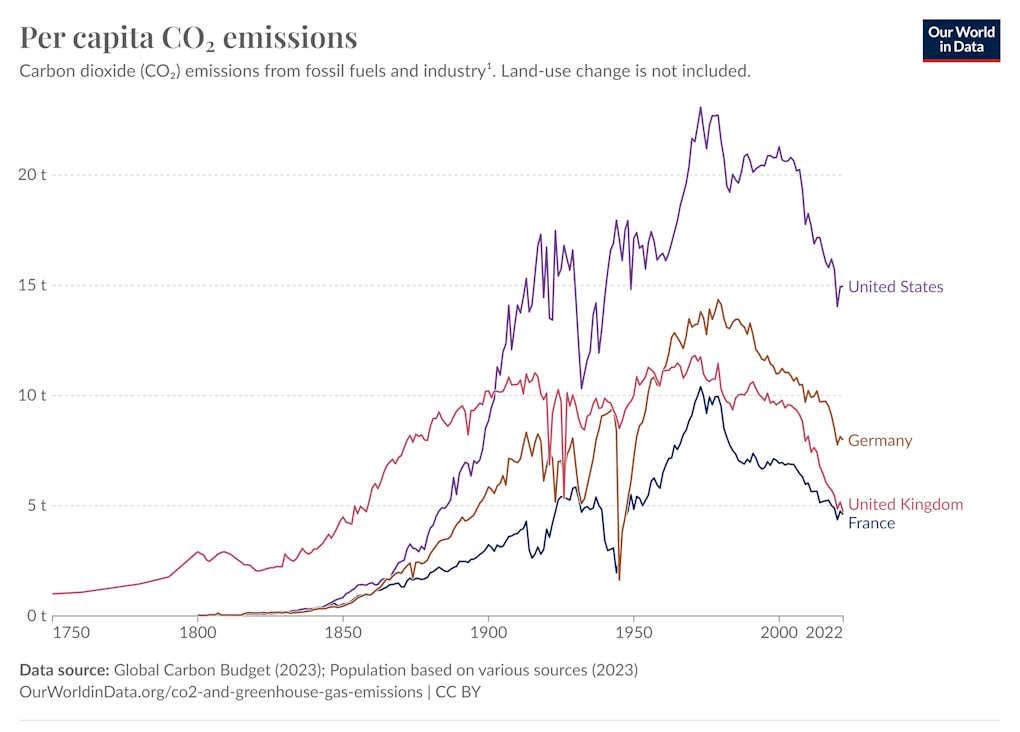
We don’t have to get theoretical in order to see the benefits of nuclear power, though. We can just look at the experience of France:
France built a bunch of nuclear reactors in the 1970s and 1980s, and by the 2000s almost 80% of France’s electricity came from nuclear power. As a result, France’s carbon emissions dropped abruptly in the 80s, even as its peers continued to pollute for a decade or two longer:
France is also ahead of most European countries in clean production — France’s carbon emissions per dollar of GDP is lower than most of its peers. And as an added benefit, France’s nuclear reactors made it less vulnerable to the cutoff of Russian gas during the Ukraine war.
In my mind, there is no question that the United States should have followed France’s lead and built a massive fleet of nuclear reactors in the 1980s and 1990s, replacing its coal-fired power plants. And there’s little doubt that regulation, and exaggerated worries about nuclear safety, contributed to our failure to do so.
To many technologists, the story of America’s failure to build nuclear is the ur-story of free enterprise versus government, of progress versus activism, and of techno-optimism versus pessimism. Nuclear’s defeat left scars of resentment, cynicism, and mistrust — of the environmental movement, and of regulation in general. Even to this day, how many nuclear reactors get built remains an important symbolic bellwether to many technologists, seeming to speak volumes about the relationship between technology and society.
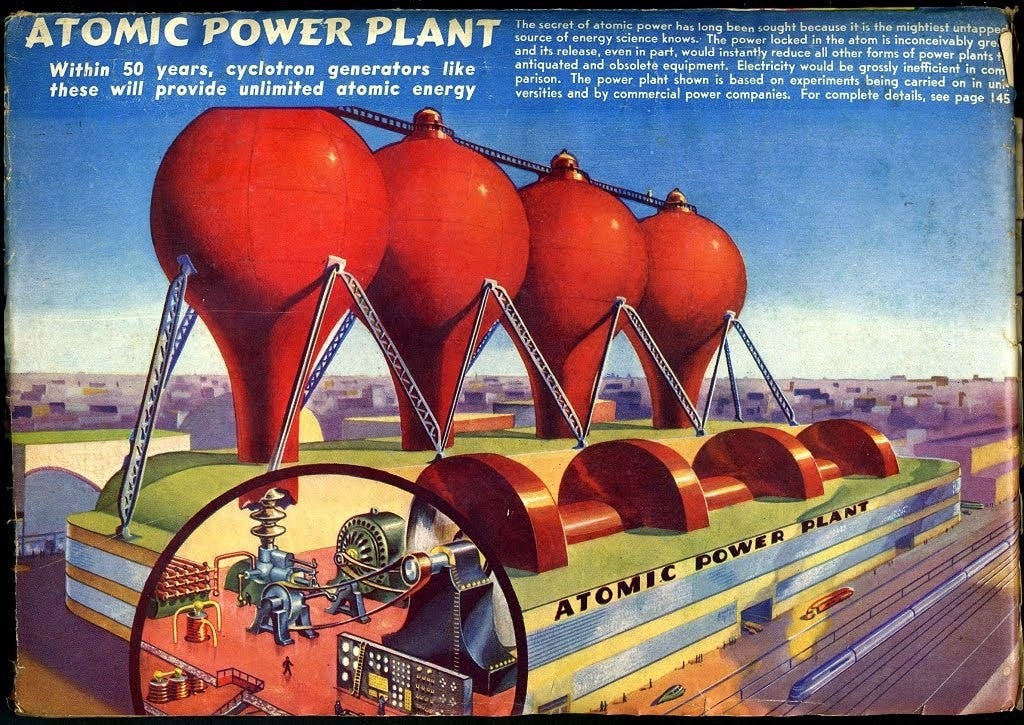
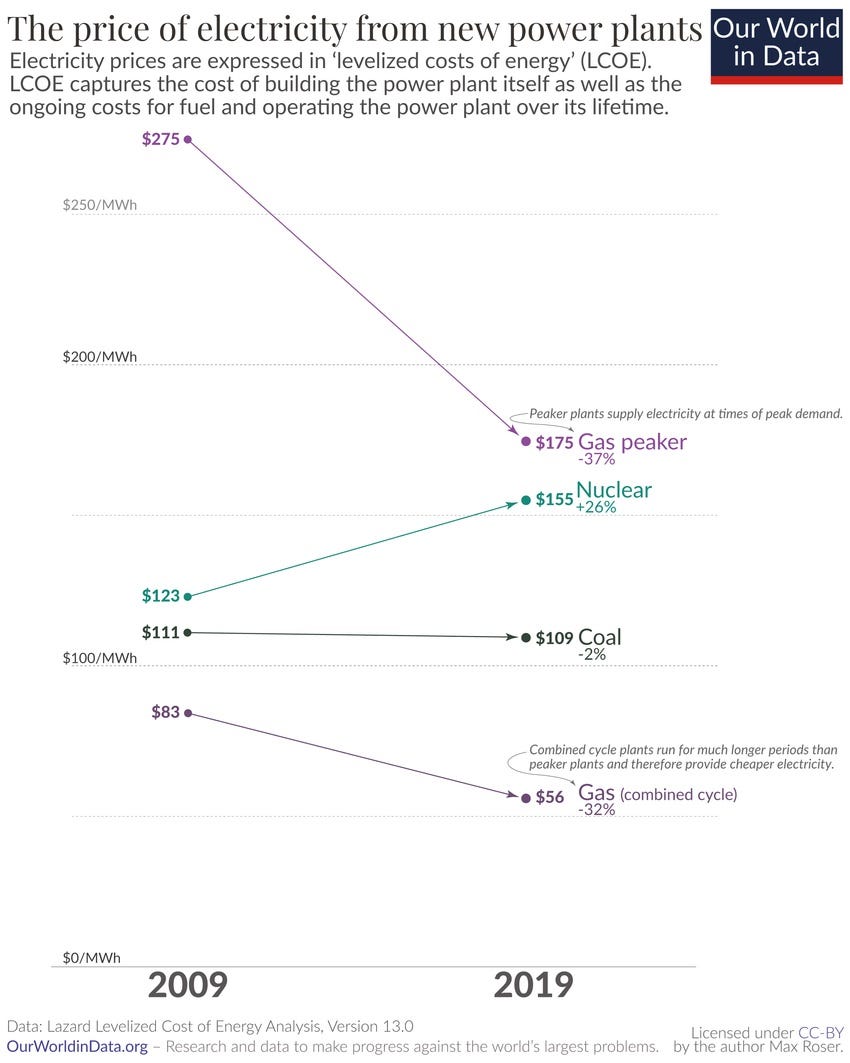
And yet as much as I like nuclear power and as much as I wish we had built a lot of it in the 80s and 90s, I can’t escape the conclusion that the nuclear ship has sailed. Nuclear power didn’t get any worse since 1980, but other technologies — in particular, solar and batteries — have gotten immeasurably, stupendously better since 1980. Nuclear still has an important place in the energy mix of the future, but as a niche source of supply rather than as the star of the show. The atomic age exists now as a retrofuture — a vision of a parallel future that might have been, which haunts us like a ghost here in the actual future that came about.
Nuclear just wasn’t able to get much cheaper
The key technological fact that has catapulted solar and batteries to stardom is the learning curve. Thanks to economies of scale and learning-by-doing, building more solar power and more batteries makes these things cost less. Here’s a famous chart that shows this process just for the single decade of the 2010s:
It’s not known how long learning curves can continue, of course; at some point, all the improvements get mined out. But so far, if you’ve bet on solar and battery learning curves to continue, you’ve always made money. Quant trader Doyne Farmer has an excellent 2022 paper, along with Rupert Way, Matthew Ives, and Penny Mealy, showing just how accurate these learning curve forecasts have been so far.
It’s not clear why nuclear hasn’t exhibited that behavior. Farmer believes that things that get done in situ instead of in a factory, like mining, homebuilding, or nuclear reactor construction, tend not to have learning curves:
Part of the story is, probably, that nuclear reactors are not cookie cutter items. They're things you construct. They're not things you manufacture. You don't build them in a factory…So they aren't really mass-produced. Now there have been attempts to mass-produce them. The French tried to make it more cookie-cutter, and the Koreans have had some luck in bringing the cost down, but only very weakly. You know, Korean nuclear reactors have dropped in cost at about a percent per year, which is pretty slow…[N]uclear power had a very fast rise for a few decades, comparable to solar and wind, but it didn't have exponentially dropping costs.
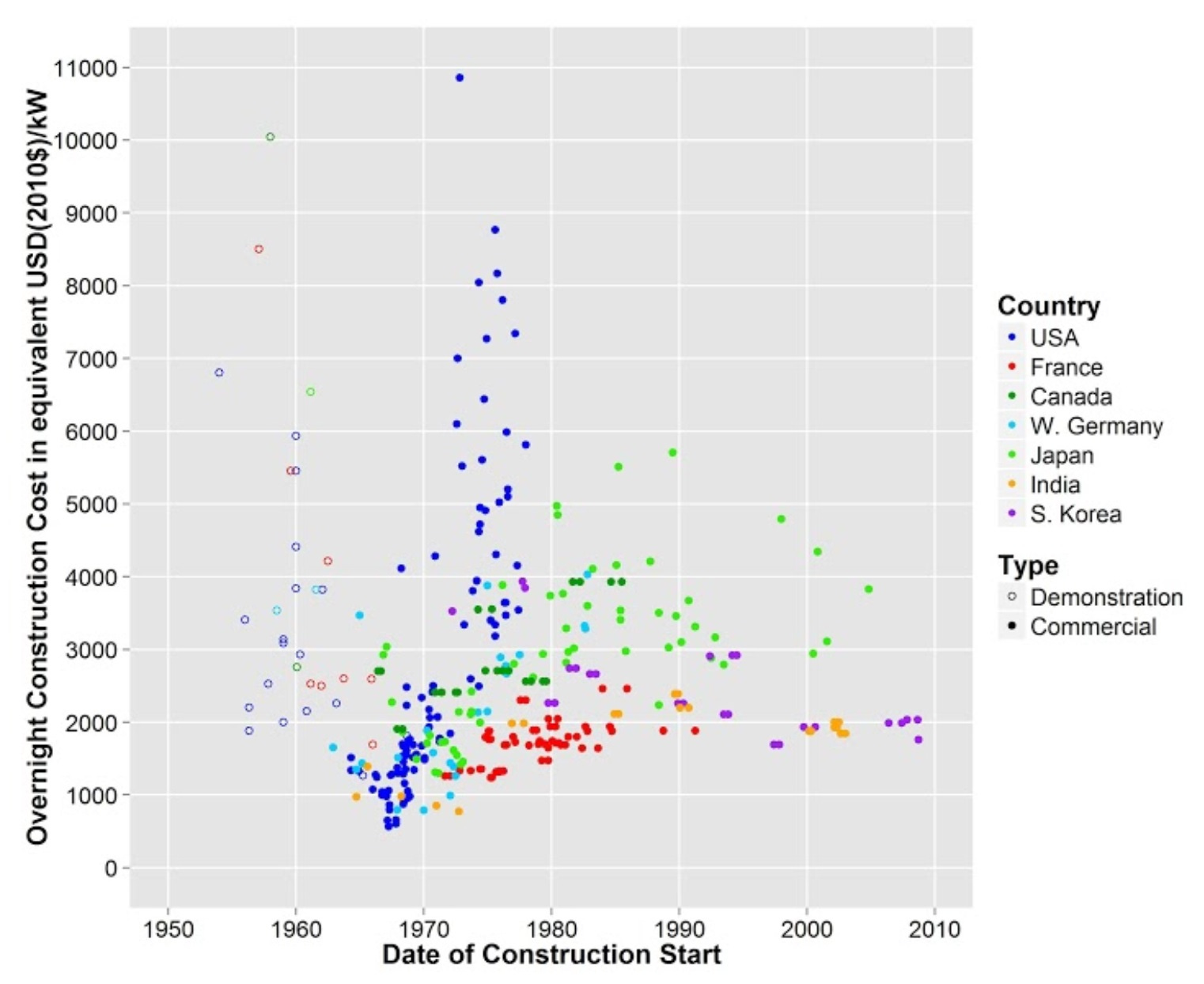
Farmer is right about other countries not being able to find nuclear’s learning curve. Though America’s nuclear costs have ballooned far more than most other countries’, there’s no one who has really managed to bring the price down. France and Japan both saw their costs for nuclear construction slowly rise over the years as they built more, while Korea has seen at best a very slow decline:
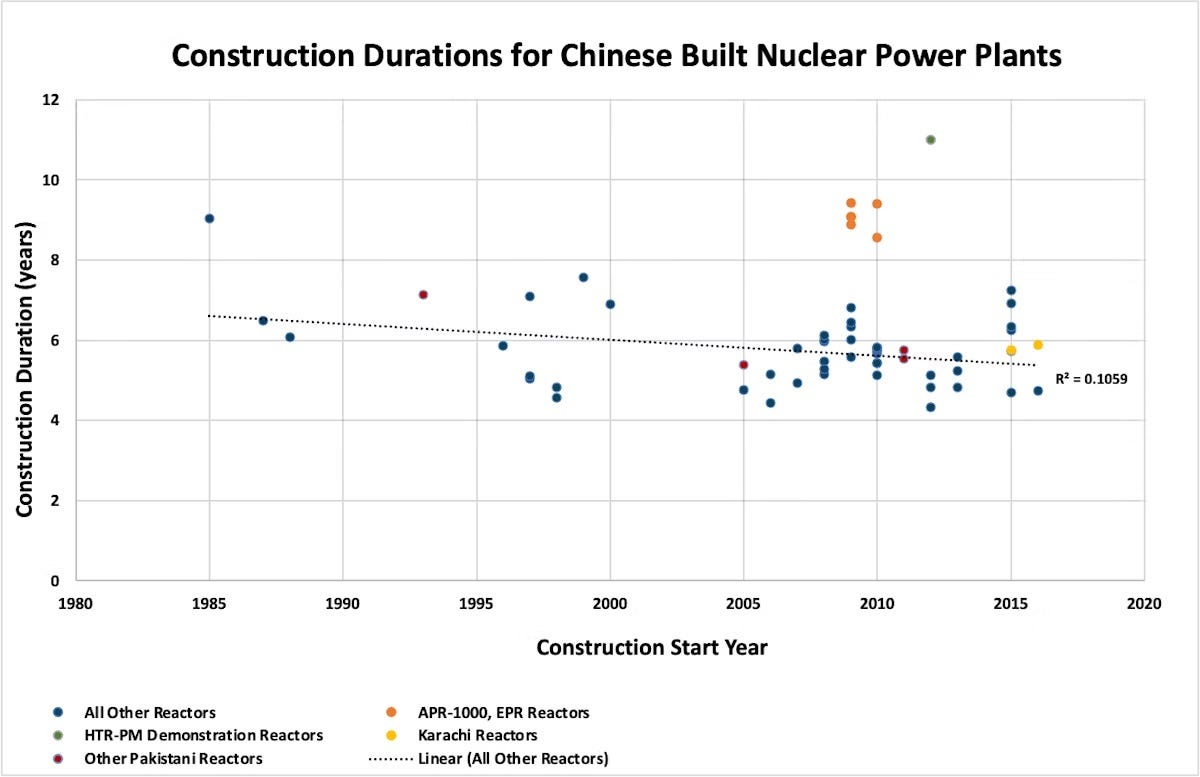
What about China? Current costs for China are estimated at $2800 to $3500 per kWh, which is about $1940 to $2426 in 2010 dollars — so, about the same as South Korea in the 2000s, and more expensive than the U.S. in the 1960s. As for the direction of change, it’s not clear. The Breakthrough Institute did find that Chinese nuclear construction times have been decreasing, though that’s a very different metric. And even there, the decrease looks extremely gradual, and entirely driven by some long construction times back in the 80s and 90s:
So I just don’t see a lot of evidence that China is driving nuclear costs down, either. The kind of learning curve that exists for solar and batteries just…doesn’t exist for nuclear. Or at least, we’ve never been able to figure out how to produce such a curve, despite many decades of trying.
Which doesn’t mean that nuclear costs couldn’t go down! The U.S. obviously experienced a bizarre and catastrophic explosion of costs in the 1970s, which set it apart from countries like France, Japan, and Korea. It’s not clear what caused that explosion of costs — it was before Three Mile Island, so the popular reaction to that accident can’t be to blame.
Earlier regulation is a more likely culprit. Brian Potter has a characteristically excellent blog post explaining how regulation drove up construction costs in the 70s. Some excerpts:
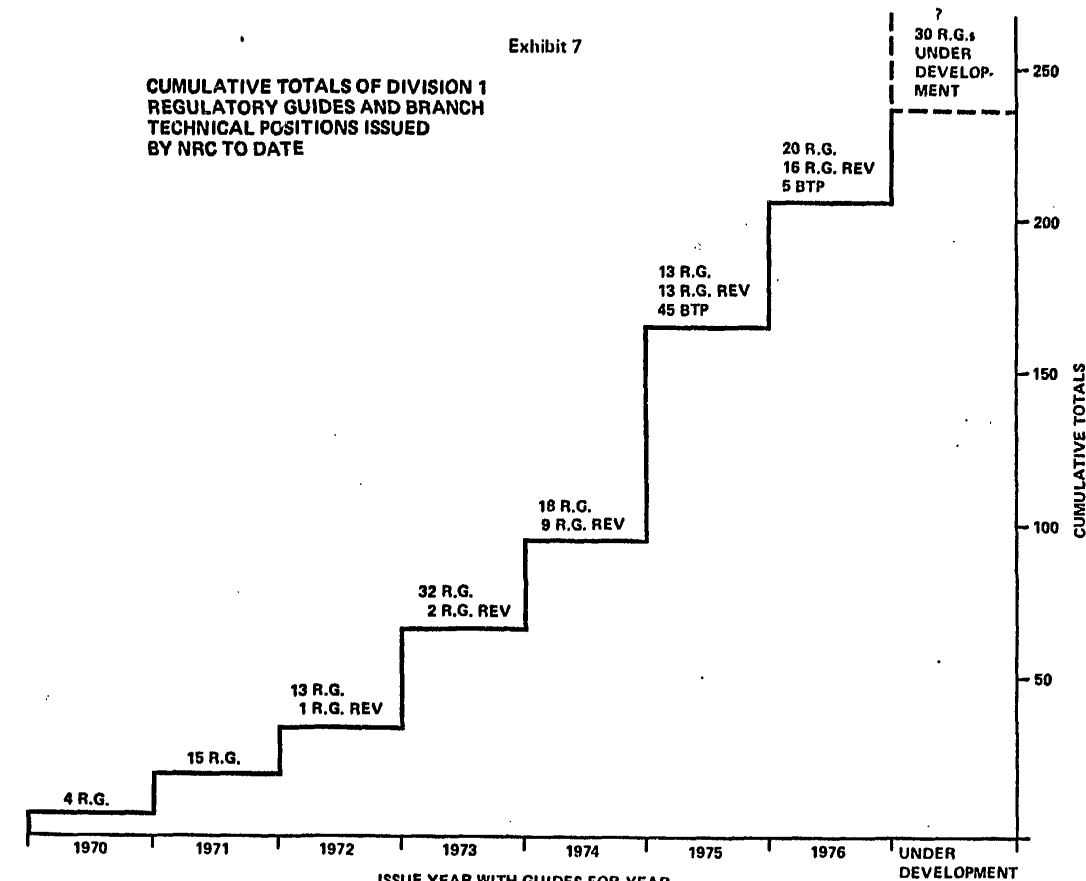
Why did labor costs [for nuclear plant construction] increase?…During the late 60s and early 70s, regulatory requirements steadily increased:
Regulatory guides issued by the NRC, from Szalay 1978
As did the thoroughness of review by the Nuclear Regulatory Commission (NRC), which is responsible for issuing plant operating licenses…
A 1980 study found that increased regulation between the late 1960s and mid 1970s was responsible for a 176% increase in plant cost, and increased labor requirements by 137%…And the Eash-Gates study found that at least 30% of the cost increase between 1976-1988 can be attributed to increased regulation. For a vivid overview of the impact of increased regulation, see Charles Komonoff’s 1981 “Power Plant Cost Escalation”:
“One key indicator of regulatory standards, the number of Atomic Energy Commission (AEC) and Nuclear Regulatory Commission (NRC) “regulatory guides” stipulating acceptable design and construction practices for reactor systems and equipment, grew almost seven-fold, from 21 in 1971 to 143 in 1978. Professional engineering societies developed new nuclear standards at an even faster rate (often in anticipation of AEC and NRC). These led to more stringent (and costly) manufacturing, testing, and performance criteria for structural materials…Over the course of the 1970s, these changes approximately doubled the amounts of materials, equipment, and labor and tripled the design engineering effort required per unit of nuclear capacity[.]
Given the fact that other countries’ reactors seem at least as safe as America’s — it took one of the largest earthquakes ever recorded, and a giant city-killing tsunami, to break a Japanese reactor in 2011 — it seems highly likely that some of these safety requirements weren’t particularly necessary. But they don’t appear to have been reviewed — new regulations just keep getting piled on top of old regulations.
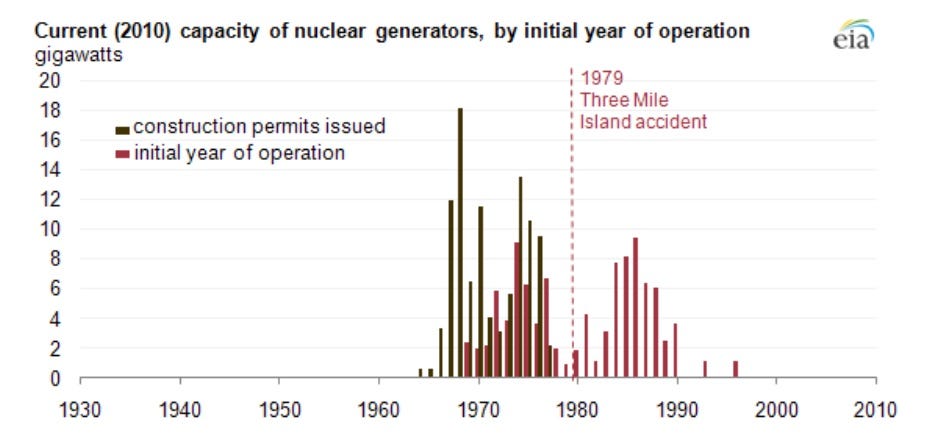
And it’s pretty clearly that mid-70s cost explosion, rather than the legacy of Three Mile Island, that halted nuclear construction in the U.S. Nuclear plants stopped getting permitted a few years before the big accident:
So the common folk tale is probably true, as far as past events are concerned — regulation really did kill the American nuclear industry.
But when it comes to what’s possible now in terms of a revitalized nuclear industry, the folk tale is too optimistic. Other countries, which used a much lighter regulatory touch, still didn’t manage to drive costs down substantially (or at all). Deregulation might be able to bring America’s costs down in line with France’s or Korea’s, but it would be unlikely to put those costs on a long-term downward path.
Nor would a nuclear renaissance necessarily make America a land of abundant energy. Despite being willing to build lots of nuclear when America refused, France’s electricity consumption per capita is only 6927 kWh/yr, compared to 11,267 in the U.S. In fact, as you can see from the chart at the start of this post, France’s per capita energy consumption from nuclear has actually fallen by over a third from its peak. Meanwhile, France’s electricity costs are fairly low by international standards, but still higher than America’s. In other words, France’s nuclear energy is greener than America’s, but it’s not more abundant.
But the most important reason why nuclear won’t be America’s main source of power is actually a very positive one. While the U.S. was wasting its opportunity to go nuclear in the 80s and 90s and 2010s, smart engineers came up with a cheap clean energy source that does have a learning curve: solar and batteries.
The real future vs. the retrofuture
A surprising number of people who are otherwise techno-optimists are negative about solar. For example, in their widely read “Foundations” post about the UK’s stagnation, Ben Southwood, Samuel Hughes, and Sam Bowman claim that renewables have technological limitations that make them inferior to nuclear power, and even blame the UK’s increasing use of renewables (mostly wind) for making Britain poorer:
Intermittent renewables…are sources that, though clean, cannot produce a constant supply of electricity, and cannot be turned on at will…Nuclear power avoids the biggest problem that solar and wind power face: it produces constant amounts of electricity across the day and year.
But Southwood et al. simply overlook the other big game-changing energy technology that’s getting exponentially cheaper every year: batteries. If you have a battery, then solar power can give you energy 24 hours a day, and during storms as well. If you have a battery, then most of the other costs that Southwood et al. cite with regards to renewables — backup capacity and grid balancing costs — go away.1 Southwood et al. claim that batteries aren’t a solution because it’s expensive to build enough batteries to store energy for “weeks-long lulls in…sunlight”. But it’s hard to imagine when the sun disappears for a week, at least outside of extreme latitudes. (The sun gets weaker during the winter, but that’s why you just overbuild solar a bit. It’s so cheap that this is easily feasible.)
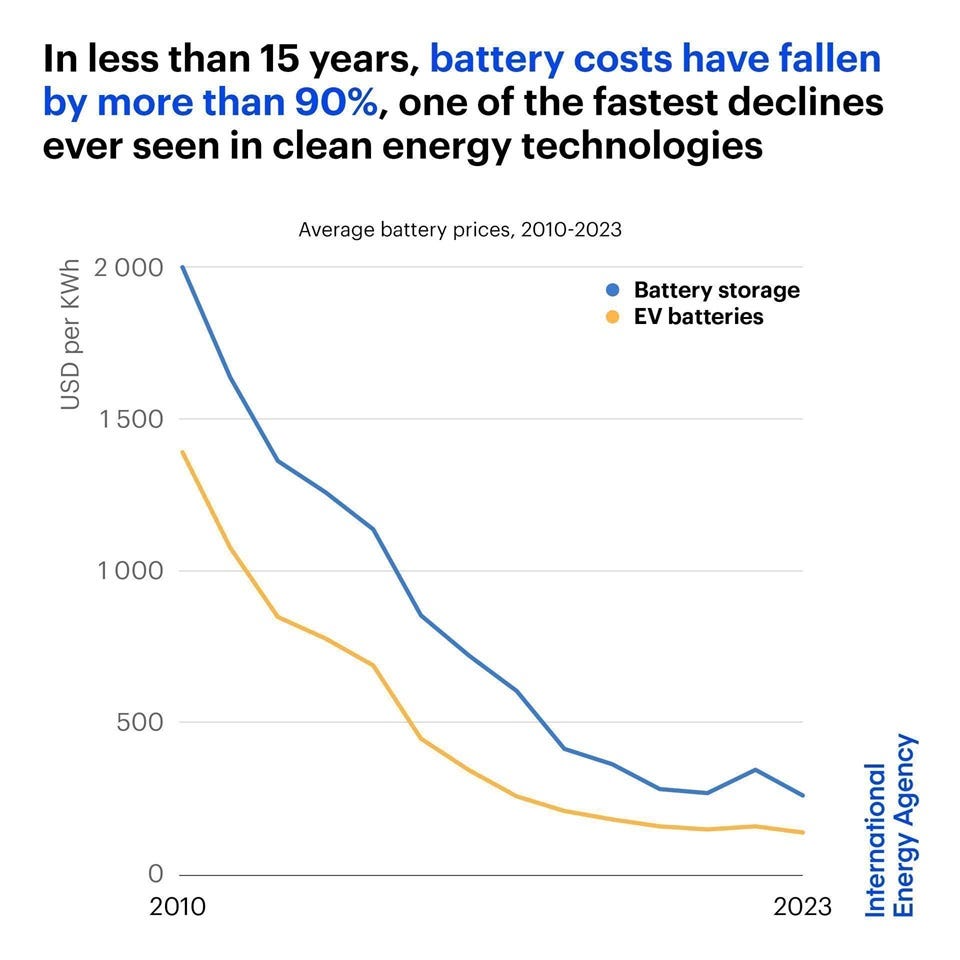
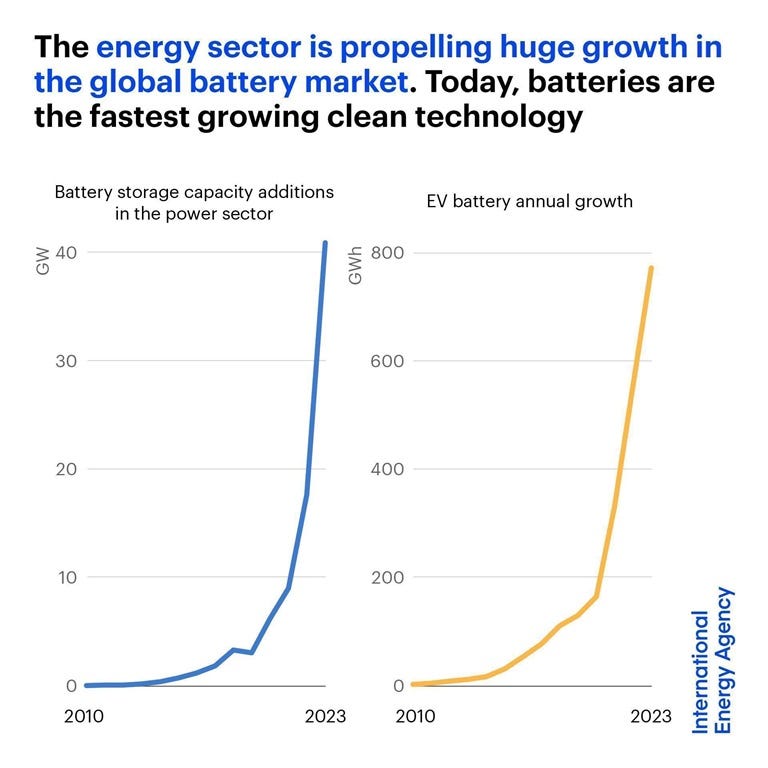
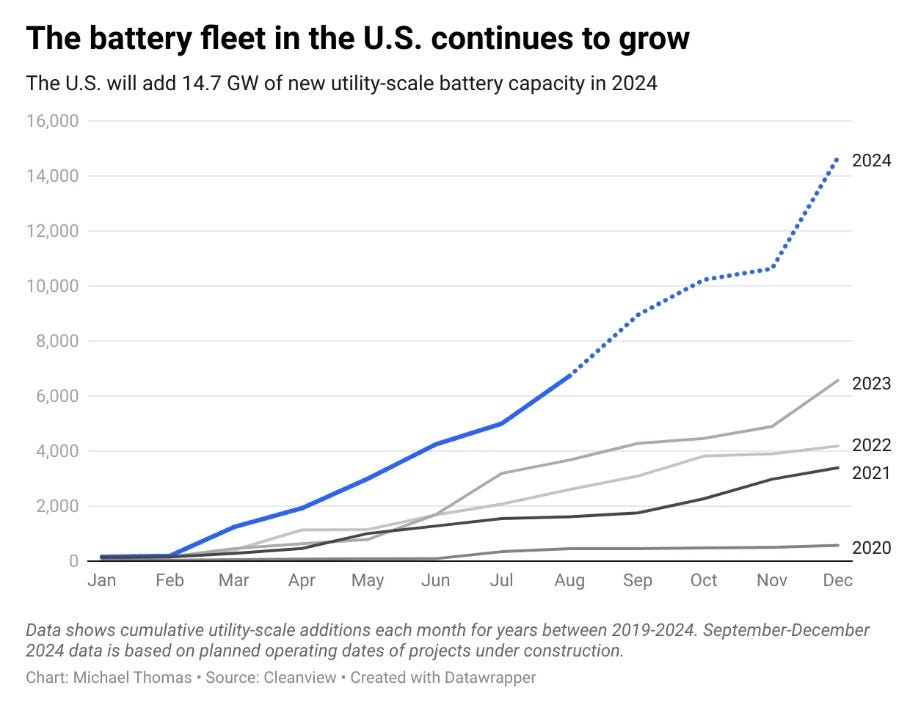
So batteries really do solve the intermittency problem. And battery costs, like solar costs, have been decreasing exponentially:
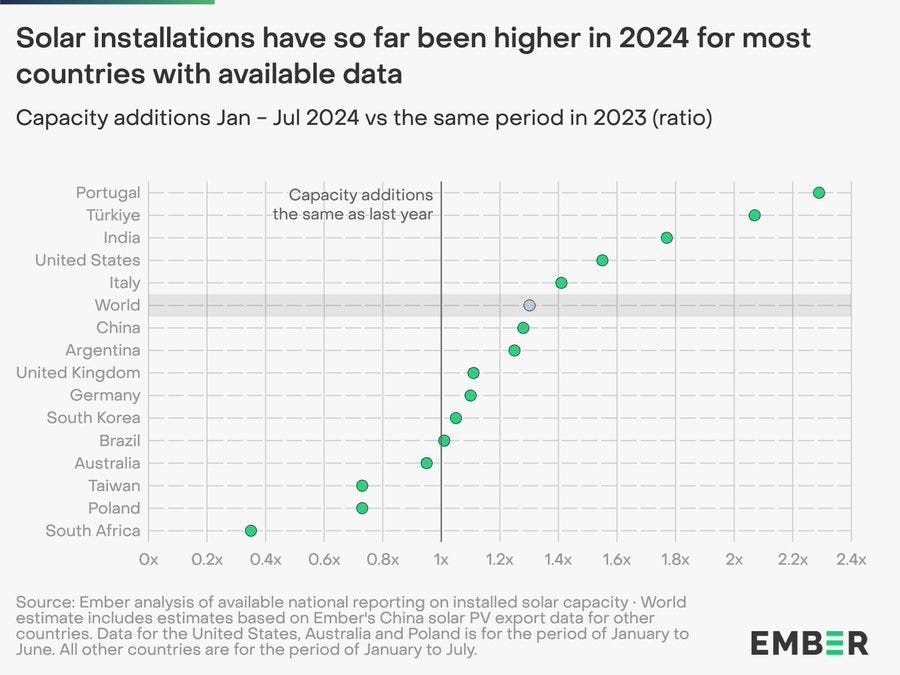
Solar is projected to equal nuclear’s share of electricity generation in the U.S. by 2030. And solar has a way of beating the forecasts.
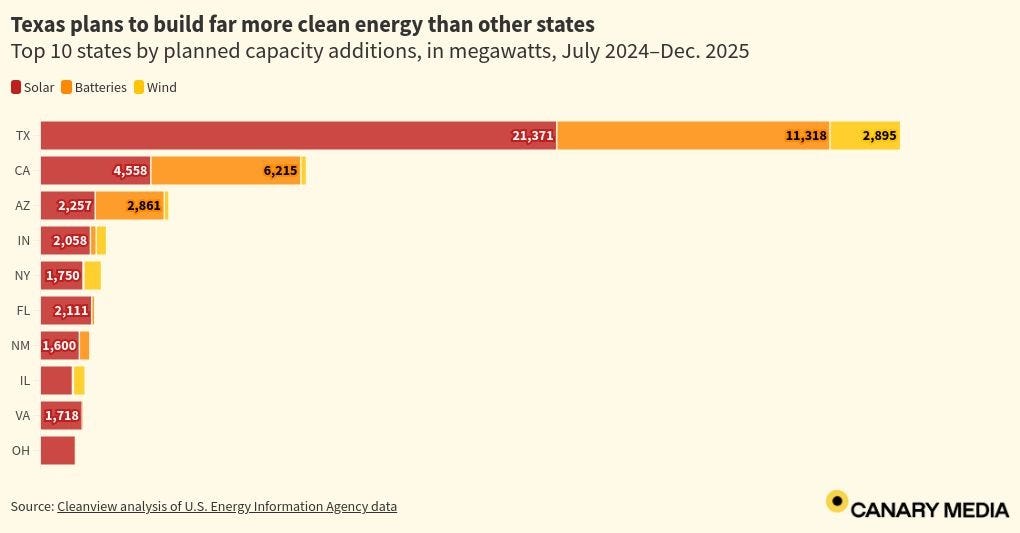
If you think this transition is ideologically driven, you need to look at the state of Texas. As a rule, Texans revere the fossil fuel industry and despise hippies telling them what they can and can’t do. And yet Texas is clobbering every other state, including California, when it comes to building solar and batteries:
The reason is simply cost. Texas is building solar and batteries because together, they form a cheap, highly reliable source of electric power.
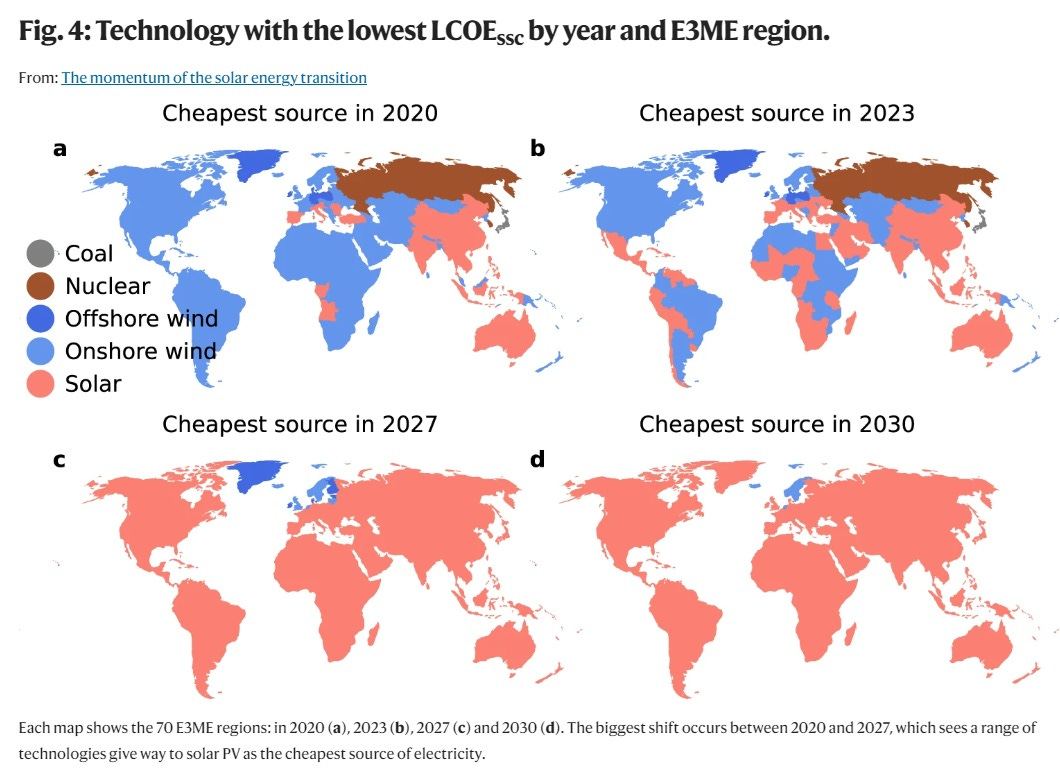
In fact, some modelers estimate that solar plus battery storage — including long-term battery storage, not just short-term storage — will be the cheapest electricity source almost everywhere in the world just three years from now:
This is a triumph of human ingenuity — of scientists, engineers, and entrepreneurs who produced a true technological revolution. But this bright reality conflicts with the bitter nuclear retrofuturist tale. In that story, solar power was the booby prize — a laughably unworkable inferior technology that anti-growth hippies tried to force on the nation with government regulation.
In fact, if we had forced ourselves to switch to solar in 1979, it would have been exactly that. But more than four decades of constant innovation have changed solar — and batteries — into something far more revolutionary than nuclear ever was, even in the countries that embraced it.
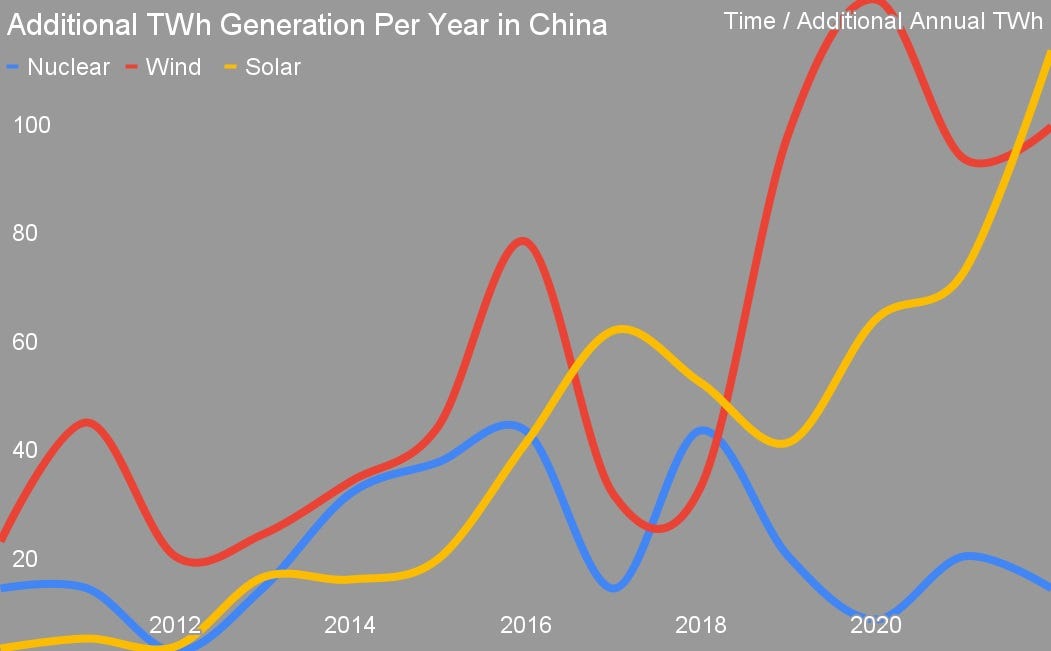
If you still think that nuclear is the future and government subsidies and mandates are the only reason that solar and batteries are outcompeting nuclear all over the world, you need to look at China. If there’s one country that values fast growth and cheap power over environmental concerns, it’s the People’s Republic of China. They certainly have no problem with nuclear power, with far more nuclear construction underway than any other country. They’re even leading the race to invent new kinds of nuclear reactors!
And yet China’s solar construction absolutely dwarfs their nuclear construction:
Source: Michael Barnard
Because it’s probably the country least affected by anti-growth, anti-progress, and anti-technology ideology, China represents the future of energy technology better than anyone else. And that future appears to be slow growth in nuclear, but an explosion of solar.
Nuclear still has important uses — in particular, where land and sunlight are scarce. But it’ll be a relatively niche energy source — a backup to the solar and batteries that form the backbone of our energy usage.
We shouldn’t hate nuclear power, or fear it. It really is good for the environment, and it really did get mistreated by the regulators and social movements of the 20th century — especially in America. Our failure to build nuclear when it was the best alternative energy source is a cautionary tale in how panic and misguided ideals can lead to national self-sabotage. And it will certainly be a useful supplement to solar and batteries.
But at the same time, we need to let that nuclear retrofuture go. We need to understand that even without regulation, nuclear would have been passed up by solar and batteries. We might have gotten the glossy 50s-poster atompunk future for three decades or so, but we missed our chance. Fortunately, the only reason we missed our chance is that we found something even better. Sometimes the future you get is even more amazing than the ones you merely imagine.
Southwood et al. do cite one reasonable example of something that’s a cost of renewables relative to nuclear: transmission lines. Solar is more spread out than nuclear, so it needs more power lines to bring power from the plant to the users.
I live in Houston TX. Noah, you have mischaracterized the Texas power situation. Wind is just as important for electricity power in Texas as solar, with natural gas. coal, and batteries acting as a backup.
The agency that runs the Texas electric grid, ERCOT, rates the monthly power capacity of various energy sources as follows:
Solar 25,961 MW
Wind 39,525 MW
Battery 8,779 MW
Natural Gas 67,066 MW
Coal 14,713 MW
Nuclear 5,268 MW
ERCOT can select which of these energy sources it will use at any given moment. My understanding is that they use solar, wind and nuclear first and then use other sources to fill in.
Interestingly, solar and wind complement each other almost perfectly. Sun shines during the day and the wind on the North Texas Plains blows most robustly at night. Generally speaking, wind produces as much power at night as solar does during the day, but last night appears to have been an exception.
Crunch time comes at dawn and dusk when both wind and solar are weak.
I’d like to see an article about long term battery storage. What is current what might be actual in a few years and long term.
What nuclear would have advantage over solar is a bad volcano. An asteroid strike or god forbid a nuclear winter. I don’t know what a war between Iran and Israel might look like. How many nuclear bombs might go off and what it might do to the atmosphere and therefore solar collection.
In thinking about the nuclear saver rattling going on none of the above are ridiculous.



I live in Houston TX. Noah, you have mischaracterized the Texas power situation. Wind is just as important for electricity power in Texas as solar, with natural gas. coal, and batteries acting as a backup.
The agency that runs the Texas electric grid, ERCOT, rates the monthly power capacity of various energy sources as follows:
Solar 25,961 MW
Wind 39,525 MW
Battery 8,779 MW
Natural Gas 67,066 MW
Coal 14,713 MW
Nuclear 5,268 MW
ERCOT can select which of these energy sources it will use at any given moment. My understanding is that they use solar, wind and nuclear first and then use other sources to fill in.
Interestingly, solar and wind complement each other almost perfectly. Sun shines during the day and the wind on the North Texas Plains blows most robustly at night. Generally speaking, wind produces as much power at night as solar does during the day, but last night appears to have been an exception.
Crunch time comes at dawn and dusk when both wind and solar are weak.
https://www.ercot.com/gridmktinfo/dashboards
I’d like to see an article about long term battery storage. What is current what might be actual in a few years and long term.
What nuclear would have advantage over solar is a bad volcano. An asteroid strike or god forbid a nuclear winter. I don’t know what a war between Iran and Israel might look like. How many nuclear bombs might go off and what it might do to the atmosphere and therefore solar collection.
In thinking about the nuclear saver rattling going on none of the above are ridiculous.