

This Thanksgiving weekend, I unfortunately suffered a great loss…my sweet rabbit Giggles passed away at the age of 10, due to an ear infection. I’ll write more about him and his life soon. In the meantime, taking a few days off of writing gives me a good opportunity to clear out some of my backlog of guest posts.
This one is especially important. This week the House is set to vote on BAAJA, the Bipartisan American Affordability and Jobs Act. This is the most important piece of permitting reform legislation in our lifetimes. For decades, the United States has been building up a regime of anti-development regulations, to the point where it’s basically impossible to build anything of consequence throughout most of the country:

This seemed to work well in the 1990s and the 2000s, when software and finance were America’s biggest engines of growth, and manufacturing was being outsourced to China. But we were simply pushing our physical challenges into the future, and that future can no longer be delayed.
Climate change is much more of an immediate threat today, and yet we can’t build the green energy and the power lines we need in order to bring our emissions down, because the anti-development laws won’t let us. Manufacturing urgently needs to be reshored from China, and yet it’s very hard to build even the most environmentally-friendly factories here, because the anti-development laws won’t let us. Our infrastructure is increasingly unaffordable to maintain, because the anti-development laws make it incredibly hard to get maintenance done. The anti-development laws have our nation by the throat, and they’re throttling the life out of us.
BAAJA is the first serious legislative attempt to dismantle the anti-development regime and replace it with something sane and humane. The Institute For Progress has been at the forefront of promoting and explaining this incredibly important bill. If you want to understand what’s in it, I heavily recommend this explainer by IFP’s Aidan Mackenzie.
So in advance of the big BAAJA vote, I asked Alec Stapp, IFP’s founder, to write a Noahpinion guest post explaining why Congress must vote yes on the bill. Here you go!
We used to be able to build things in this country. But since the 1960s, policymakers have passed a raft of state and federal laws that make it harder to build infrastructure of all kinds, for both good and bad reasons. The substantive protections in laws like the Clean Air Act have delivered enormous benefits relative to their costs. But the procedural rules embedded within some of these laws, especially the National Environmental Policy Act (NEPA) and the National Historic Preservation Act (NHPA), have created a “litigation doom loop” for projects, while delivering few offsetting benefits.
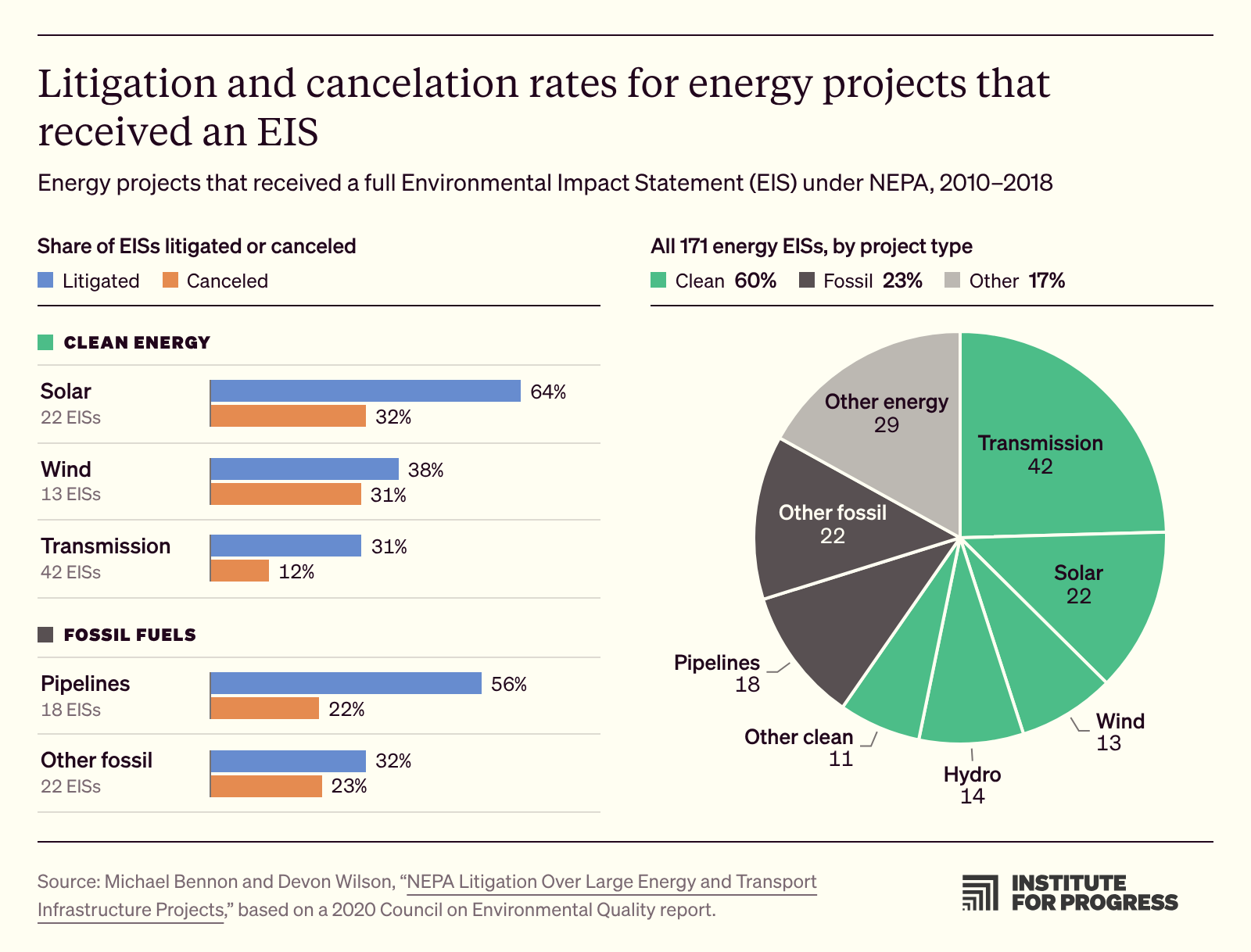
If an agency fails to document every potentially significant impact, or consider every mitigation measure a plaintiff’s lawyer might dream up, a judge can enjoin the project or vacate its permits and send it back for further review. The uncertainty of these delays raises costs for developers and reduces the scope of projects they consider investing in. It also disproportionately burdens clean energy infrastructure. For example, of the solar projects that required an environmental impact statement between 2010 and 2018, 64% were sued and 32% were ultimately canceled, both higher rates than for fossil fuel projects.
Over the last decade, more and more people have woken up to the costs these procedural roadblocks impose on our everyday lives: higher electricity bills, more expensive fuel, and worse pollution. These are the natural consequences of a permitting system that’s biased toward the status quo by making it difficult to build new infrastructure. In recent years, Congress has made multiple attempts at permitting reform. The two most ambitious efforts — the Building American Energy Security Act of 2022 (BAES) and the Energy Permitting Reform Act of 2024 (EPRA) — ultimately failed. But now new permitting reform champions, including the Senate’s foremost Democratic climate hawks, have pulled together the best bipartisan permitting reform deal yet.
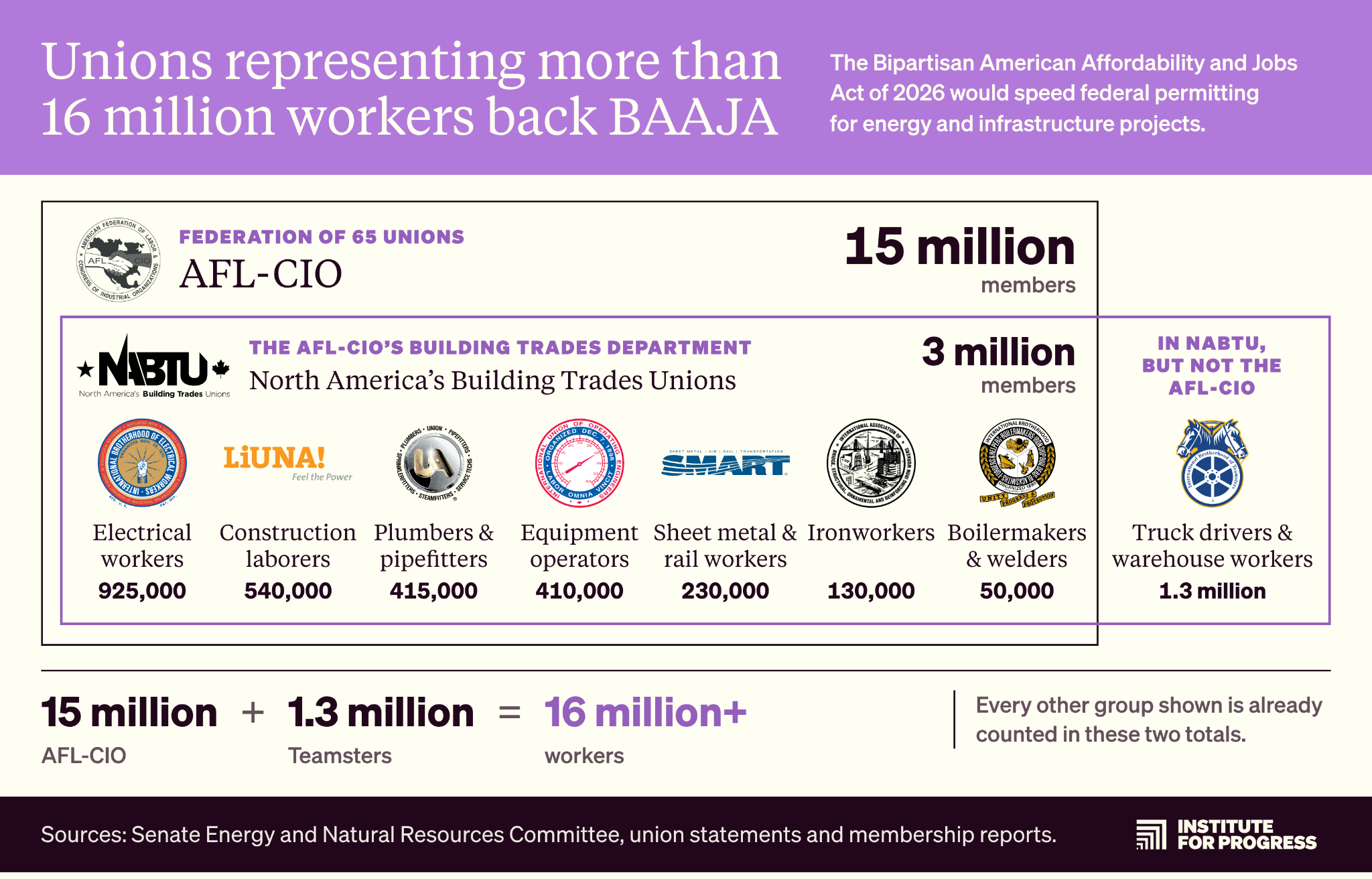
Led by Senators Heinrich, Whitehouse, Capito, and Lee, the Bipartisan American Affordability and Jobs Act (BAAJA) would substantially curtail litigation risk for projects while maintaining all of the substantive environmental protections that exist today. And most importantly for clean energy deployment, the bill would give the federal government backstop authority to site and permit the transmission lines needed to connect new clean energy technologies, like solar and geothermal, to the grid and to power electric vehicles and heat pumps. Miraculously, BAAJA is simultaneously good for emissions, affordability, jobs, transit, and housing. And while some environmental groups, such as the Sierra Club and the Natural Resources Defense Council (NRDC), are opposing the bill, the Democratic stakeholders with the most to gain from a return to building — union workers — have come out strongly in favor of BAAJA.
However, given the midterm results, some Democrats think they should wait until the next Congress to negotiate a new bill that’s more favorable to their priorities. At first blush, pursuing a new bill seems reasonable — after all, Democrats did just win historic margins in each chamber — but on deeper examination, this plan has two major problems:
Democrats are unlikely to nuke the filibuster next Congress and, even if they did, they would not have veto-proof majorities in either chamber, so any permitting reform deal will still need President Trump’s signature. With the filibuster in place, it will also need at least four Senate Republicans.
The likely incoming chairmen of two of the most important committees for permitting reform — Rep. Jared Huffman on House Natural Resources and Sen. Jeff Merkley on Senate Environment and Public Works — have opposed every major permitting reform bill of the last five years.
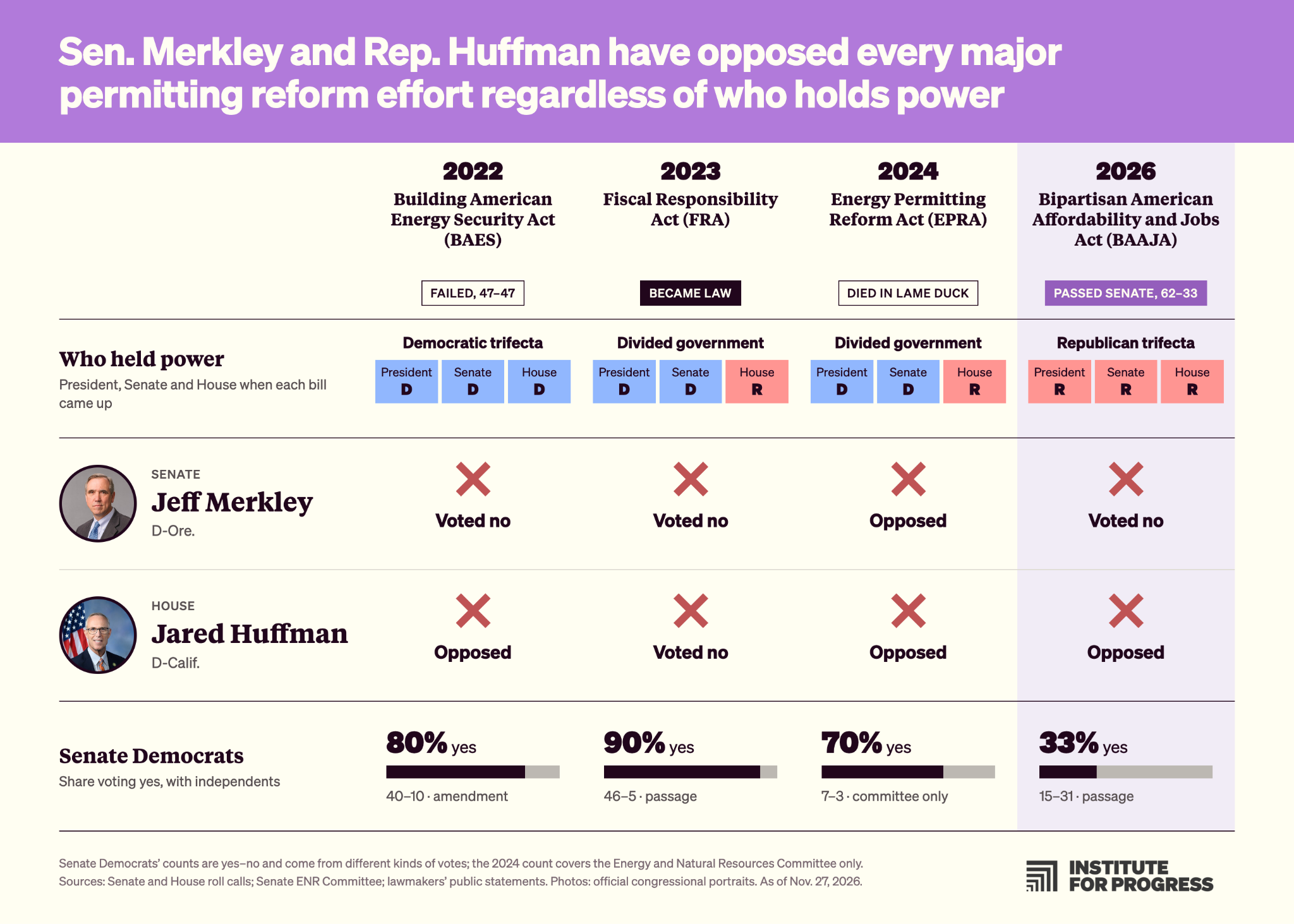
Rep. Huffman and Sen. Merkley are very unlikely to deliver a better deal because they’ve shown, under different balances of power across the last three Congresses, that they oppose all the reforms Republicans care most about — which is a death knell for permitting reform since any deal has to be bipartisan. Rep. Huffman and Sen. Merkley are unusual in this unwillingness to compromise: they opposed every past deal that a majority of their fellow Democrats voted for. This becomes clear when you look at the legislative history for the three main permitting reform deals prior to BAAJA: BAES (2022), the Fiscal Responsibility Act (FRA, 2023), and EPRA (2024).
The Building American Energy Security Act (2022)
In exchange for his vote on the Inflation Reduction Act in August 2022, Sen. Manchin secured a commitment that the Biden Administration and Leader Schumer would work with him on a permitting reform bill. The result was BAES, which would have directed the president to designate 25 priority energy projects for expedited review and expanded federal authority to permit interstate transmission lines. Given that BAES was negotiated under a Democratic trifecta, it did relatively little to advance fossil fuel development. It permitted one pipeline in West Virginia that was important to WV Senators Manchin and Capito. And it set shot clocks and page limits on NEPA environmental reviews, which most Republicans felt was akin to rearranging the deck chairs on the Titanic (because the changes didn’t address the underlying litigation risk projects face).
Nevertheless, green groups like the NRDC called the bill “radical” and its Mountain Valley Pipeline provision “draconian.” On December 15, 2022, the Senate voted on adding it to the annual defense bill, the NDAA. The Senate Democratic caucus supported the measure 40-10. But only seven Republicans voted for it, so the final tally of 47-47 fell well short of the 60 votes needed to adopt the amendment. The League of Conservation Voters scored a “no” as the pro-environment vote, which meant it gave positive marks to the Senate Republicans who voted no and negative marks to the Democratic climate hawks who voted yes. Sen. Merkley was one of only 10 members of the Democratic caucus who voted no on this Democratic-led permitting bill. And Rep. Huffman, a lead signer of a 77-member House letter urging leaders to keep the bill out of must-pass legislation, repeatedly called it a “shit sandwich.”
The Fiscal Responsibility Act (2023)
Following the failure of BAES, there was a serious push to add permitting reform to the debt ceiling deal, the Fiscal Responsibility Act of 2023, including transmission reform (the BIG WIRES Act) in exchange for NEPA litigation reforms. But the deal fell apart, and ultimately the only permitting reform in the FRA was the West Virginia pipeline authorization from BAES, some modest NEPA reforms that set deadlines and page limits for environmental reviews but did not limit lawsuits, and a study on the need for transmission reform. The bill passed with overwhelming Democratic support in both the House (165-46) and Senate (46-5). Yet despite the minor nature of these reforms, Rep. Huffman and Sen. Merkley voted no on the whole deal, each citing its permitting provisions among their reasons for opposition.
Prior to his no vote, Rep. Huffman again co-led a sign-on letter from House Democrats to proactively pressure the Biden Administration against any reforms (emphasis added) “gutting or changing” NEPA. In the letter, Rep. Huffman and his colleagues recognized the need for “reforming the transmission planning process and transmission cost allocation process,” but insisted that “these reforms can and must be accomplished without undermining any bedrock environmental laws.” This have-your-cake-and-eat-it-too approach to transmission reform, apart from being substantively wrong (our procedural environmental laws really will require reform if we want a rapid buildout of electrical and clean energy infrastructure), had the foreseeable political effect: Republicans declined the offer.
The Energy Permitting Reform Act (2024)
The most recent permitting reform attempt prior to BAAJA was the Energy Permitting Reform Act of 2024. EPRA went much further than BAES or FRA on both clean energy and fossil fuels, giving both Democrats and Republicans more of what they wanted. It had provisions on transmission, judicial review, mining, LNG, geothermal, and leasing. It sailed through the Senate Energy and Natural Resources Committee with eight of nine Republicans and seven of the 10 senators on the Democratic side voting in favor.
While more ambitious than BAES, EPRA didn’t amend the Clean Water Act, NEPA, or the Endangered Species Act (ESA), changes to which are long-held Republican priorities. House Republicans under Speaker Johnson balked at the bill under pressure from the utilities and President-elect Trump chose not to push for its passage. EPRA was a stark example of how challenging it is to reach a compromise on permitting reform: it didn’t go far enough to win over House Republicans or President-elect Trump, yet Sen. Merkley and Rep. Huffman still publicly opposed it for going too far.
The Bipartisan American Affordability and Jobs Act, “BAAJA” (2026)
Now Congress is considering BAAJA. It’s already passed the Senate 62-33. Sen. Merkley and Rep. Huffman have been working hard to tank the deal, with the starkest example being Sen. Merkley’s behavior during the amendment process in the Senate. He put forward, along with fellow Oregonian Sen. Wyden, a partisan amendment that would have been a poison pill for the whole bill.
Sen. Merkley then objected to a unanimous consent request to approve a bipartisan manager’s amendment that included technical fixes to the bill and some modest substantive improvements to address Tribal concerns. Even after the bill had passed, while it could still be amended, Sen. Merkley objected to the manager’s amendment again. By then he could no longer stop the bill. His objection could only make it worse for Democratic priorities (presumably with the goal of making it harder to pass in the House).
The tyranny of the minority
We’re at a crossroads as a country. We should be building all kinds of new infrastructure to support the electrification of the economy — first and foremost, the power lines needed to move electricity from where it’s generated to where it’s needed. But at a time of rising electricity demand, we are actually worse today at getting transmission lines permitted and built than we were 10 years ago:
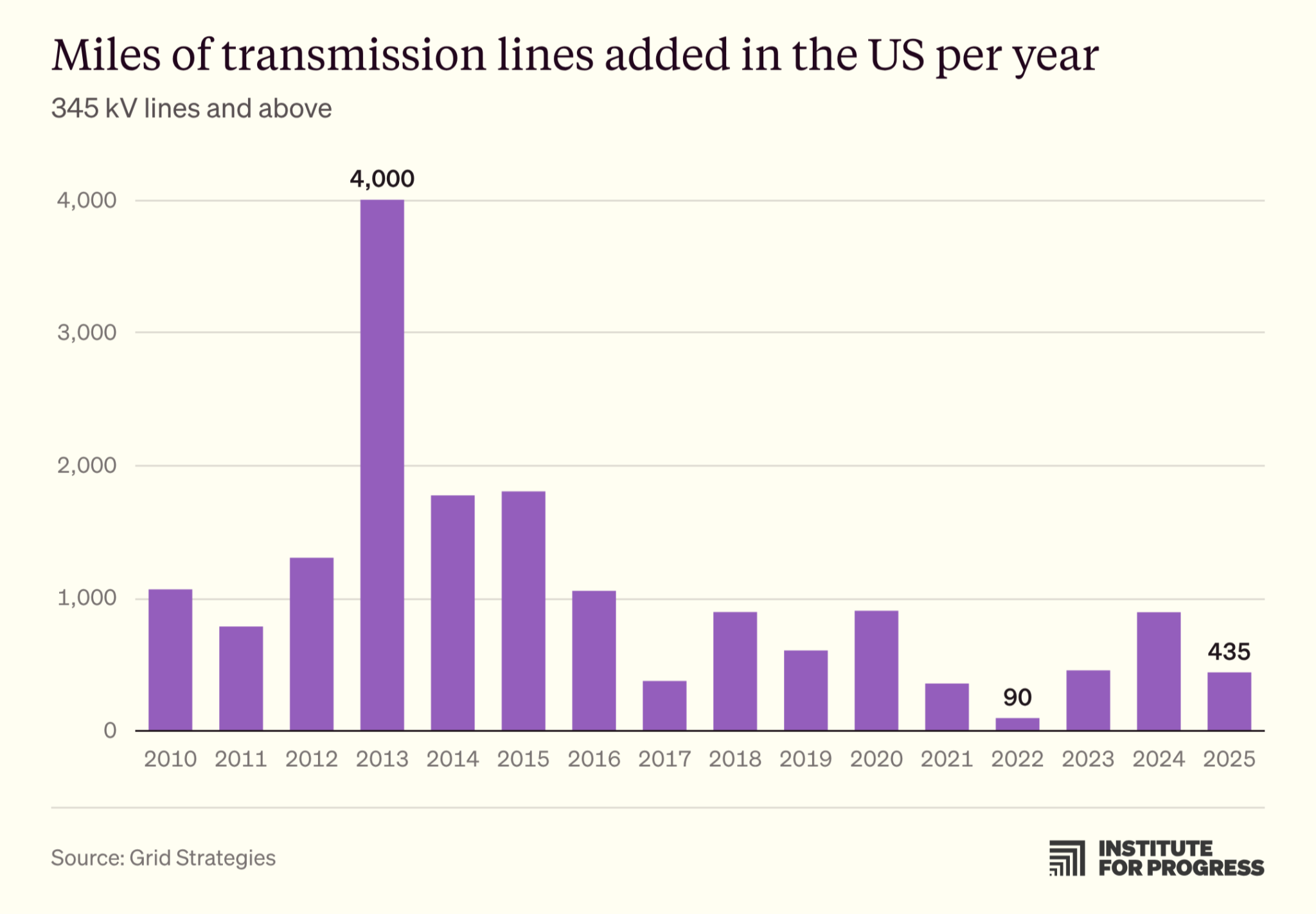
Sen. Merkley’s brinksmanship is an apt analogy for what’s gone wrong with our permitting system over the last half century. We’ve given a small handful of unrepresentative people a veto over building anything that anyone anywhere doesn’t like, regardless of how many diffuse benefits the project might create. Similarly, Sen. Merkley’s objection to the unanimous consent request, which fellow Democratic Sen. Gallego called a “dirty” move, shows that when one senator holds the other 99 hostage, we get worse outcomes.
Rep. Huffman and Sen. Merkley have now shown four times that they reject the tradeoffs that any bipartisan permitting reform will require; it will be impossible to enact legislation that makes it easier to build transmission or clean energy on their watch next Congress. Rep. Huffman has explicitly said that he won’t countenance the changes to NEPA, NHPA, and ESA that Republicans want. It’s doubtful the two of them can negotiate a deal that even secures the support of every Senate Democrat, let alone four (or more) Senate Republicans and President Trump. The choice for House Democrats isn’t between this deal and a better one next Congress; it’s between this deal and no deal. It’s time to pass the bill in front of them and stop letting a minority deprive the rest of us of a more prosperous and sustainable future.

Sorry for your loss.
Crossing my fingers that the House vote on Monday goes well for the bill.